Freezer Adhesive Explained: Why Labels Fall Off Frozen Packs
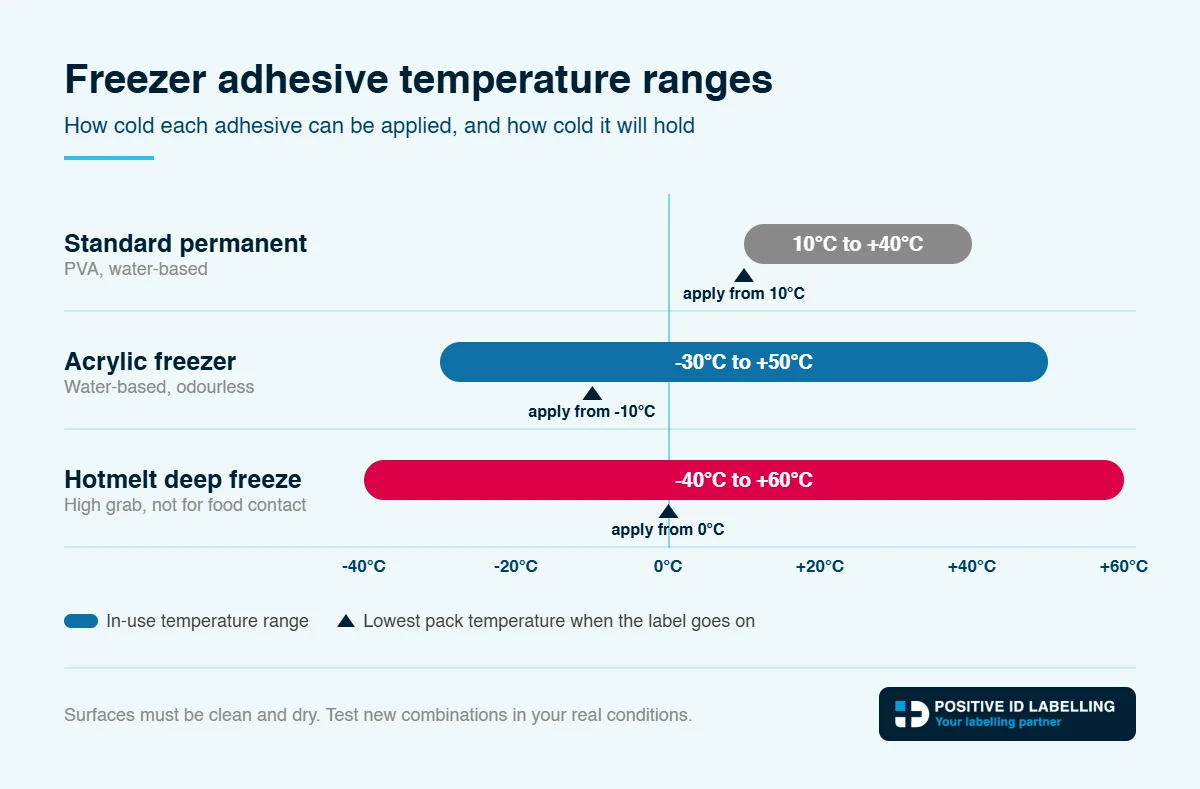
A standard permanent label adhesive is designed to be applied above 10°C. Put that label on a tray coming off a chill line at 2°C, and it may never properly grip. Then the pack goes into a freezer, and an hour later the label is on the floor.
That’s the problem a cold-grade adhesive solves. At Positive ID Labels, adhesive selection is one of the first things we ask about when quoting freezer labels, because the wrong choice causes more label failures than anything else. And it will leave you thinking our product isn’t up to scratch when it is just a matter of choosing the right adhesive.
This guide explains why labels fail in the cold, how our two freezer adhesives differ, and how to apply labels so they stay put.
Why Labels Fail in the Cold
Cold doesn’t just make glue less sticky. Several things happen at once, and most failures involve more than one of them.
The frustrating part is timing. Labels often look fine at the end of the line, then fail hours later in storage, after the batch has already been signed off. By the time anyone notices, a whole pallet may need relabelling.
Choosing a Freezer Adhesive: Our Two Options
We use two adhesive technologies for cold work. Both are permanent. The right one depends on how cold the label gets, and how cold the pack is when you apply it.
Acrylic freezer adhesive
Our acrylic option applies at temperatures down to -10°C and holds from -30°C to +50°C. It’s water-based, biodegradable and odourless.
It suits chilled and frozen food, ready meals, ice cream tubs and products held in domestic or light commercial freezers. It also copes well with packs labelled straight from a chill line. For most frozen food packs, it’s the one to start with.
Hotmelt deep freeze adhesive
For colder storage and tougher handling, our hotmelt adhesive holds from -40°C to +60°C. It needs a pack surface of at least 0°C when applied, and it has a strong, high-grab bond.
Use it for commercial deep-freeze storage, cold chain logistics and rough environments. It has a slight odour and isn’t suitable for direct food contact, so it should only touch the outside of packaging, never the food itself.
Freezer adhesive versus wet pack adhesive
These solve different problems. Wet pack adhesive is designed for warm, wet surfaces, such as fresh meat and fish packs straight off a production line. It’s not a freezer adhesive. If your packs are both wet and heading for the freezer, talk to us and we’ll recommend a combination to test.
The Label Matters Too
Adhesive is half the specification, and the label material is the other half. For frozen products, we usually recommend polypropylene, which is waterproof by nature and stays flexible in the cold. Paper is fine for dry, short-term chilled use, but it struggles with condensation.
If you print data such as dates and barcodes yourself, choose a topcoated direct thermal label, or thermal transfer with a resin ribbon. Plain wax print smudges as frost melts, which can leave barcodes unreadable at the warehouse or the till. That’s a costly problem to discover after despatch.
Freezer adhesive application checklist
Get the Specification Right First Time
Labels that fall off cost you stock, traceability and customer confidence. A missing label can mean a pack that can’t legally be sold, or a batch you can’t trace in a recall. Tell us your storage temperature, your packaging and when the label goes on, and we’ll specify a freezer adhesive and material to match. Our quotes are fixed prices, so there are no surprises later.
Call 01332 864895 or send us your details through the enquiry form.

I had an amazing experience working with Positive ID Labelling, especially Natalie. The labels were absolutely brilliant quality and exceeded my expectations. Natalie was fantastic throughout the whole process. Communication was amazing from start to finish. She was so helpful, guided me through everything, and made the whole experience stress free and enjoyable. She was also genuinely funny and a pleasure to work with, which made everything even better. I’ll definitely be working with Natalie again on future projects and would highly recommend Positive ID Labelling to anyone looking for high-quality labels and excellent customer service.

Fantastic label printing service. Labels to a very high specification. Helen was great at sorting out our requirements, quotes, and order.

We’ve had a great experience working with this supplier, especially with Natalie - she is always very responsive, professional, and friendly. The pricing is highly competitive and the sales service has been excellent from start to finish.If I could offer one suggestion, it would be to improve the account and invoice management process. It would be really helpful if there were a system for clients to easily track their past orders and invoices in one place.Overall, very pleased with the service and look forward to continuing our collaboration.

Natalie and Positive ID labelling were amazing. I have some really beautiful egg box labels that were exactly what I asked for. Brilliant communication and undertanding from everyone i dealt with. Pricing was good and I will not look any further for all my labelling needs. Thank you again!

Frequently Asked Questions
What temperature can freezer labels handle?
Our acrylic freezer adhesive holds down to -30°C, and our hotmelt deep freeze adhesive holds down to -40°C.
Can I apply labels inside the freezer?
Acrylic freezer adhesive applies down to -10°C. Hotmelt needs a pack surface of at least 0°C. In both cases, a dry surface is essential.
Why do labels stick at first, then fall off later?
Usually the adhesive bonded to condensation, or it didn’t have time to build strength before freezing. Changing application timing often fixes it.
Are freezer labels food safe?
Labels go on packaging, not food. Our hotmelt adhesive isn’t suitable for direct food contact, so it must only touch the outer pack.
Do I need polypropylene, or will paper do?
For frozen storage, polypropylene performs far better. It resists condensation and stays flexible, while paper softens when wet.
Can you help test a new freezer label?
Yes. Call 01332 864895 and we’ll talk through your conditions and the best combination to trial.