Natasha’s Law: A Practical Guide To Compliant Food Labels For Small Food Businesses
Natasha’s Law compliance sounds intimidating. For café owners, takeaway managers, and food-to-go businesses, it’s often the first regulation they discover during an inspection and sometimes after they’ve already made labels that don’t meet it.
Getting Natasha’s Law compliance right matters enormously. The regulation exists because of real harm that can be done to allergen sufferers, and non-compliance carries genuine consequences. But here’s the truth: it’s not complicated once you understand what you actually need to do and how to keep doing it consistently every shift.
This guide walks you through Natasha’s Law in practical terms, what it requires, who must comply, how to keep labels accurate when recipes or suppliers change, and how reliable labelling processes prevent the mistakes that trip up even conscientious businesses.
What Is Natasha’s Law And Who Must Comply?
Natasha’s Law is the common name for amendments to the Food Information Regulations that came into force on October 1st, 2021. The regulation was introduced after determined campaigning by her parents, following the death of Natasha Ednan-Laperouse, a teenager who suffered a fatal allergic reaction to a food product from a high street bakery. The bakery had failed to declare the sesame allergen in their product. The law changed to close that gap.
Natasha’s Law applies to prepacked for direct sale (PPDS) foods which are products you prepare and pack on the same premises before selling them directly to the consumer. This includes:
Cafés and coffee shops that make and package sandwiches, salads, or baked goods for takeaway. Takeaway restaurants that pack food before a customer orders it. Bakeries that package bread, cakes, and pastries for shelf display. Deli counters that pre-portion, pack and label charcuterie. Juice bars that bottle fresh juices prior to purchase i.e. not on demand. Food-to-go businesses selling ready meals or packed lunches.
If you sell food that is prepacked at your premises before the customer orders and buys it, Natasha’s Law compliance is your responsibility.
The Legal Requirement: What Must Be On Every PPDS Label?
Natasha’s Law requires every prepacked for direct sale food to carry:
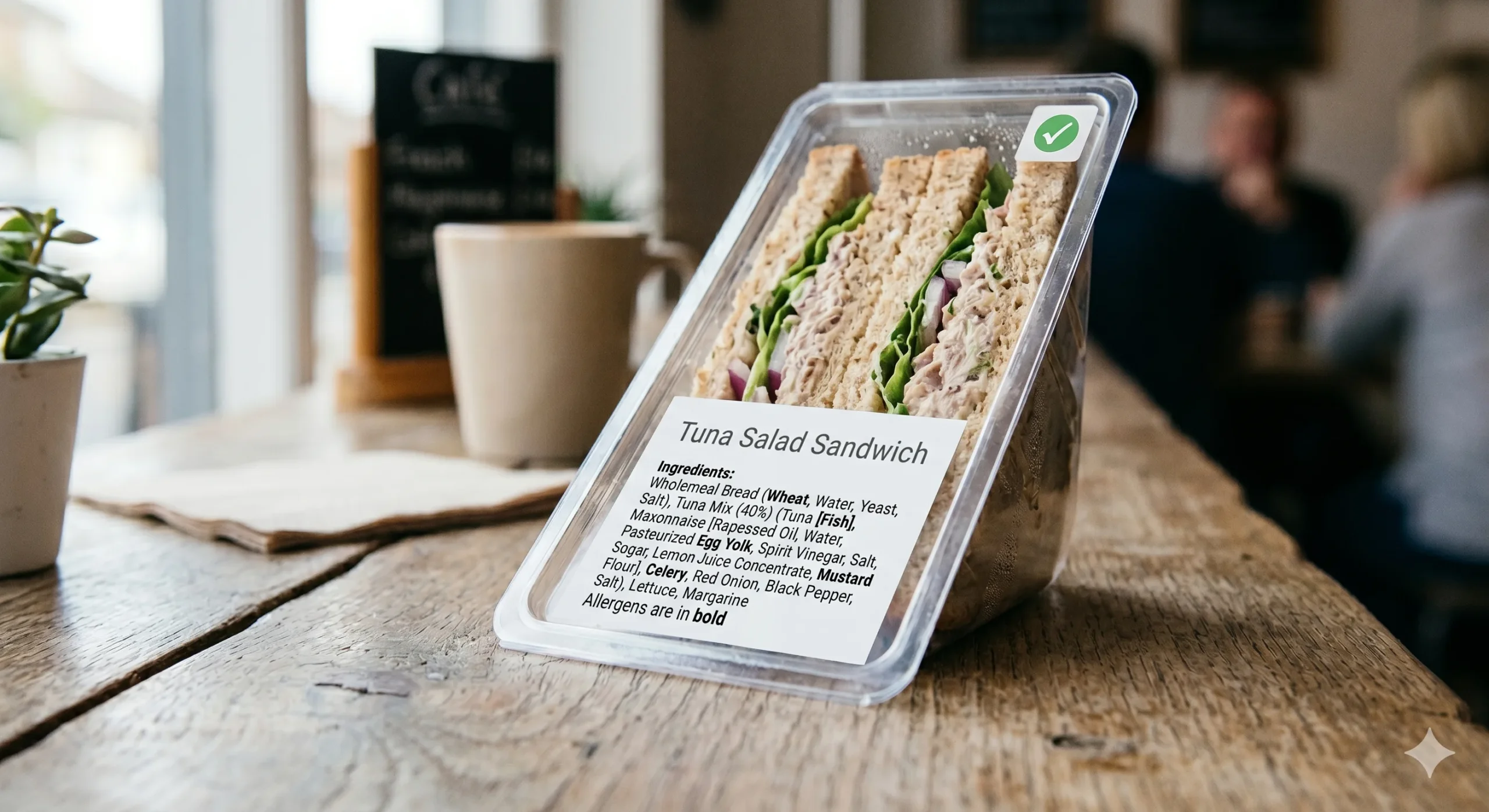
- A product name: the actual name of the food (e.g. “Tuna Salad Sandwich,” not just “Sandwich”)
- A complete ingredients list: everything that goes into the product, listed in descending weight order (Quantitative Ingredient Declaration or QUID)
- All 14 regulated allergens clearly highlighted within the ingredients list: any of the following: celery, cereals containing gluten, crustaceans, eggs, fish, lupin, milk, molluscs, mustard, nuts (tree nuts), peanuts (ground nuts), sesame, soya, sulphites, and their derivatives.
- The allergen information must be visually distinguished: typically bold text, a different colour, or capital letters. The most common approach is bold text. This visual emphasis is not optional; it’s a legal requirement.
- A use-by or best-before date (depending on shelf life) with storage instructions where necessary
- Net quantity of the product
- The name and address of the food business (for traceability)
Beyond allergens, you may need to include other information. If your product contains genetically modified ingredients, you must declare it. If ingredients have been significantly processed, this should be clear in the ingredient list. Nutritional information is increasingly required depending on your business type and sales channel, but generally only for larger food production businesses.
Common Causes Of Non-Compliance: Where Small Businesses Get It Wrong
Even businesses trying hard to comply often slip up. The most frequent mistakes are:
Missing allergens. A supplier changes an ingredient and the allergen information isn’t updated on the label. A new staff member prepares a recipe without checking the updated ingredient list. An allergen is present but not visually distinguished in the ingredient text.
Incomplete ingredient lists. Using an old label template from a previous version of the recipe. Describing ingredients too vaguely (e.g. “spice mix” instead of listing the individual spices that might contain allergens). Forgetting that water, salt, or oil count as ingredients and must be declared.
Incorrect declaration of allergens: Having a section of the label with a list of allergens present – not contained within the ingredient listing section.
Outdated labels. A supplier changes; the allergen status changes; the label stays the same. A recipe is tweaked; three ingredients shift order; nobody updates the label template.
Poor version control. No system for tracking which version of a label is current. Multiple staff members with different label templates on their computers or ill-trained staff editing labels incorrectly. Nobody confirms that old stock is gone before new labels are printed.
Allergen emphasis failures. Allergens mentioned in the ingredients list but not clearly distinguished from non-allergenic ingredients. Bold text that’s too subtle to be clearly visible. Different allergens emphasized differently on different batches.
These aren’t failures of intention, they’re failures of process. Small businesses are busy and few staff members are tasked with lots of compliance obligations. Without a reliable system, errors slip through.
Keeping Labels Accurate: The Process That Works
Natasha’s Law compliance isn’t a one-time exercise. It’s a process that runs every shift. Here’s how to make it work:
Document your recipes. For each product, create a master recipe file with every ingredient and its allergen status. Whenever a supplier changes or an ingredient is swapped, update this master file immediately before the next batch is made. This document becomes your labelling source of truth.
Create label templates with allergen emphasis built in. Use software or a designer to build templates that automatically bold or highlight allergenic ingredients. Don’t rely on printing a generic label and hand-highlighting allergens.
Approve new recipes and label changes. When an ingredient supplier changes, have someone responsible (usually the owner or a manager) sign off on the new ingredients and the updated label before anything is printed. This creates accountability and catches errors before they reach customers.
Print and batch-check. Print a test label from any new batch before running a full production. Check that allergen emphasis is visible, that the recipe matches your master ingredient list, and that dates are correct.
Destroy old stock. When you print new labels, physically destroy or clearly mark old labels so they cannot be accidentally used. This prevents the common error of outdated labels being used months later.
Train staff consistently. Everyone who prepares food or applies labels should understand why allergen information is critical and how to check it’s correct. One careless person is enough to create a serious problem.
Use labelling software or thermal printers if you do this regularly. If you’re labelling dozens of items daily, manual labelling becomes error-prone. Thermal printers with configured label software eliminate transcription errors and ensure consistency.
These sound like bureaucratic extras. In reality, they’re the difference between confidence that your labels are correct and worry that you’ve missed something.
Positive ID Labels have developed Nutridata allergen labelling software to deliver this specific solution for small, medium and large food producers.
Why Reliable Labelling Matters Beyond Compliance?
Natasha’s Law exists because allergen errors cause real harm. Compliance is the minimum standard. But there’s a secondary benefit: reliable labelling builds trust with customers. When people know your labels are accurate, they buy from you more confidently. They recommend you to friends. They don’t worry about whether that salad is allergen free because your labels are accurate.
For small food businesses, that trust is everything. It’s also your protection. If an allergen incident does occur, being able to demonstrate that you have documented processes, staff training, and careful label management protects you legally and reputationally.
Getting Labels Made Right: Working With A UK Label Printer
Once you’ve got your recipe and allergen information confirmed, you need labels printed. Your options are:
Thermal transfer printing: if you’re labelling variable data (dates, batch codes, pack times), a thermal printer with label software lets staff print labels in-house throughout the day. This works best for businesses labelling hundreds of PPDS items daily. Thermal printers require compatible labels and ribbons, and staff training on the software, but they eliminate delays and give you complete control over what’s printed.
Positive ID Labels specialises in providing food businesses with the tools to deliver this including labels, printers and software, all installed for you with peace of mind. Pre-printed template labels are designed to be overprinted with the right data on the day of production so your business is secure and compliant with Natasha’s Law.
Pre-printed labels: if your product range is stable and you label in batches, pre-printed labels from a label manufacturer reduce labour and ensure consistency. Digital printing means short runs (even a few hundred labels) are cost-effective, and turnaround is typically 3-5 days.
Hybrid approach: some businesses pre-print the standard information and leave space for dates and batch codes to be added in-house via thermal printer or hand-stamp.
Whichever route you choose, your label printer should understand Natasha’s Law requirements and be able to advise on allergen formatting. Not all printers are equally familiar with the regulation – but Positive ID Labels specialise in this very aspect of food labelling.
FAQ: Your Natasha’s Law Questions Answered
Q: Do I need to include nutrition information on PPDS food labels?
A: Not universally, but increasingly yes. From October 2021, prepacked for direct sale foods are exempt from mandatory nutrition labelling under certain conditions (turnover, business size). However, if you’ve already declared certain nutrients or make nutrition claims, you must provide full nutrition labelling. Check with your local trading standards authority if you’re unsure as the rules vary by region and business size. Nutridata comes in two forms, Lite for allergen labelling and Pro for allergen and nutrition labelling.
Q: Can I use a generic “May Contain” warning instead of listing specific allergens?
A: No. Natasha’s Law requires specific allergen declarations based on actual ingredients. “May contain” warnings are permissible if there’s genuine cross-contamination risk, but this should be assessed and documented, not used as a catch-all caution.
Q: What happens if I forget to emphasise an allergen?
A: The label is non-compliant, even if the allergen is mentioned somewhere in the ingredient list. Visual distinction of allergens is not optional, it’s a legal requirement. Any unemphasised allergen is a breach.
Q: How often do I need to update labels if my recipe changes slightly?
A: Immediately. If an ingredient changes, if a supplier changes, or if the quantity of ingredients shifts significantly, the label must be updated before the product is sold. Even “small” changes can affect allergen status. If the change will manifestly influence the allergen content, it is a non-negotiable requirement.
Q: Do allergens have to be bold? Can I use other formatting?
A: Bold is common, but any clear visual distinction works – a different colour, capital letters, italics, or a box around the allergen. The key is that the emphasis is immediately apparent without scanning carefully. The legal requirement is to be differentiated and that differentiation method must be declared.
The exact wording is: “[allergens] shall be emphasised through a typeset that clearly distinguishes it from the rest of the list of ingredients, for example by means of the font, style or background colour.”
Q: What if I buy pre-made components from a supplier?
A: You are responsible for knowing what’s in them. Get full ingredient and allergen declarations from your supplier and verify them against the label you’re printing. Don’t assume.
Q: Are there exemptions for very small businesses?
A: The regulation applies to all PPDS food businesses, regardless of size. There is no small-business exemption for Natasha’s Law compliance.
Q: Can I use handwritten labels if I’m a very small operation?
A: You can, provided the handwritten information is accurate, clear, legible, and permanent. Handwritten labels are labour-intensive and error-prone whereas thermal or pre-printed labels are more reliable. It is not recommended to hand write your labels.
Q: What’s the penalty for non-compliance?
A: Local trading standards authorities can issue improvement notices, emergency prohibitions, or prosecute. Penalties can include fines up to £20,000 or criminal conviction but trading standards are more concerned with improvement towards Natasha’s Law compliance, rather than enforcement action which is costly and ultimately only required for uncooperative or repeat offenders.. More importantly, non-compliance puts customers at risk of serious allergic reactions.
Q: How do I know if my label design meets the requirement?
A: Ask your label printer to confirm allergen emphasis meets Natasha’s Law standards before printing. Ring your local trading standards office if you’re uncertain. Do not guess. Bear in mind that trading standards officers do and will exercise subjective rather than objective judgement and can be challenged if they are advising in a ‘grey area’ such as how you differentiate allergens in your ingredient list.
Getting Started: Next Steps
Natasha’s Law compliance starts with knowing exactly what goes into each product and documenting it. Once you’ve done that, reliable labelling becomes straightforward.
If you’re currently labelling manually or using outdated templates, now is the time to move to a more reliable system like Nutridata – supplied free of charge to our label customers buying a label printer and labels to work with it. Whether that’s thermal printing, pre-printed labels from a manufacturer, or a hybrid approach depends on your product volume and production patterns.
At Positive ID Labels, we work with small food businesses across the UK like cafés, takeaways, bakeries, and food-to-go operations, to help them get Natasha’s Law compliance right without adding complexity to their day. We supply thermal printers and labels configured for allergen-compliant labelling. We also produce pre-printed labels for businesses with stable product ranges.
Getting labels right doesn’t require perfection; it requires a process. Once you have one, compliance becomes automatic, and you gain genuine peace of mind.
Have questions about Natasha’s Law compliance or what labelling solution works for your business? Call us on 01332 864895. We’ll walk you through your requirements, explain your options, and help you choose the approach that fits your operation. Or fill out our contact form and we’ll call you back within one working day.
Your customers depend on accurate allergen information. We’ll help you deliver it consistently.