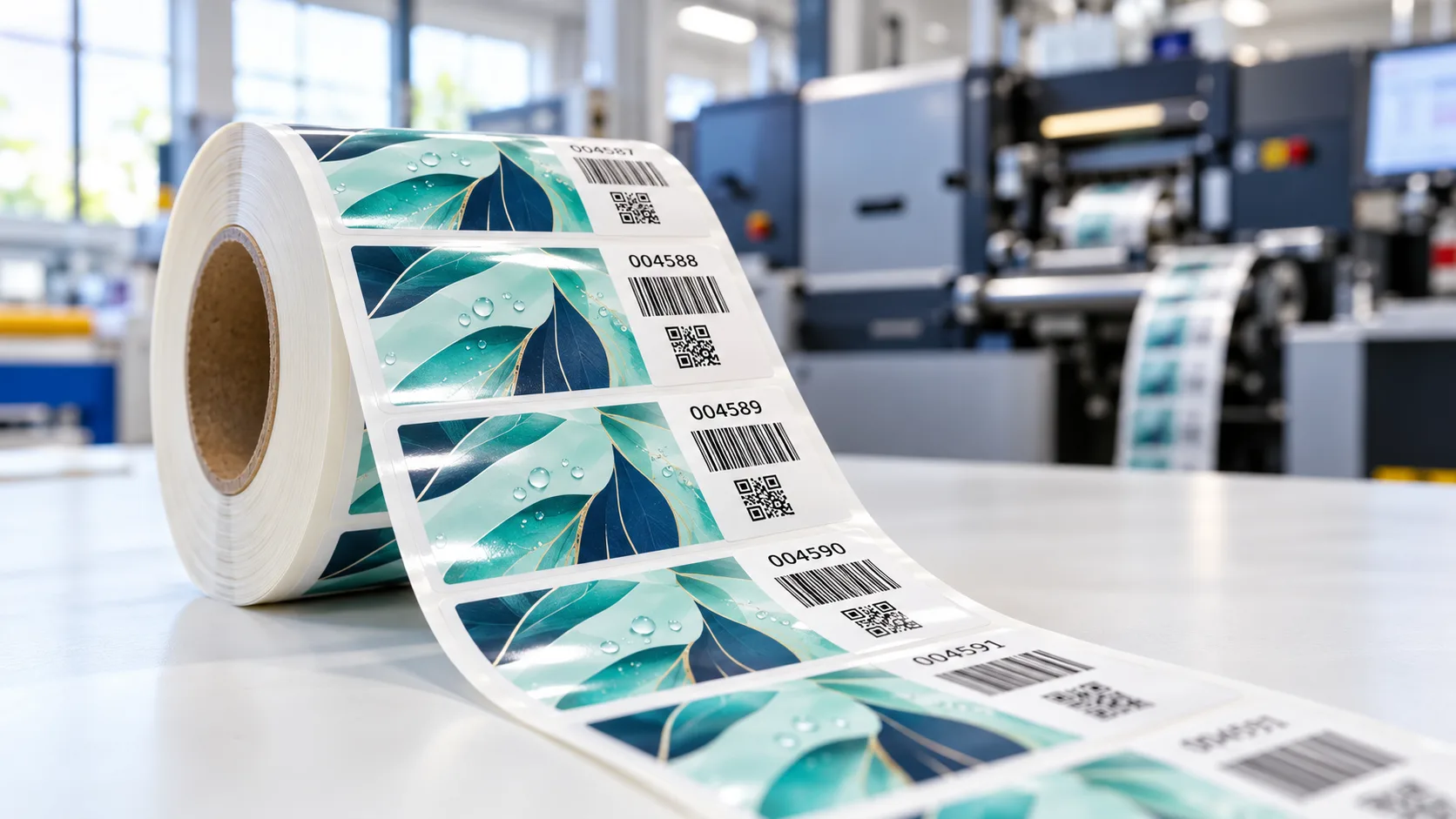
Every label on the roll can now be different, but it has always meant a lot of set up work – but no longer. Positive ID Labels has built its own variable data system for our Jetrion digital press, so serial numbers, batch codes, barcodes and QR codes can be printed straight onto your labels in the same pass as your design, from a spreadsheet or a simple start number.
Sequential and variable labels, without the fuss
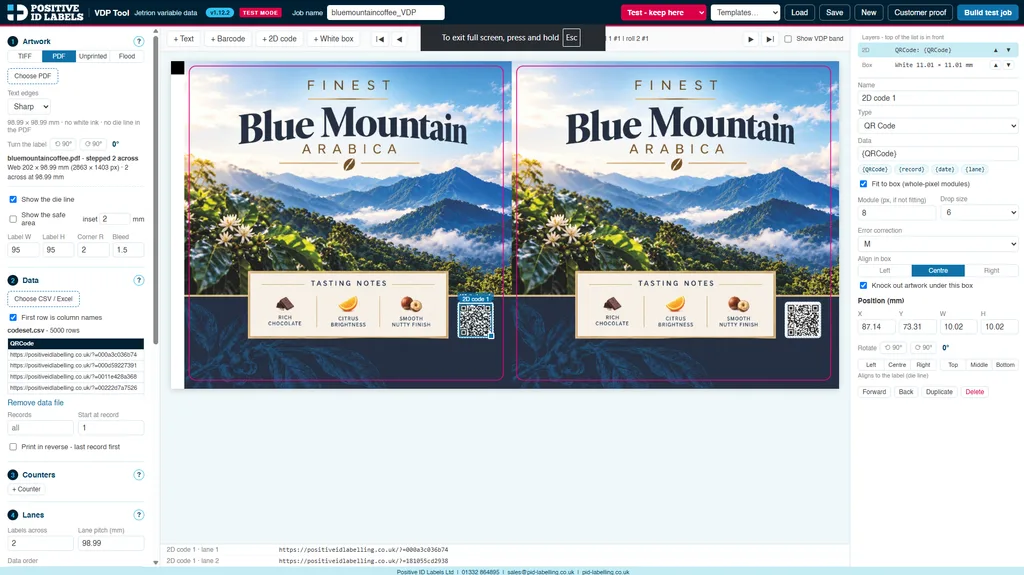
Until now, numbered and personalised labels meant extra set-up work for every job. We have replaced that with a system designed in-house around the way we print. Send us your artwork and your list (or just tell us where the numbers start) and we set up the job, check it, send you a proof and print it.
It works with the artwork you already have. A print-ready PDF, Adobe Illustrator (AI file)or a TIFF is fine. A plain label with nothing printed but the numbers is fine too, as is a solid colour background with the variable data on top. The new tool handles all that for you.
What can change from label to label
| What | Examples |
|---|---|
| Sequential numbers | 0001, 0002, 0003 … with any start number, step and number of digits |
| Numbers with fixed text | 599807570001A000, 599807570002A000 … (a fixed prefix and suffix around the count) |
| Data from your file | Names, product codes, batch and lot numbers, dates, from a CSV or Excel spreadsheet |
| Linear barcodes | Code 128, EAN-13, ITF-14 and other common types, printed from your numbers or data |
| 2D codes | QR codes and Data Matrix, linking each label to its own page or record |
| Text | Any font, size and position, with automatic line wrapping for longer text |
The variable information prints in black over your design. It can sit on a clear white panel within a coloured design, so every code stays sharp and easy to read.
Jobs it makes easy
- Asset and equipment tags: a numbered label for every item, with a barcode or QR code that matches the number printed beside it.
- Batch, lot and serial labels: a product label in full colour, with each label carrying its own serial number and barcode.
- Tickets, vouchers and raffle labels: unique numbers in sequence, split onto rolls of exactly the quantity you need.
- Event and promotional labels: a personalised name, code or web link on every label, straight from your spreadsheet.
- Clear labels with white ink: designs on clear film with a white background behind the printing, and the variable data on top.
Checked, proofed and rolled the way you need
- Every barcode is checked. Before a job goes to press, our system reads back each barcode and QR code it has created and confirms it scans to the right value.
- You see it before we print it. You get a PDF proof showing sample labels with their real numbers and data: the first, the last and a selection in between.
- Rolls of the quantity you choose. Ask for 500 or 1,000 labels on a roll and the numbering is laid out so each roll runs in order. You can also have each roll count down, so the first label off the roll is the last number.
- Several labels across, numbered sensibly. Rolls can be numbered in sequence, or labels can run in order across the web. The system has a range of approaches to give you sequential labels how you want.
- Big runs planned properly. Long jobs are split into press runs that fit our rolls, with the breaks placed between your rolls, never in the middle of one.
Frequently asked questions
Why put variable data on my labels?
Traceability (batch, lot and serial numbers that link each item to its production record), asset and stock control, unique codes for promotions, competitions and warranty registration, and protection against counterfeiting. New retail barcode standards are adding another reason (see the next question).
What is GS1 Sunrise 2027 and does it affect me?
By the end of 2027, retail checkouts are expected to scan 2D barcodes as well as the familiar EAN/UPC barcode as part of the GS1 Sunrise 2027 project. The 2D codes (a QR code using GS1 Digital Link, or a GS1 DataMatrix) can carry more than the product number: batch, expiry date or a serial number, plus a link to product information. During the changeover, packs carry both the traditional barcode and the 2D code. We already print GS1 DataMatrix, GS1 QR and GS1-128 codes, and QR codes carrying GS1 Digital Link web addresses. Each label can carry its own batch, expiry date and serial number, and we check that every code reads correctly as GS1 before printing. If you are planning for 2027, talk to us early.
What about the Deposit Return Scheme?
The UK Deposit Return Scheme for drinks containers is due to start on 1 October 2027. Containers in the scheme need a new barcode registered for the scheme and the scheme logo, and stock carrying them must not be sold before the launch date. The deposit barcode is the same on every container of a product, so this is a label change rather than variable data. Digital printing makes it easy to produce the new versions in the quantities you need, alongside any batch or date codes.
Which fonts can I use?
Unlike many variable data label manufacturers, we are not tied to a short list of fonts built into the printer. We can use a wide range of fonts, including your brand font if you send it to us (subject to its licence), with bold, italic, underline and automatic line wrapping. If you need a specific font, just send us the ttf (TrueType Font file) and we will load it into our system for you.
Which barcodes can you print?
Code 128, EAN-13, EAN-8, UPC-A, UPC-E, ITF-14, Interleaved 2 of 5, Code 39, Code 93, Codabar, GS1 DataBar and GS1-128 (with ITF-14 bearer bars where needed), plus QR, Data Matrix, GS1 DataMatrix, GS1 QR, PDF417 and Aztec 2D codes. Tell us if you need a specific size, quiet zone, bar width reduction or human-readable text layout, or a code type not listed here. As our system was built in-house, we are happy to include other barcoding libraries and symbologies.
Can the variable information be in colour?
At the moment the variable information (numbers, text and codes) prints in black, on top of your full-colour design or on a white panel within it. Black gives the sharpest, most reliable barcodes. Full-colour variable printing is something we are looking into.
Are there artwork set-up charges?
Our system was built to make variable jobs quick to set up, so there are no heavy artwork preparation costs. Send a print-ready PDF and your data, or simply tell us where the numbers start. We aim to offer a self-service function soon, but in the meantime, we can prepare your files in a few minutes, so we no longer need to charge for this service.
Can a repeat order carry on from the last one?
Yes. We keep your job set up, so your next order picks up where the last one finished: the numbers simply continue from the last label we printed.
How do I know every code will scan?
Every barcode and 2D code our system creates is read back and checked by our software against its intended value before the job is released to the press. You also approve a PDF proof first. Our system is pixel-perfect, so all barcodes are built at the printer’s native resolution using single ink only.
How to order
Tell us about your job and send us:
- Your artwork: a print-ready PDF of one label (or tell us the size and colour for a plain or single-colour label).
- Your data: a CSV or Excel file with one row per label, or just the start number, the number of digits and any fixed text around it.
- The details: how many labels in total, how many on each roll, and whether the numbers should count up or down on the roll.
We set up the job and send you a proof to approve, then we print. Contact us on 01332 864895 or fill in a form and we can call you back – alternatively, email you files and data to sales@pid-labelling.co.uk with a short explanation of what you want.