CLP Labelling Changes: What the EU Vote Means for You
Will your hazard labels still be legal in 2028? If you sell cleaning products, coatings or other chemicals into the EU or Northern Ireland, that question just got a clearer answer. On 22 October 2026, the European Parliament approved new rules for CLP labelling.
At Positive ID Labels, we print labels for chemical and cleaning products, so we’ve read the agreed text closely. This guide explains what changes on your labels, when it starts, and why the “2030” date you may have seen is not the whole story.
Why the New CLP Labelling Rules Matter
CLP stands for Classification, Labelling and Packaging. It is the EU law that sets out hazard pictograms, signal words and safety statements on chemical products. A 2024 update added strict formatting rules, including minimum font sizes and black text on a white background.
Industry pushed back. Many hazard labels would have needed to grow, or lose languages. So the EU paused the rules until 1 January 2028 and drafted a simpler version, known as “Omnibus VI”. That simpler version is what MEPs backed this week, by 477 votes to 59 (as reported by Agence Europe).
For CLP labelling, Omnibus VI is mostly good news: fewer fixed rules for trade labels, and more time to relabel.
It is not law yet. The Council of the EU must formally adopt it. It then comes into force 20 days after it appears in the Official Journal.
What Changes on Your CLP Labelling
The agreed text treats consumer and trade products differently.
Products sold to the public must use hazard text with an x-height of at least 1.2 mm. The x-height is the height of a lower-case “x”. Packs of 125 ml or less can drop to 0.9 mm. These standards now align with the food labelling regulations that have been in place since 2016.
Business-to-business products have no fixed font size. Instead, every label must be easy to read. That means:
- a colour that contrasts with the background
- one sans-serif typeface (no “tails” on the letters)
- letter and line spacing that stops text crowding or overlapping
- a font size that suits the label size and the user
The old fixed “black on white” and “120% line spacing” rules are replaced by these general tests. Minimum label and pictogram sizes stay. For packs up to 3 litres, aim for a 52 x 74 mm label where possible, with pictograms of at least 10 x 10 mm.
Relabelling After a CLP Labelling Change
When a substance gets a tougher classification, you must update the label without undue delay, and within 15 months at most. The old limit was 6 months. Interestingly, the lawmakers mention firms that outsource label printing, and the longer lead times for fold-out labels, as reasons for the change.
Small Packs and Digital CLP Labelling
Some small inner packs, such as ink cartridges, can carry just the hazard pictograms plus a QR code. The full label must then sit on the outer pack. Labels will also need a “digital contact”, such as an email address or web page, next to the supplier details.
When Do the New Rules Start?
The 18-Month Clock
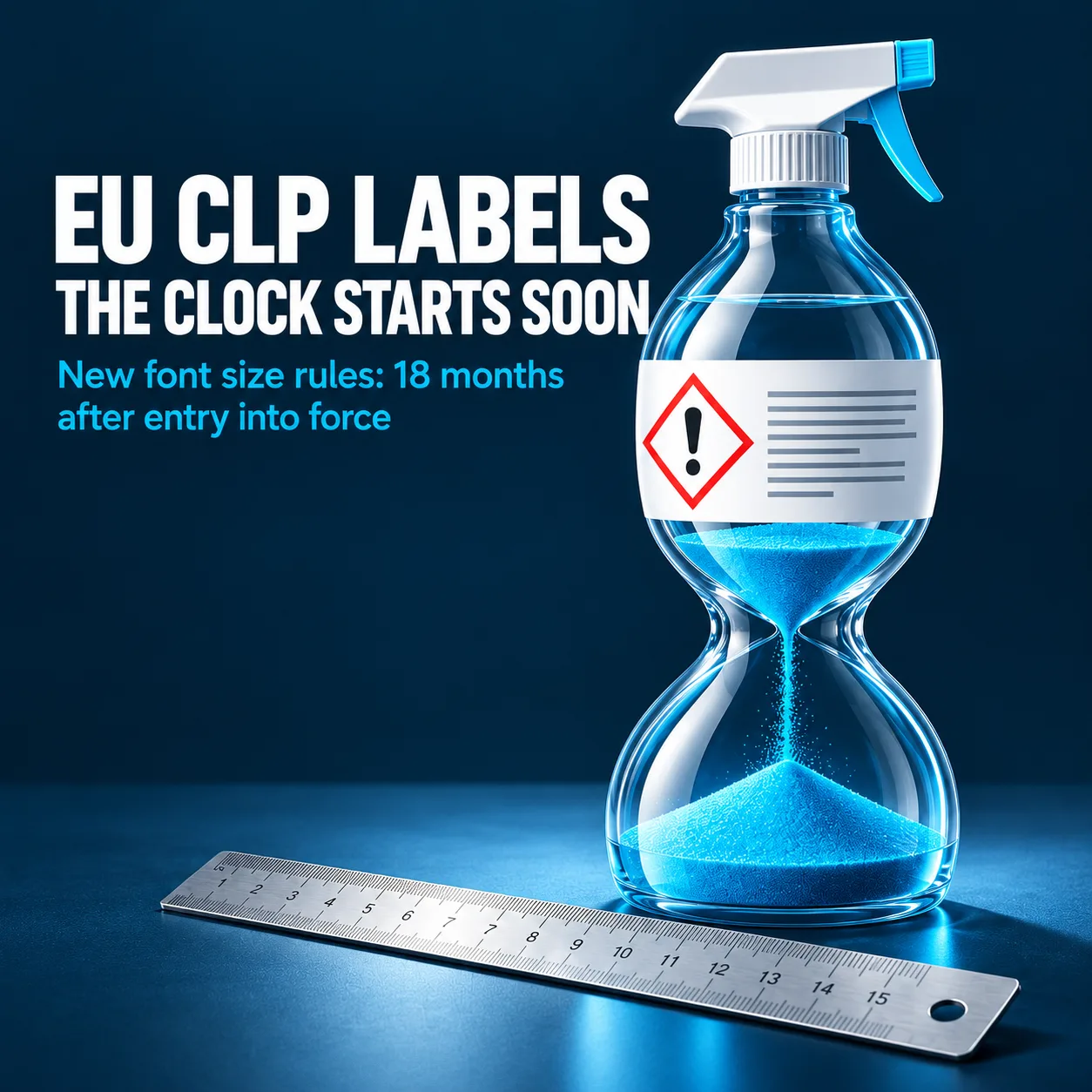
Press releases in June said the new dates would be “1 January 2030”. The agreed legal text is more precise. It says the formatting and relabelling rules apply 18 months after the law comes into force. If the law is published around the turn of the year, that points to mid-2028. Please treat that as our estimate, not law.
Other dates hang off the same clock:
- Old rules allowed until the end of the month after month 17.
- Older stock, placed on the market before that cut-off, can stay on sale until 42 months after entry into force.
- Digital contact and small-pack rules apply after 36 months.
That 36 to 42-month window is where the “2030” figure comes from. Until the new law is in force, today’s date of 1 January 2028 still stands.
GB, Northern Ireland and the EU
- EU: the new rules apply once published.
- Northern Ireland: EU CLP applies under the Windsor Framework.
- Great Britain: not affected. GB CLP is separate. HSE is reported to be preparing a consultation on closer alignment, but nothing has been proposed yet.
So products sold in both markets may need separate GB and EU versions.
How to Prepare Your Hazard Labels
You don’t need to scrap any compliant stock. But it is worth planning now:
- Sort your products into consumer and trade lines, by market.
- Measure the x-height on your EU and NI consumer labels. Is it at least 1.2 mm?
- Check your space. If bigger text won’t fit, consider a multipage label.
- Plan artwork for 2027 to 2028, not 2030.
- Keep GB and EU files separate, so a future change only touches one version.
- Ask your suppliers how they will tell you about classification changes, so the 15-month clock never catches you out.
Good CLP labelling starts with good information. If you’re unsure where your range stands, call 01332 864895 and we’ll talk it through with you.
How Positive ID Labels Can Help
- Crisp small text. Our Screen UV inkjet press prints at 600dpi, so 1 mm characters stay sharp and readable on white polypropylene.
- Tough materials. Polypropylene resists oils, solvents and cleaning agents, which is why it’s our standard choice for chemical labels. Varnish or laminate adds protection in transit.
- More room. Multipage and peel-and-reveal labels make space for several languages on small bottles.
- Fast reprints. Short digital runs make a 15-month relabelling window easy to meet. For volume work, we hold over 1,000 cutting dies.
- Fixed prices. Call 01332 864895 or use our enquiry form for free, practical guidance. The price we quote is the price you pay.
Frequently Asked Questions
Are the new EU CLP labelling rules law yet?
Not yet. The European Parliament approved them on 22 October 2026. The Council must still formally adopt them, and they come into force 20 days after publication in the Official Journal.
What is the minimum font size on CLP hazard labels?
For products sold to the public, hazard text needs an x-height of at least 1.2 mm. Packs of 125 ml or less can use 0.9 mm. Trade-only products have no fixed size but must be clearly legible.
Is the CLP formatting deadline now 2030?
Not for most labels. The formatting rules start 18 months after the law comes into force, likely around mid-2028 (our estimate). Older stock and the digital contact rules run to about 2030.
Do my labels still need to be black on white?
The agreed text drops the fixed black-on-white rule. Text must contrast clearly with the background, use one sans-serif typeface and be well spaced.
How long do I have to relabel after a reclassification?
You must act without undue delay, and within 15 months at most. Suppliers must also pass on classification changes through the supply chain.
Can I use a QR code instead of a full hazard label?
Only on certain small inner packs whose size is limited by their function. The pictograms must still be printed, and the outer pack must carry the full label.
Does this affect products sold only in Great Britain?
No. GB CLP is a separate law. HSE is reported to be considering closer alignment with the EU, so it is worth keeping an eye on.
Do the new rules apply in Northern Ireland?
Yes. EU CLP applies in Northern Ireland under the Windsor Framework, so NI labels follow the EU rules.
Can I start using the new format early?
Yes. The agreed text says suppliers should be able to apply the new rules voluntarily before they become compulsory.
What label material works best for chemical products?
White polypropylene is our usual choice. It resists water, oils and cleaning agents, and it holds fine print well. Call 01332 864895 to talk through your products.
Sources
- European Parliament Legislative Observatory, procedure 2025/0531(COD): https://oeil.europarl.europa.eu/oeil/en/procedure-file?reference=2025/0531(COD)
- Council of the EU, document 11042/26 (agreed text, 26 June 2026): https://data.consilium.europa.eu/doc/document/ST-11042-2026-INIT/en/pdf
- Council of the EU press release, 17 June 2026: https://www.consilium.europa.eu/en/press/press-releases/2026/06/17/council-and-parliament-strike-deal-to-simplify-requirements-for-chemical-products/
- Regulation (EU) 2025/2439 (“stop-the-clock”): https://eur-lex.europa.eu/legal-content/EN/TXT/HTML/?uri=OJ:L_202502439
- Agence Europe, 23 October 2026 (vote count): https://agenceurope.eu/en/bulletin/article/13966/8/european-parliament-approves-agreement-with-eu-council-on-simplifying-eu-rules-governing-use-of-chemical-products
Last checked: 23 October 2026. Dates based on “months after entry into force” are estimates until the law is published in the Official Journal.
Disclaimer
All guides are provided in good faith for information purposes only and do not constitute legal advice. For specific compliance questions about specific labelling laws, contact a specialist or contact your local Trading Standards authority. Read our Regulatory Information Disclaimer