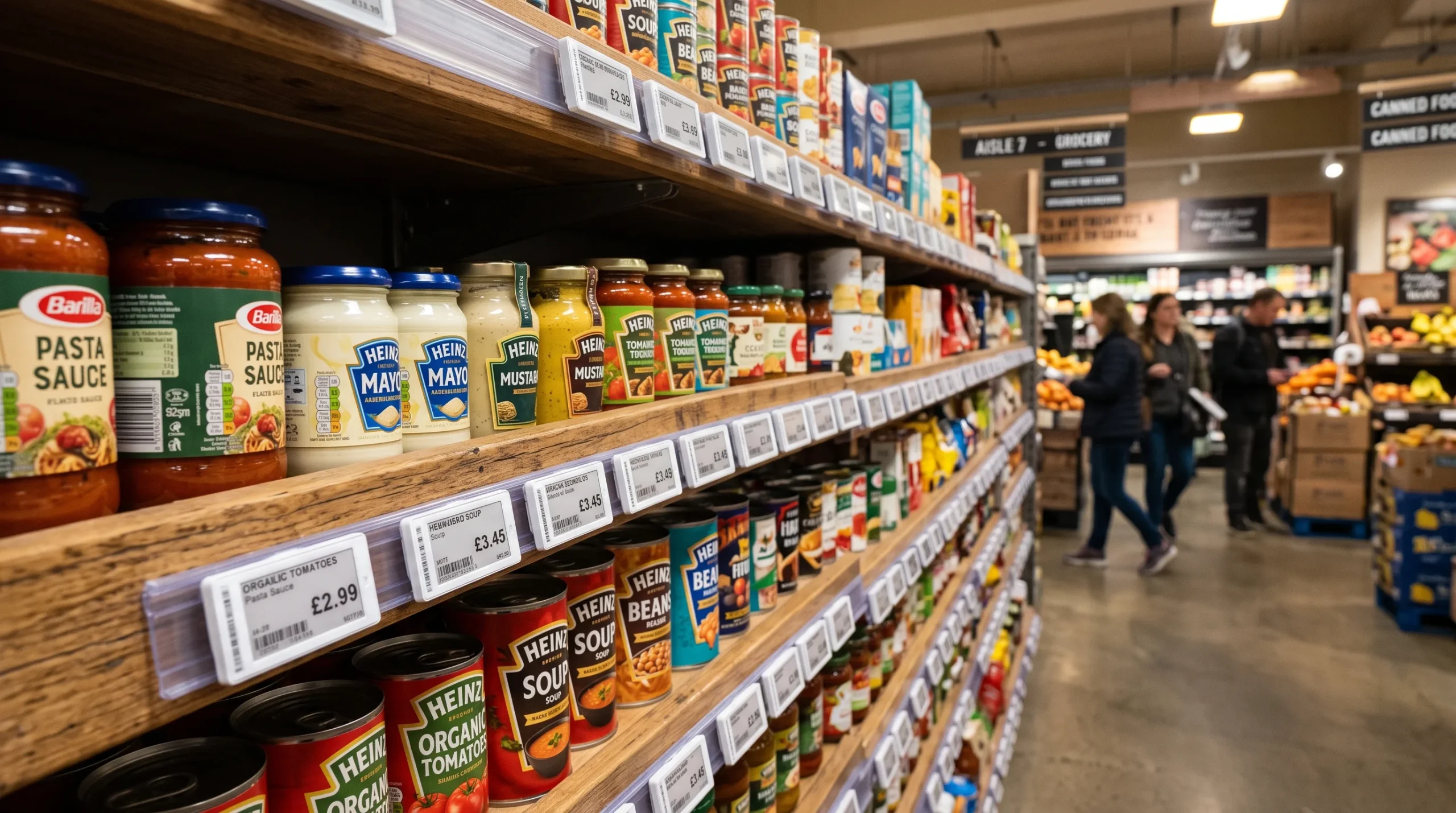
How Shelf Edge Labels Improve Pricing Accuracy and Customer Confidence
Shelf edge labels are the small printed strips that sit along the front of a shelf, showing the price, product name and often a barcode. They are the last piece of information a customer reads before deciding to buy, and the first thing they blame when the price at the till does not match.
The short answer is this. Accurate shelf edge labelling reduces pricing disputes at the checkout, speeds up restocking, and keeps you on the right side of consumer pricing law. Get them wrong and you lose margin, time and trust in the same afternoon.
Positive ID Labels supply printed retail labels, shelf strips, ticket rolls and blank stock for retailers across the UK. This guide covers what they need to say, what they should be made from, and how to keep them accurate when prices change weekly.
What Shelf Edge Labels Need to Show
There is no single legal template, but UK pricing rules are clear on the principle. The selling price must be unambiguous, easily identifiable and clearly legible to the customer.
In practice that means four things on every strip:
- The selling price, in a size the customer can read without stooping (can be done with pricing guns)
- The product description, matching what is actually on the shelf
- The unit price where required, so shoppers can compare across pack sizes
- A barcode or product code, so your staff can reorder and price-check quickly
Unit pricing is where most retailers slip. If you sell the same product in more than one size, the price per kilogram or per litre lets a customer compare them properly. It is also the detail trading standards officers look at first.
Why Accurate Shelf Edge Labels Protect Your Margin
A mispriced strip costs more than the difference on one sale.
If the shelf says one price and the till says another, most retailers honour the lower figure to keep the customer happy. Do that a dozen times a week on a fast-moving line and the loss is real. Worse, the staff time spent investigating a single pricing query usually costs more than the item.
The reverse is worse still. Charging more at the till than the shelf advertises is a consumer protection issue, not an admin error.
Choosing the Right Material for Shelf Edge Labels
The material decision comes down to how long the strip needs to survive and where it sits.
Standard coated card suits most indoor shelving. It prints sharply, takes a barcode well, and costs least. If your prices change weekly, paper is the sensible choice because you are replacing the strip before it can degrade. Will require thermal transfer ribbon printing.
Polypropylene or polyethene type materials is the answer for chilled aisles, wet areas and anywhere the label faces moisture. Plastic will not cockle, tear or go translucent when a shopper handles it with damp hands. Fresh produce, chilled cabinets and butchery counters all justify the extra cost. Will require thermal transfer ribbon printing.
Direct thermal material lets you print on demand from a small printer at the shelf. Ideal for frequent price changes, though the image fades over six to twelve months, so it suits short-cycle pricing rather than permanent fixtures.
All materials are ideally supplied on continuous rolls and used with a thermal printer including a guillotine attachment. This means you can extend or reduce the size of the shelf edge labels to what suits your needs.
Printing Your Own Shelf Edge Labels On Site
Printing in-store gives you same-day price changes without waiting for a delivery.
A desktop thermal printer handles a few thousand strips a day comfortably, which covers most independent retailers and convenience stores. Pair it with software that pulls prices from your EPOS system and the risk of a typo disappears, because nobody is retyping anything.
For larger estates, pre-printed strips ordered in bulk work out cheaper per unit and give you consistent brand presentation across every site. Many retailers run both: bulk-printed for stable lines, on-demand for promotions. If you are not sure which split suits you, call 01332 864895 and we will work it through with you.
Keeping Shelf Edge Labels Accurate Between Price Changes
The system matters more than the label.
Print price change strips in aisle order rather than alphabetically. Staff work down the aisle once instead of walking it three times. Colour-code promotional strips so they are obvious to remove when the offer ends, because expired promotions are the single most common source of till disputes.
And build in a spot check. Ten random price comparisons a week takes five minutes and catches problems before a customer does.
Frequently Asked Questions
What size should a shelf edge label be? The most common UK sizes are 26mm and 39mm deep, in widths to suit standard rail lengths. The right size is whatever fits your existing rails, so measure the channel before ordering. We can match almost any rail if you send us a sample.
Can I print barcodes on shelf strips? Yes, and you should. A scannable barcode on the strip lets staff price-check and reorder without handling stock. Make sure your printer resolution suits the barcode size, because a cramped barcode on a narrow strip needs 300dpi rather than 203dpi.
Do shelf edge labels have to show unit pricing? Where products come in different sizes, unit pricing lets customers compare fairly and is expected under UK pricing rules. Layout matters here: the unit price should be legible but clearly secondary to the selling price.
How do I stop labels falling out of the rails? Usually the strip is slightly too narrow for the channel. Card stock at the correct weight holds its shape far better than thin paper. If your rails are worn, a marginally thicker material solves it without replacing the fittings.
Can you match our existing shelf strip design? Yes. Send us a sample or a photograph with a ruler alongside it and we will match the size, layout and colours. Most retailers want continuity across stores, so we hold artwork on file for repeat runs.
What is the difference between shelf edge labels and shelf talkers? Shelf edge labels carry the price and product information along the rail. Shelf talkers are the projecting cards that stick out into the aisle to draw attention to an offer. Many retailers use both, with the talker flagging the promotion and the strip carrying the actual price.
Getting Your Shelf Strips Right
Not sure which material suits your aisles, or whether printing in store beats ordering in bulk? That is exactly the sort of question our team enjoys. Call 01332 864895 and tell us what you are pricing, how often it changes, and what your rails look like.
We quote a fixed price over the phone, not an estimate that moves later. Most orders leave us within five working days.