Plastic Packaging Tax and Your Labels: What Changes in 2027
£228.82. That is what every tonne of chargeable plastic packaging costs a UK business from 1 April 2026. Plastic packaging tax has been around since 2022, but two changes due in April 2027 are worth a few minutes of your time, especially if you buy plastic labels or print recycled-content claims on pack.
At Positive ID Labels we print labels on polypropylene and paper every day, so customers ask us what the tax means for them. This guide explains what HMRC is changing, whether labels are caught, and what (if anything) needs to change on your artwork. Spoiler: nothing on the label is mandated. But your claims might need a second look.
This is general guidance, not tax advice. Check your own position with HMRC or your accountant.
What Is Changing with Plastic Packaging Tax in 2027?
HMRC published draft regulations on 6 October 2026. The consultation closes at 11:59pm on 21 December 2026. Two things matter for packaging buyers.
Mass balance for chemically recycled plastic
Chemical recycling breaks plastic waste down so it can be made into new plastic. The problem is tracing exactly how much recycled material ends up in a given pack. A mass balance approach solves this by allocating recycled content through a certified bookkeeping system.
HMRC proposes that, from 1 April 2027, businesses can use certified mass balance to count chemically recycled plastic towards the 30% recycled content threshold. The draft rules set conditions on certification, auditing, monitoring and record keeping. More detail will follow in HMRC notices.
Pre-consumer waste stops counting
This one is already confirmed in HMRC guidance (updated 28 August 2026). From 1 April 2027, pre-consumer plastic waste will no longer be accepted as recycled plastic for plastic packaging tax. Pre-consumer waste is scrap from manufacturing that never reached a shopper.
If your film, bottle or label stock reached 30% recycled content using factory offcuts, it may not pass the test after that date. Ask your suppliers how they will evidence recycled content from April 2027.
Further ahead, HMRC confirmed on 28 October 2026 that it intends to make third-party certification mandatory for mechanically recycled plastic, from 1 April 2030. Evidence for recycled content claims is only going to get stricter.
Are Your Labels Caught by Plastic Packaging Tax?
Here’s the bit most guides skip. A self-adhesive label made of plastic, such as polypropylene, can be a plastic packaging component in its own right. HMRC says a label “may also be a packaging component”.
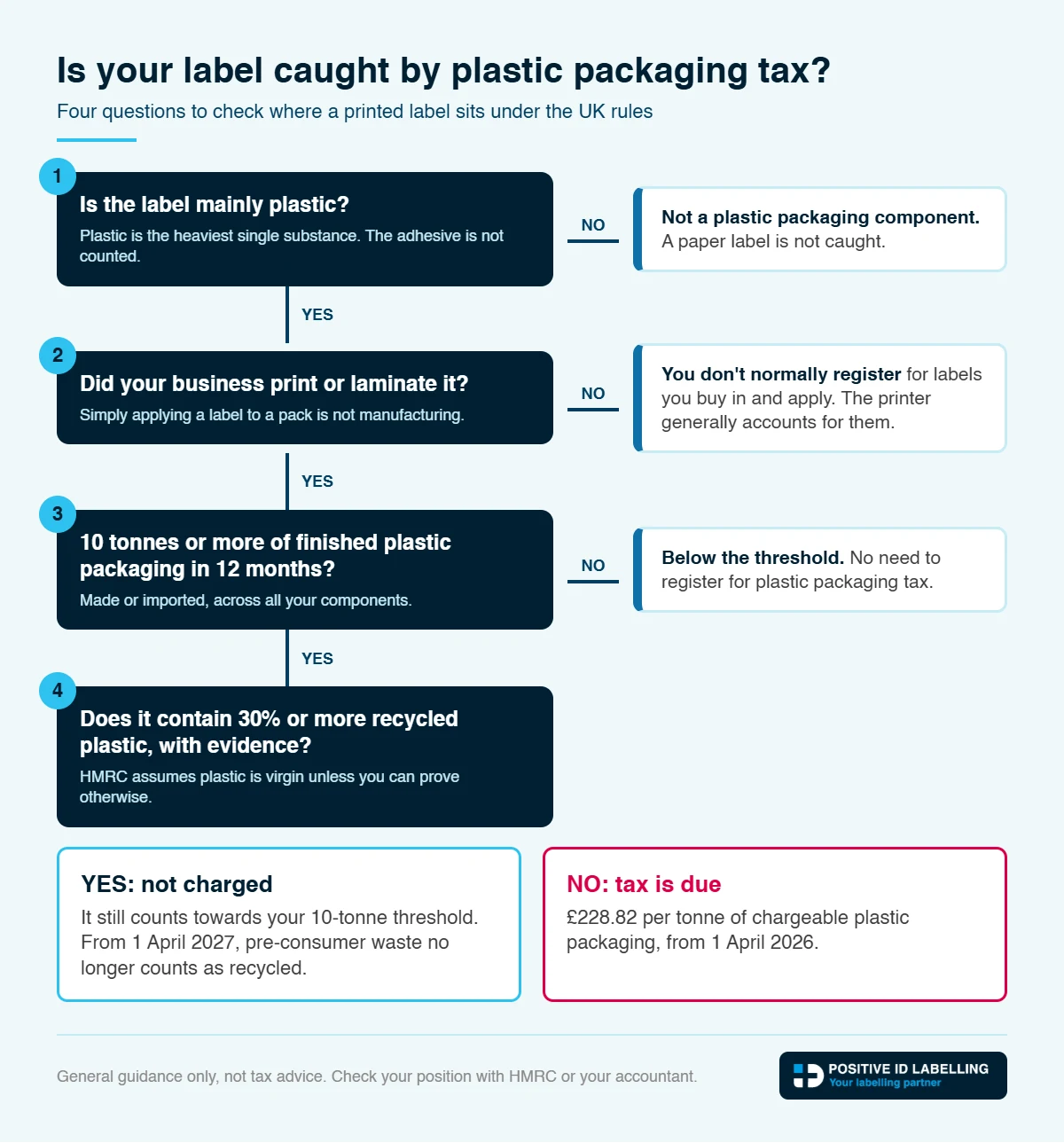
Who pays plastic packaging tax on a printed label
Liability sits with the business that makes the last “substantial modification” before the packaging is filled. HMRC lists printing and laminating as substantial modifications. Simply applying a label to a pack is not.
In practice, the business that prints or laminates a plastic label is generally the one that accounts for the tax on it. That only applies if it is over the 10-tonne threshold: businesses must register if they make or import 10 tonnes or more of finished plastic packaging components in 12 months. If you only apply labels you buy in, you do not normally register for those labels.
The 30% recycled content test
Components containing 30% or more recycled plastic are not charged, although they still count towards the 10-tonne threshold. HMRC assumes plastic is virgin unless there is evidence. For multi-material items, the component counts as plastic if plastic is the heaviest single substance. A non-plastic adhesive is not counted as another substance.
Plastic packaging tax and the release liner
Some industry sources say a plastic backing liner is a separate component and in scope. This is reported only: we have not seen it confirmed on gov.uk. If you buy large volumes of filmic labels, raise it with your adviser.
Plastic packaging tax dates to put in your diary
What This Means for the Words on Your Pack
There is no PPT logo, and HMRC’s consultation does not mention labelling. So you won’t be reprinting labels because of the tax itself. The risk is elsewhere.
Recycled-content claims after April 2027
Many brands print statements like “made with 30% recycled plastic”. If that claim relies on pre-consumer content, it may become hard to substantiate after 1 April 2027. The CMA’s Green Claims Code says environmental claims must be truthful and backed by evidence. Since April 2025 the CMA can fine businesses directly under consumer law.
Our suggestion: list every pack that carries a recycled-content claim, ask your supplier what the evidence will be, and update artwork before your next print run, not after. Once your revised wording is signed off, call 01332 864895 and we’ll quote for the reprint.
Paper or plastic? Choose on performance
Paper labels are not plastic packaging components. That doesn’t mean you should switch. Polypropylene is the right material for wet, chilled and chemical environments, where paper would fail. A label that peels off in the chiller costs far more than any tax.
Where paper does suit the job, we have good options. Tintoretto textured paper, printed on our 1200dpi Xeikon, is moisture-resistant and built for chilled environments. Vellum gives an uncoated, natural feel. All our materials are FSC-compliant. We’ll recommend what performs best for your product, and we’ll give you a fixed price, not an estimate.
Your next step
Plastic packaging tax rarely changes a label on its own. What it does change is the evidence behind the claims you print. Take ten minutes to check which of your packs mention recycled content, then talk to us before your next reorder. Call 01332 864895 or send us your artwork through the enquiry form, and we’ll quote for any reprint you need.
Frequently Asked Questions
Does plastic packaging tax change what I must print on my label?
No. There is no mandatory mark, logo or statement. The changes affect how recycled content is evidenced and taxed, not label content. Voluntary recycled-content claims must still be accurate.
Is a polypropylene label a plastic packaging component?
It can be. HMRC says a label may be a packaging component. Polypropylene labels are plastic, so they fall within the scope of the tax, subject to the usual rules and thresholds.
Who pays the tax on printed plastic labels?
Generally the business doing the last substantial modification, and HMRC lists printing and laminating as substantial modifications. Applying a label is not. The 10-tonne registration threshold still applies.
What is mass balance in chemical recycling?
It is a certified accounting method that allocates chemically recycled input to outputs, because the recycled molecules can’t be physically traced. HMRC proposes allowing it for the tax from 1 April 2027, subject to certification and auditing.
Why does pre-consumer waste matter for recycled content claims?
From 1 April 2027 it no longer counts as recycled plastic for the tax. Packaging that met the 30% test using factory scrap may fail it. Any on-pack claim based on that content should be checked.
Will I need to reprint my labels?
Only if your artwork carries a recycled-content claim that will no longer be accurate. Labels without such claims are not affected by these changes.
Does the tax apply in Northern Ireland?
Yes. It is a UK-wide tax covering England, Scotland, Wales and Northern Ireland. The EU has no direct equivalent; its plastic levy is paid by Member States.
Should I switch to paper labels to avoid the tax?
Choose on performance, not tax. Paper labels are not plastic components, but polypropylene is often essential for moisture, chilling or chemical contact. Call 01332 864895 or use our enquiry form and we’ll help you weigh up the materials.
Sources
- HMRC, draft legislation: chemical recycling and mass balance (6 October 2026): https://www.gov.uk/government/consultations/draft-legislation-plastic-packaging-tax-chemical-recycling-and-adoption-of-a-mass-balance-approach
- HMRC, Work out which packaging is subject to Plastic Packaging Tax (updated 28 August 2026): https://www.gov.uk/guidance/work-out-which-packaging-is-subject-to-plastic-packaging-tax
- HMRC, Decide if you need to register for Plastic Packaging Tax: https://www.gov.uk/guidance/decide-if-you-need-to-register-for-plastic-packaging-tax
- HMRC, Plastic Packaging Tax policy paper: https://www.gov.uk/government/publications/introduction-of-plastic-packaging-tax/plastic-packaging-tax
- HMRC, Potential certification for mechanically recycled plastic packaging: consultation outcome (28 October 2026): https://www.gov.uk/government/consultations/plastic-packaging-tax-mechanically-recycled-plastic-packaging/outcome/plastic-packaging-tax-potential-certification-for-mechanically-recycled-plastic-packaging
- CMA, Green Claims Code: https://www.gov.uk/government/publications/green-claims-code-making-environmental-claims