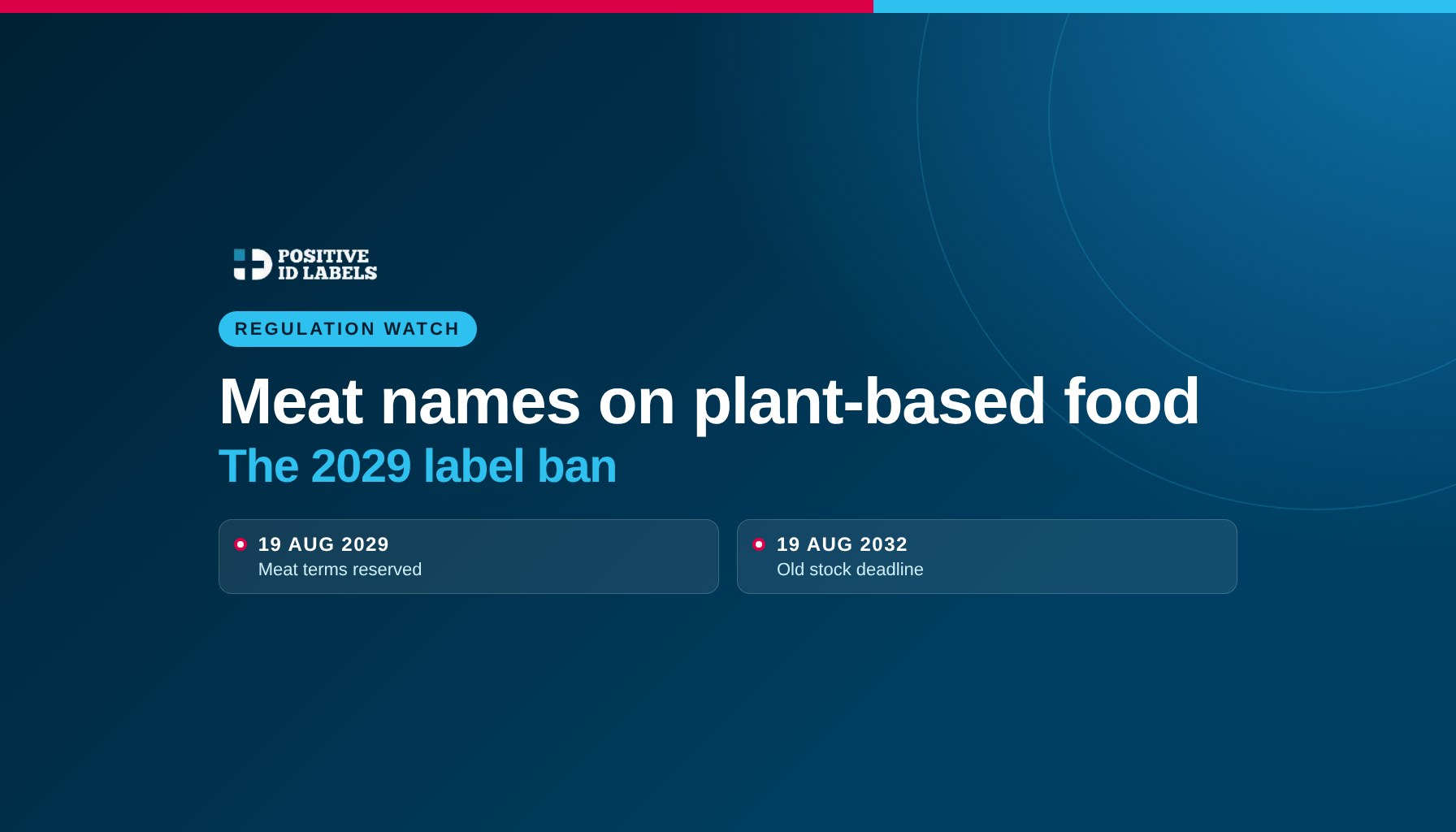
Plant-based brands spent a decade teaching shoppers what “vegan bacon” and “plant-based chicken” mean. Now the names have to go. From 19 August 2029, 32 meat names will be reserved for food that contains meat, in the EU and, under the UK-EU SPS agreement, in Great Britain too.
At Positive ID Labels, we print labels for food brands of every size. This guide explains which words are affected, which survive, and how to plan a rebrand without binning label stock. It’s general information, not legal advice.
This guide is part of Regulation Watch, where we track UK and EU label rule changes. You’ll find every key date, free printable checklists and topic email alerts in one place.
Which Meat Names Are Being Reserved?
The rule comes from EU Regulation 2026/1739. Defra’s SPS guidance confirms British businesses will follow it from the same date. It reserves the word “meat” and 31 other terms:
- Animals: beef, veal, pork, poultry, chicken, turkey, duck, goose, lamb, mutton, ovine, goat.
- Cuts and parts: drumstick, tenderloin, sirloin, flank, loin, ribs, shoulder, shank, chop, wing, breast, thigh, brisket, ribeye, T-bone, rump, liver.
- Products: bacon, steak.
What Still Gets to Use These Meat Names
“Burger” and “sausage” are not on the list, so a veggie burger or a vegan sausage can keep its name. Fish and seafood terms are not affected. The UK can also seek exceptions for long-established names, and Defra says it will discuss this with trade associations.
Who the Meat Names Rule Covers
Defra’s guidance names three groups that won’t be allowed to use the restricted terms:
- Plant-based alternatives, such as a soya “chicken” fillet.
- Cultivated meat, grown from cells, if it reaches the market.
- Part-meat products where a meat ingredient has been swapped for a non-meat one.
The Dates That Matter
The restrictions apply from 19 August 2029. Products made or imported lawfully before then can stay on sale until stocks run out, or until 19 August 2032, whichever comes first.
Why Meat Names Matter for Your Brand, Not Just Your Label
For many brands the product name is the brand. Losing “chicken” from “no-chicken nuggets” isn’t a font change. It may mean new names, new artwork and new positioning, plus listings and online shop updates.
It isn’t only the pack. The EU rule reserves these terms at every stage of marketing, so expect it to reach your website, online listings, point-of-sale material and trade price lists too. Changing the label but leaving “vegan steak” on your product page would only fix half the problem.
If you also sell into the EU, the same 19 August 2029 date applies there, so one rebrand can cover both markets. How the rule will apply in Northern Ireland hasn’t been confirmed yet.
The legislation that brings this into GB law hasn’t been made yet, and the UK may yet seek exceptions. Keep an eye on Defra’s updates, but don’t leave the planning until 2029.
Meat Names on Labels You Haven’t Used Yet
The sell-through period covers finished products, not spare labels. A roll of labels printed in 2028 for a “plant-based steak” can’t go on product made after 19 August 2029. Plan your last order with the old name carefully.
Planning a Rebrand Around the Meat Names Ban
- List every product name and description that uses one of the 32 terms, including flavour lines such as “chicken style”.
- Agree new names early, with trademark checks, so artwork is ready well ahead of the date.
- Test new names on short runs in a few stores before committing to volume.
- Run down old label stock so you aren’t left with rolls you can’t use.
Planning a rebrand? Call 01332 864895 for a fixed-price quote on the new labels.
Free download: Meat names 2029 checklist (PDF). The actions from this guide as a printable checklist, with the key dates and sources.
How Positive ID Labels Can Help
A name change is a chance to refresh the whole label, from the material to the finish. Here’s what we can do:
- Premium print for a new look. Our Xeikon prints at 1200dpi on premium papers, including Tintoretto textured paper for an artisan feel.
- Metallic shelf appeal. Silver polypropylene with white ink gives a foil-like finish without the cost of foil.
- Labels for the chiller and freezer. Polypropylene handles condensation, and our acrylic freezer adhesive holds from -30°C to +50°C.
- Short runs, then volume. Digital runs suit trial names. For long runs on our flexo presses, we hold over 1,000 dies, so tooling is often free.
We quote a price, not an estimate, and that’s the price you pay. Call 01332 864895 or send your artwork through our enquiry form.
Frequently Asked Questions
Can I still call my product a veggie burger?
Yes. “Burger” isn’t one of the reserved meat names, so plant-based burgers can keep the word. The same goes for “sausage”.
Is “vegan bacon” banned in the UK?
From 19 August 2029, yes, once the rule applies in Great Britain under the SPS agreement. “Bacon” is one of the 31 reserved terms, alongside the word “meat”.
When does the ban start?
The restrictions apply from 19 August 2029. Products made or imported before then can be sold until stocks run out, or 19 August 2032 at the latest.
Does this apply to cultivated meat?
Yes. Defra’s guidance says cell or tissue cultured foods won’t be allowed to use the restricted terms.
Are fish names affected?
No. Fishery and aquaculture products are outside the restriction, so terms used for fish and seafood are not covered.
Can I use “chicken-style” or “beef flavour”?
The rule restricts the reserved terms themselves, so phrases built on them need care. Check the final GB legislation and take advice before you print.
Will the UK keep any of these names?
Possibly. EU rules let countries seek exceptions for long-established names that don’t confuse shoppers. Defra says it will discuss this with trade associations.
Do I need to change my labels now?
No. Current names are legal until 19 August 2029. But a rebrand takes months, and most brands reorder labels several times a year, so it’s sensible to plan the switch into your normal reorder cycle rather than leave it to the last run.
Which label material suits chilled plant-based food?
Polypropylene copes well with chilled cabinets and condensation. For frozen ranges, ask us about our freezer adhesives.
Sources
- Defra, Food labelling changes: preparing your business (20 November 2026): https://www.gov.uk/guidance/food-labelling-changes-preparing-your-business
- Regulation (EU) 2026/1739, Official Journal, 29 July 2026: https://eur-lex.europa.eu/legal-content/EN/TXT/HTML/?uri=CELEX:32026R1739
- Osborne Clarke, EU clamps down on meat names (11 September 2026): https://www.osborneclarke.com/insights/eu-clamps-down-meat-names-plant-based-and-cultivated-alternatives
Last checked: 24 November 2026. General information, not legal advice.
Before you print
This post explains the rules as we understood them when it was last edited. It is general information, not legal advice, and we don’t check label content for compliance. The business selling the product is responsible for what its label says. For advice on your product, contact your local Trading Standards or the Food Standards Agency.
Last edited:
Read our full disclaimer | See the latest rule changes | Get a fixed-price quote or call 01332 864895
Regulation Watch
Get Regulation Watch by email
Plain-English updates when a labelling rule changes for your products, with dates and what to do about your label stock. Pick the topics that matter to you.
- Only the topics you pick
- Key dates and what to do
- Unsubscribe any time