How To Load, Set and Troubleshoot a Date Labelling Gun
A date labelling gun is one of the simplest tools in any food business, right up until it prints crooked, smudges, or jams halfway through a batch. Almost every fault has the same handful of causes, and none of them needs an engineer.
The short version: most problems with your date labelling gun come down to three things. Labels loaded on the wrong path, an ink roller that has dried out, or bands that have not been clicked fully into position. Check those in that order, and you will fix the large majority of faults in under two minutes.
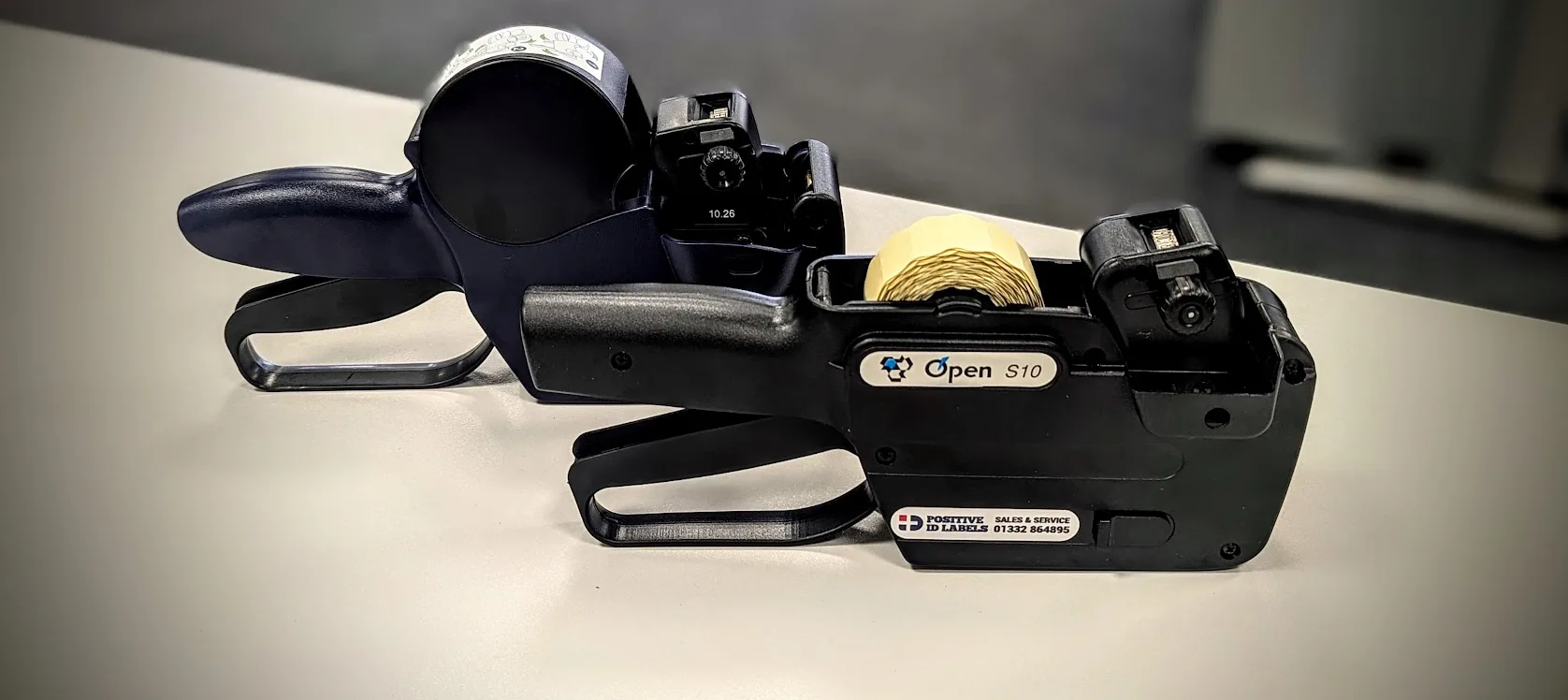
Positive ID Labels supply pricing and date labelling guns, pricing gun labels and ink rollers to UK food businesses, and have for over twenty years. Here is how to load your date labelling gun properly, set the date, and deal with the faults that actually happen.
Loading a Date Labelling Gun Correctly
Loading looks obvious and is where most faults begin.
- Open the top cover and remove the old roll and its core completely. A leftover core is the most common cause of a gun that feels stiff.
- Drop the new roll in so the labels feed off the top of the roll, not underneath. Backwards is the single most frequent loading error.
- Thread the backing paper through the label path and around the feed roller, keeping it flat and untwisted.
- Peel three or four labels off the backing before you close the cover, so the mechanism has slack to grip.
- Close the cover and squeeze the trigger four or five times without applying a label, letting the gun settle into rhythm.
If the first few labels come out skewed, that is normal. If they are still skewed after a dozen or so, the roll is not sitting square in the housing.
Setting the Date on Your Date Labelling Gun
Every date labelling gun uses printing bands, small numbered wheels you rotate to set the characters.
Turn each band using the side bezel on the print head until the character you want sits at the top, facing you. You should feel a positive click. A band left between positions prints a half character or nothing at all, which looks like an ink fault but is not.
Set the whole date, then test on a spare label before you start the batch. Read it back before you commit. It takes three seconds and catches a transposed month.
One point worth understanding. Bands print mirrored on the gun face, so what looks right on the wheel is what prints on the label.
Which Date Should Your Date Labelling Gun Print?
This trips up new staff more than the mechanics do – understanding date labelling.
Getting these the wrong way round is a food safety issue, not a labelling preference. If your gun is set to print one format all week, make sure it is the right one for what you are dating that day.
Date Labelling Gun Faults and Their Fixes
- Labels smudge or print faintly. The ink roller has dried out or run low. They are consumable and typically last several thousand impressions. Replace rather than revive. Keep a spare in the drawer, because a dry roller always happens mid-batch.
- Labels print crooked. Usually the roll is not seated squarely, or a label has partially peeled inside the mechanism. Open up, remove the roll, check the path is clear, and reload.
- Nothing prints at all. Check the ink roller is actually fitted. It sounds absurd, but after a clean it is easy to close the gun without replacing it.
- The gun jams repeatedly. Adhesive residue on the feed roller is the usual culprit. Clean it with isopropyl alcohol on a cloth. Never use water, and never pick at it with anything metal.
- Labels do not stick to packaging. This is a material problem rather than a gun problem. Standard permanent adhesive needs a dry, clean, dust-free surface. If you are labelling chilled or damp packs straight off the line, you need a different adhesive rather than a different gun.
- The date is right, but staff cannot read it. Check band alignment first. If the characters are clear but cramped, a larger label format gives you more room.
Keeping a Date Labelling Gun Running for Years
Three habits do almost all the work.
Wipe the feed roller weekly with isopropyl alcohol. Store the gun closed, so dust does not settle on the print bands. And use labels made for your model, because a marginally wrong width will track badly and wear the mechanism unevenly.
A date labelling gun is cheap to replace and cheaper to look after. A five-minute clean each Friday is the difference between two years and six. If yours is past saving, call 01332 864895 and we will match a replacement to the labels you already hold.
Frequently Asked Questions
How often should the ink roller be replaced? Typically every few thousand impressions, though it varies with how much ink each impression uses. When print starts fading at the edges of characters, that is the signal. Keep a spare, because they always run out mid-batch.
Can I print a date and a price on the same gun? Two-line and three-line guns let you print a date on one line and a price or batch code on another. A single-line gun will only do one, so check which you have before promising a customer two pieces of information.
Do date gun labels work on frozen packaging? Standard adhesive struggles on cold or damp surfaces. For chilled and freezer packs, you need a freezer-grade adhesive, which applies at low temperature and holds as the pack gets colder. Tell us the temperature at the moment of application, because that matters more than the storage temperature.
Why do my labels curl off after a few hours? Usually the surface was damp, dusty or greasy when the label went on. Adhesive needs contact to bond. If the packaging itself is the problem, a wet-surface adhesive will hold where a standard one cannot.
Are all date gun labels the same size? No. Common sizes include 26x12mm and 22x12mm, and guns are built around a specific format. Send us the model number or a sample label and we will match it exactly.
Can I get a gun that prints letters as well as numbers? Yes. Alphanumeric guns take letter bands as well as numeric, which suits batch codes, initials and short text. They cost a little more and are worth it if you code by operator or line.
Need Labels, Rollers or a Replacement Gun?
Most people call us because something has run out mid-shift. We keep the common formats in stock and can usually deliver same or next working day. For custom printed labels, most orders leave us within five to ten working days depending on our current workload.
If you are not sure which labels fit your gun, send a photograph of the model number or post us a used label. We will identify it and quote a fixed price, not an estimate.
Call 01332 864895 and we will sort it.