DRS Barcode Guide: New GTINs and the July 2027 Deadline
Every existing barcode on an in-scope drinks container has to change. That is the plain message from Exchange for Change, the body running the deposit return scheme in England, Scotland and Northern Ireland. If you sell drinks in plastic bottles or cans, each product needs a new DRS barcode, registered on the scheme’s Article List, by 9 July 2027.
At Positive ID Labels, we print drinks labels for brewers, soft drinks makers and contract fillers. This guide explains the two registration stages, what changes on your label and how to time your artwork.
This guide is part of Regulation Watch, where we track UK and EU label rule changes. You’ll find every key date, free printable checklists and topic email alerts in one place.
How DRS Barcode Registration Works
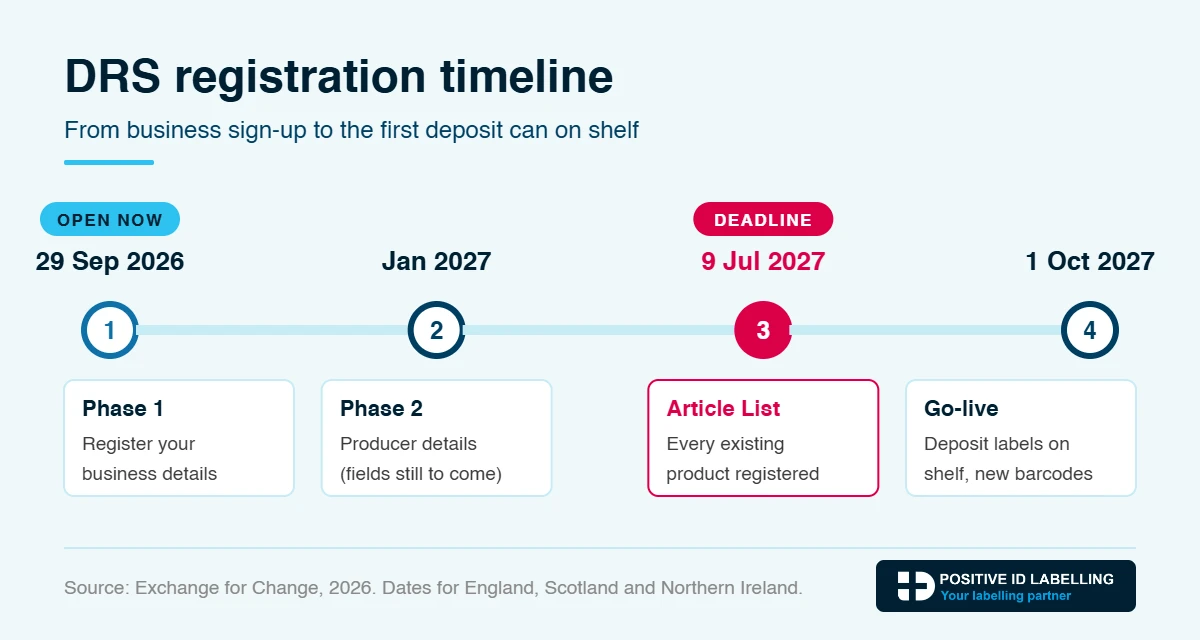
Registration happens in two parts: your business first, then each product.
Stage one: registering your business
Phase 1 opened on 29 September 2026. It asks for company details, contacts, trading names and addresses. There is no formal deadline, but Exchange for Change asks producers to complete it “as soon as possible”.
Phase 2 opens in January 2027. It will ask for information specific to your role as a producer. The exact Phase 2 data fields have not been published yet.
Stage two: registering every product
Each in-scope product must appear on the Scheme Article List. This list holds the product name, container details, barcode and deposit amount. It is updated daily and sent to reverse vending machines, so they recognise your container.
Existing products must be registered no later than 12 weeks before go-live, which is 9 July 2027. Later registrations are handled on “reasonable endeavours” only, so treat 9 July as your real deadline.
Under the England and NI regulations, retailers and wholesalers must not supply deposit items from an unregistered producer.
What Changes on Your Drinks Label
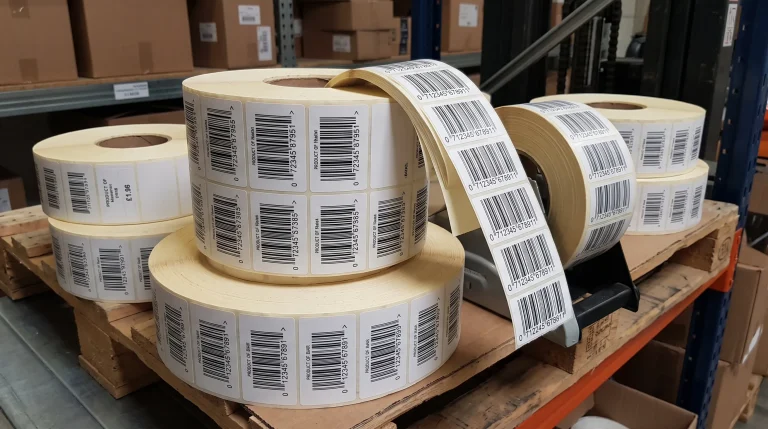
Two new elements appear on every in-scope container: the scheme logo and a new barcode. This guide covers the barcode. Our deposit return scheme labels guide covers the logo and existing stock.
New GTINs behind every DRS barcode
The new code is a fresh GTIN (Global Trade Item Number) registered with the scheme. International barcodes must change too, and may attract an extra charge on the producer fee. That figure has not been announced.
DRS barcode types and print quality
The Material Specification (v6, June 2026) accepts EAN-13, EAN-8, UPC-A and UPC-E. Each must be GS1-compliant and unique to the product. Print quality must meet ISO 15420 and hold Grade 1.5 (ISO 15416) for the whole life of the pack.
A barcode that scans on day one but scuffs in a crate fails.
Placing a DRS barcode on bottles and cans
Call 01332 864895 and we’ll check your barcode will print cleanly on the material you choose.
Planning Your Artwork and Print Runs
GS1 UK advises planning new GTINs early. Barcode work “should not be left until the final stages” of an artwork schedule. A simple order of play:
- Complete Phase 1 registration now.
- Allocate new GTINs through GS1 UK.
- Update label artwork with the new barcode and scheme logo.
- Register products on the Article List by 9 July 2027.
- Print compliant labels ready for the first fill after 1 October 2027.
Lock your final label design before registering. Changing a bottle’s label coverage, dimensions or material later means a new submission.
Exporting too? Products sold only outside the UK scheme should not carry the DRS logo or barcode. Many brands will need two label versions. Short digital runs make that affordable: our Xeikon prints at 1200dpi and our Screen UV inkjet at 600dpi, both giving crisp, sharp barcode labels. White polypropylene with a varnish or laminate helps labels survive ice, condensation and transit knocks.

I had an amazing experience working with Positive ID Labelling, especially Natalie. The labels were absolutely brilliant quality and exceeded my expectations. Natalie was fantastic throughout the whole process. Communication was amazing from start to finish. She was so helpful, guided me through everything, and made the whole experience stress free and enjoyable. She was also genuinely funny and a pleasure to work with, which made everything even better. I’ll definitely be working with Natalie again on future projects and would highly recommend Positive ID Labelling to anyone looking for high-quality labels and excellent customer service.

Fantastic label printing service. Labels to a very high specification. Helen was great at sorting out our requirements, quotes, and order.

We’ve had a great experience working with this supplier, especially with Natalie - she is always very responsive, professional, and friendly. The pricing is highly competitive and the sales service has been excellent from start to finish.If I could offer one suggestion, it would be to improve the account and invoice management process. It would be really helpful if there were a system for clients to easily track their past orders and invoices in one place.Overall, very pleased with the service and look forward to continuing our collaboration.

Natalie and Positive ID labelling were amazing. I have some really beautiful egg box labels that were exactly what I asked for. Brilliant communication and undertanding from everyone i dealt with. Pricing was good and I will not look any further for all my labelling needs. Thank you again!

Frequently Asked Questions
Do I have to change my existing barcodes for DRS?
Yes. Exchange for Change says all existing product barcodes must change for in-scope drinks. Each product needs a new GTIN registered on the Scheme Article List.
When is the deadline to register existing products?
9 July 2027, which is 12 weeks before go-live on 1 October 2027. Registrations after that date are on a “reasonable endeavours” basis only.
Is there a deadline for Phase 1 registration?
There is no formal deadline. Exchange for Change asks producers to register as soon as possible. Phase 2 opens in January 2027.
Which barcode formats does the scheme accept?
A DRS barcode can be EAN-13, EAN-8, UPC-A or UPC-E. Each must be GS1-compliant and unique to that product.
Where should the barcode go on a can?
At least 8mm from the base, readable at a 30° tilt. It must not sit on the top or the base of the can.
Do multipacks need separate barcodes?
Yes. Every container carries its own scheme barcode, and the outer multipack barcode should not match the containers inside.
Do low-volume products need registering?
Yes. Products under the low-volume limit (6,250 units per SKU in the first period, then 5,000 a year) are exempt from fees and the logo, but must still register and report volumes.
How long does registration take after launch?
After 1 October 2027, new products must be registered before going on sale. Standard containers reach the Article List within 2 weeks; non-standard ones within 4 weeks.
Does Positive ID Labels allocate GTINs?
No. GTINs come from GS1 UK, and you register products with Exchange for Change. We print your new labels and can advise on materials and finishes that keep barcodes readable.
Get Your DRS Labels Ready
July 2027 sounds far off, but artwork, GTINs, proofs and print all take time. Call 01332 864895 or use our enquiry form for a fixed-price quote. The price we quote is the price you pay.
Sources
- Exchange for Change, registration opens (29 Sep 2026): https://exchangeforchange.co.uk/news/exchange-for-change-opens-registration-for-deposit-return-scheme/
- Exchange for Change, Material Specification v6 (June 2026): https://exchangeforchange.co.uk/wp-content/uploads/2026/06/Exchange-for-Change-Material-Specification-FINAL-v6-June-2026.pdf
- Exchange for Change, FAQs: https://exchangeforchange.co.uk/faqs/
- SI 2025/67, deposit scheme regulations for England and Northern Ireland: https://www.legislation.gov.uk/uksi/2025/67/contents/made
- GS1 UK, DRS barcode readiness: https://www.gs1uk.org/insights/news/Exchange-for-Change-update-puts-DRS-barcode-readiness-on-the-agenda
Free download: DRS barcode and registration checklist (PDF). The actions from this guide as a printable checklist, with the key dates and sources.
Before you print
This post explains the rules as we understood them when it was last checked. It is general information, not legal advice, and we don’t check label content for compliance. The business selling the product is responsible for what its label says. For advice on your product, contact Exchange for Change or GS1 UK.
Last checked: 20 October 2026
Last edited:
Read our full disclaimer | See the latest rule changes | Get a fixed-price quote or call 01332 864895
Regulation Watch
Get Regulation Watch by email
Plain-English updates when a labelling rule changes for your products, with dates and what to do about your label stock. Pick the topics that matter to you.
- Only the topics you pick
- Key dates and what to do
- Unsubscribe any time