Unit Pricing on Shelf Labels: What UK Retailers Must Show
Unit pricing is the part of shelf edge labelling that retailers most often get wrong, and it is the part enforcement officers look at first. It is the price per kilogram, per litre or per item that lets a shopper compare a 400g jar against a 750g one without doing mental arithmetic in the aisle.
The short answer: where products are sold by weight, volume, length or number, the unit pricing must be shown alongside the selling price. It has to be unambiguous, easily identifiable and clearly legible, and it must use a consistent unit across comparable products so the comparison actually works.
Positive ID Labels can print shelf strips and blank stock for retailers across the UK. This guide covers what unit pricing has to show, how to lay it out so it stays legible, and the errors that cause problems.
Why Unit Pricing Exists
The purpose is comparison, not disclosure.
A customer looking at three jars of coffee in different sizes cannot reasonably work out which is better value while standing in an aisle. Unit pricing does that work for them by expressing every option in the same terms irrespective of the price gun label price.
That has a practical consequence worth understanding. The comparison only works if the unit pricing is consistent. If one jar shows a price per 100g and the one beside it shows a price per kilogram, the customer has to convert, and the requirement has failed in spirit even where the figures are technically correct.
Consistency across comparable products is the principle to hold onto. It answers most layout questions before they are asked.
Getting Unit Pricing Legible on a Small Strip
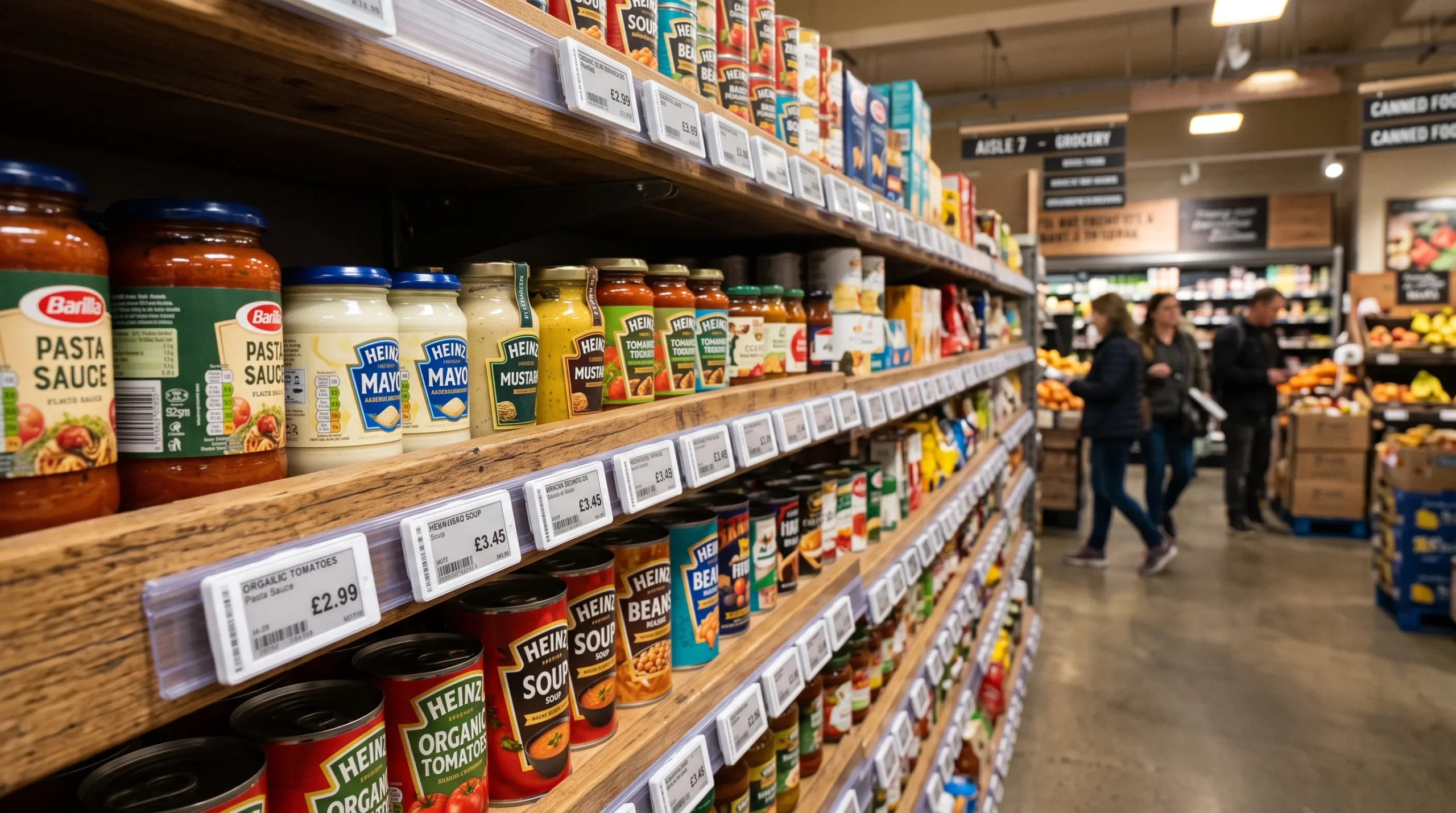
This is where the practical difficulty sits. A shelf strip is a small surface already carrying the selling price, the product description and often a barcode.
Three layout principles work reliably.
Where space is genuinely tight, a slightly deeper strip solves more problems than reducing type size. A 39mm strip gives noticeably more room than a 26mm one. If you are unsure what your rails will take, just measure with a ruler – we can make that width or a little wider to bow the unit pricing label slightly.
Unit Pricing Mistakes That Cause Problems
Five recur often enough to be worth listing.
That last one is the most common, and it is a process problem rather than a labelling one. If your shelf strips are generated from your EPOS system, the unit price should be calculated automatically from the selling price and pack size. If someone is typing it, it will eventually be wrong.
Printing Unit Pricing On Demand
Automatic calculation is the single biggest improvement most retailers can make here.
Software that pulls the selling price and the pack size from your system and derives the unit price removes the entire category of transcription error. Nobody is retyping anything, so nobody mistypes anything.
For a small retailer, a desktop thermal printer with the right labelling software and a cutter kit handles a few thousand strips a day and lets you reprice the same afternoon a price changes. For larger estates, bulk-printed strips for stable lines combined with on-demand printing for promotions is the usual arrangement.
Direct thermal material suits shelf strips well, because they are replaced long before the image would fade.
What About Loose and Weighed Goods?
Products sold loose from a counter, weighed at the point of sale, work differently from packaged goods on a shelf.
The price per kilogram is the selling price in that case, displayed on the ticket at the counter, and it is doing the comparison job directly.
Where you sell the same product both loose and prepacked, keeping the units consistent between the two helps customers considerably and avoids the appearance of a discrepancy.
Frequently Asked Questions
Which products need a unit price shown? Broadly, products sold by weight, volume, length or number where a customer would reasonably compare across sizes. Some small packs and certain product categories have exemptions, so check current guidance for your specific range rather than applying a blanket rule.
What unit should I use? Whichever allows fair comparison across the products a customer would consider alternatives, applied consistently. Per kilogram and per litre are common for larger items, per 100g and per 100ml for smaller ones. The important thing is that comparable products share the same unit.
Does the unit price have to be the same size as the selling price? No. The selling price is the primary information. The unit price must be clearly legible and easily identifiable, which is a lower bar than equal prominence, but it is a real bar. If a customer has to squint, it is too small.
What happens on promotional pricing? The unit price should reflect what the customer will actually pay. A promotional strip showing the original unit price alongside a reduced selling price is misleading and is the sort of thing that draws complaints.
Can I calculate unit prices automatically? Yes, and you should. Labelling software that derives the unit price from the selling price and pack size removes manual calculation entirely, which removes the most common source of error.
How often should shelf strips be checked? A spot check of ten random products a week takes five minutes and catches problems before customers or trading standards do. Focus on lines where prices change frequently, since those are where errors accumulate.
Getting Your Shelf Strips Right
If your unit pricing is being typed by hand, or your strips do not leave room for it legibly, both are solvable and neither is expensive.
Tell us what your rails look like, how often prices change and whether you print in store or order in bulk. We will advise on strip size, material and whether on-demand printing would save you time.
Call 01332 864895 or send your requirements through the enquiry form. We quote a fixed price over the phone, and most orders leave us within five working days.
Regulatory note: price marking requirements are set out in UK price marking legislation and enforced by local trading standards. Requirements vary by product category and are periodically updated, so confirm current guidance for your specific range.