Waterproof Stickers: When Do You Need Them?
A label gets wet and the ink runs. Text becomes illegible within hours. The adhesive fails, and the label floats off the bottle. Standard labels fail in wet conditions because they’re not designed to survive moisture, condensation, chemical spray, or outdoor exposure.
Waterproof stickers solve this problem but you don’t always need them. Understanding when waterproof stickers are necessary helps you avoid paying for capabilities you don’t require while ensuring important information stays readable where it matters.
The Difference Between Standard And Waterproof Stickers
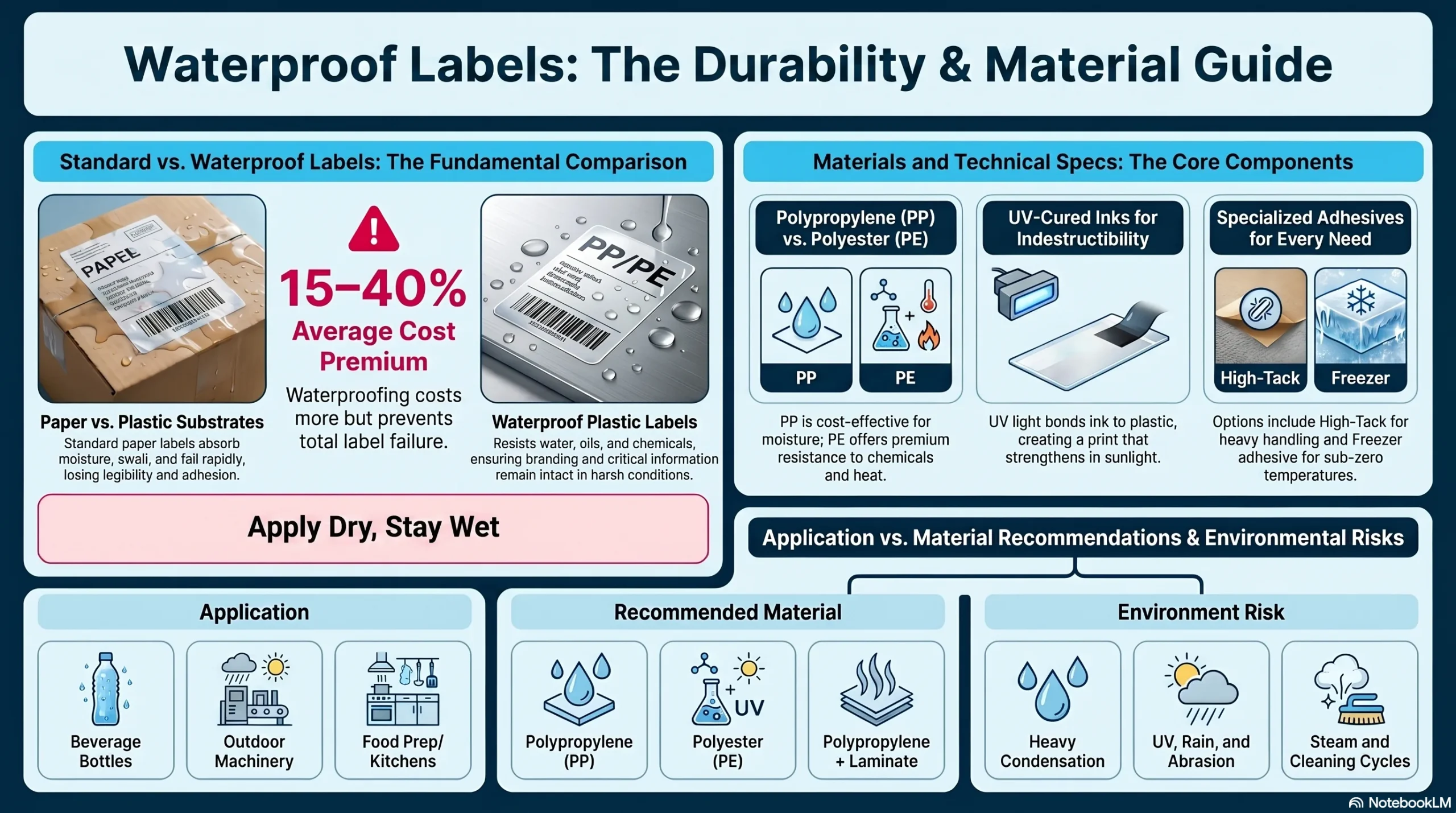
Standard labels use a paper substrate with standard adhesive. Paper absorbs moisture and swells. Ink smudges. Adhesive loses grip when wet. In dry environments — retail shelves, indoor storage, temperature-controlled warehouses — standard labels perform perfectly and cost less.
Waterproof stickers use a plastic substrate (polypropylene or polyester) with water-resistant adhesive. Plastic doesn’t absorb moisture. Ink bonds to plastic rather than soaking in. Adhesive maintains grip even when wet. In wet environments, waterproof labels stay legible and secure where standard labels fail within hours.
The trade-off: waterproof labels cost more. They’re worth the cost in wet conditions. In dry conditions, they’re an unnecessary expense.
Applications That Require Waterproof Stickers
Beverage bottles — Condensation forms immediately on cold bottles. Labels get wet. Standard labels fail. Waterproof labels keep product information, ingredients, and branding visible and secure.
Outdoor products — Garden tools, outdoor furniture, equipment stored outdoors. Rain exposure means standard labels fail. Waterproof labels survive seasons of outdoor storage.
Chemical and cleaning products — Splash zones, spill risks, storage in damp environments. Labels must survive chemical contact and moisture. Waterproof substrate resists both.
Food preparation equipment — Commercial kitchens, food production lines, washing areas. Moisture from steam, cleaning, and food handling degrades standard labels. Waterproof labels maintain legibility and stay adhered through cleaning cycles.
Refrigerated products — Frozen foods, chilled beverages, and medical refrigeration. Condensation forms on packaging. Standard labels deteriorate. Waterproof labels maintain compliance labels and product information through the entire cold chain.
Outdoor machinery and tools — Construction equipment, agricultural machinery, and tools stored in damp sheds. Exposure to rain, mud splatter, and humidity. Waterproof labels survive conditions that destroy paper.
Choosing Materials for your Waterproof Stickers
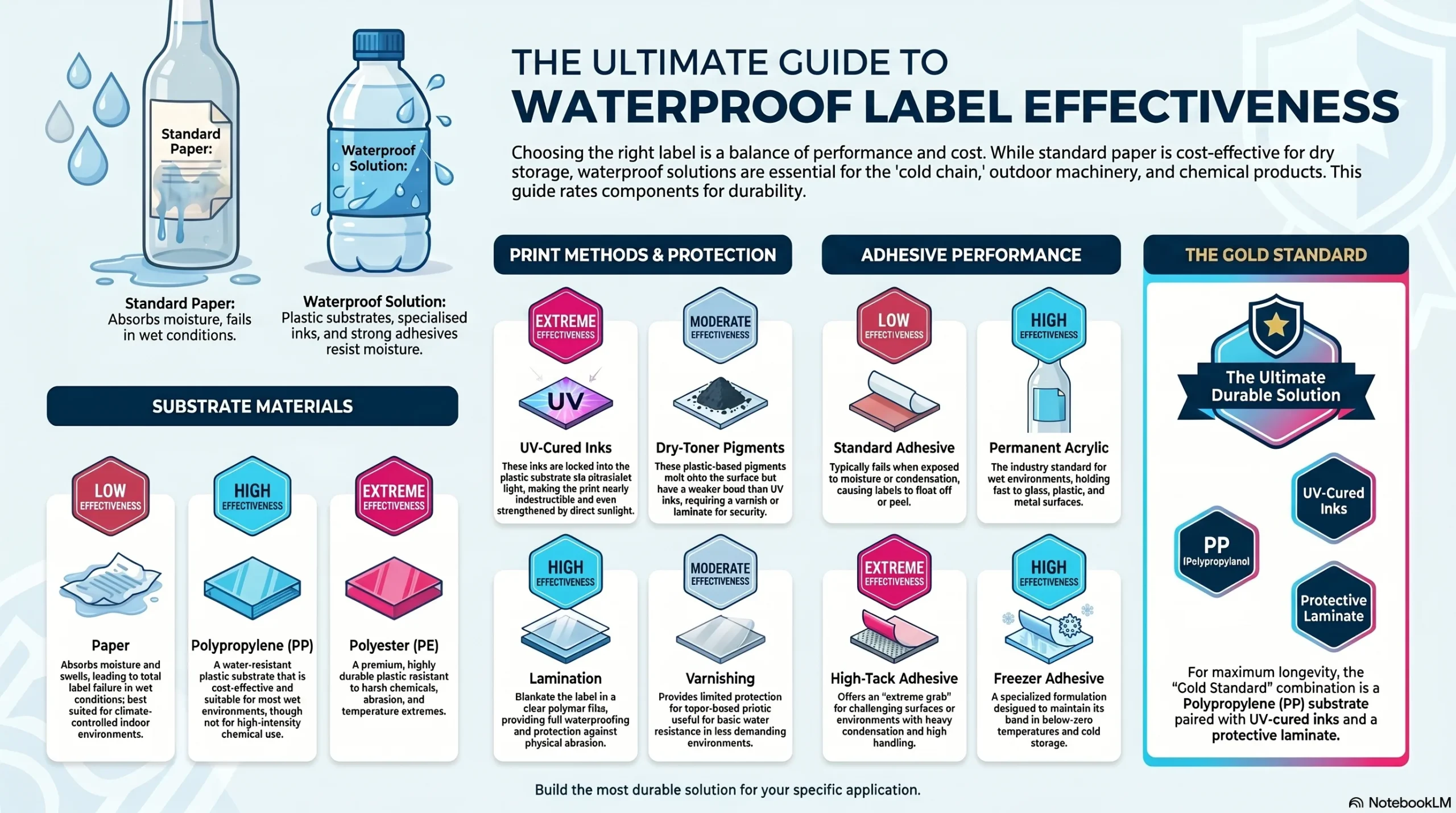
Polypropylene (PP): Plastic substrate, water-resistant, resistant to most chemicals. Cost-effective waterproof option. Suitable for wet environments but not chemical-intensive applications.
Polyester (PE): Plastic substrate, extremely durable, resistant to harsh chemicals, temperature extremes, and abrasion. Premium waterproof option. Best for chemical products, outdoor industrial use, and extreme conditions.
Clear PP or Silver PP or polyesters: Transparent substrate creates “no-label look” when applied to bottles. Text appears printed directly onto the surface. Premium aesthetic for high-end beverages and chemical products. Silver substrates can be overprinted with white ink, leaving silver parts which can be printed with any colour to give a faux-foil effect at a fraction of the cost.
Print Method for Waterproof Sticker Labels
Using man-made polymer materials means they are unsuitable for water-based inks. This leaves us with two print methods to ensure your waterproof stickers perform as expected:
UV-cured inks: UV inks are cured using ultraviolet light (UV). The UV light changes the chemical structure of the ink, which locks the colours into place. On plastic materials, the chemical change also binds the ink into the substrate face. This makes the print hold fast to the material. A combination of polypropylene and UV ink is nearly indestructible.
Furthermore, the ink actually strengthens its bond to the material in direct sunlight as the UV light from the sun continues the chemical reaction.
Dry-Toner pigments: Dry-toner is a plastic that melts onto the substrate face. The bond is weaker than that of UV-cured inks. As such, we recommend at least using a varnish to lock the toner into place, or for belt and braces, a laminate.
Lamination: Laminating the material adds a layer of durability. It effectively blankets the entire label in a thin but durable, waterproof film. In its simplest terms, it is like placing selotape over the label to ensure the ink is not damaged or disturbed by any physical abrasion. Being made from a clear polymer, the labels become fully waterproof.
Lamination can be used in some circumstances with paper-based substrates, but given that you will be using a polymer laminate, there is little to no environmental benefit, and there will likely be lower waterproofing.
A polypropylene substrate with a UV ink and a gloss or matte laminate is the most durable face solution for waterproof stickers.
Varnishing: Varnishing will provide limited protection for dry-toner based print. On UV-cured inks, it is totally unnecessary apart from presentation.
In less demanding environments that do not necessarily require full waterroof capability, a matte or gloss varnish can support some water resistance at a lower cost than lamination. If you only need water-resistant stickers, a varnish may be all you need for dry-toner inks.
Adhesive Selection For Waterproof Labels
Standard adhesive fails on wet surfaces. Waterproof labels use enhanced adhesive formulations designed for moisture environments.
Permanent acrylic adhesive: Works on dry surfaces at the point of application. Holds on glass, plastic, and metal. Suitable for most wet-environment applications.
High-tack adhesive: Extreme grab for challenging surfaces or high-handling environments. Maintains grip even under condensation or moisture contact.
Freezer adhesive: Formulated for below-zero temperatures. For frozen food products and cold storage applications.
When Standard Labels Are Sufficient
Retail shelf products in climate-controlled environments don’t need waterproof labels. Indoor storage in dry conditions doesn’t require waterproof. Products handled briefly before consumption don’t need premium durability. In these cases, standard labels work fine and save cost.
FAQ: Waterproof Label Questions
Q: Are waterproof labels truly waterproof? A: That depends on the construction of the parts of the label. They survive wet conditions and condensation. True waterproofing depends on adhesive type and surface conditions. Test in your specific environment before committing to large orders – call us on 01332 864895 to find out more.
Q: How much more do waterproof labels cost? A: Typically 15-40% premium over standard labels, depending on material and order volume. Exact cost depends on size, quantity, and adhesive specification.
Q: Can I use waterproof labels in dry conditions? A: Yes. They work fine in dry environments. You’re paying for durability you don’t need, but they perform perfectly.
Q: What surface conditions allow waterproof labels to stick? A: Clean, dry surfaces at application. Then, waterproof labels handle wet conditions. If you’re applying labels to wet surfaces, you need special wetproof adhesive — a different product.
Q: Do waterproof labels work on curved bottles? A: Yes, on most plastic and glass bottles. Test on your specific bottle shape and material before large orders.
Q: How long do waterproof labels last outdoors? A: Depending on sun exposure, temperatures, and conditions: 6 months to 2 years. UV exposure fades ink faster than wet exposure degrades adhesive – but UV inks can last for years, even in direct sunlight.
Getting Waterproof Stickers Right
Waterproof sticker labels solve real problems in wet environments. They maintain compliance labelling, product information, and branding where standard labels fail. They’re worth the cost where moisture is present; unnecessary where it isn’t.
At Positive ID Labels, we supply waterproof labels in polypropylene and polyester, with adhesives suited to your specific environment and handling conditions. We help you choose the right material and adhesive for your application.
Need waterproof labels for your product? Call us on 01332 864895. Describe your environment, product type, and storage conditions. We’ll recommend the right waterproof solution.
Waterproof labels keep your information legible where standard labels fail.