
QUID Declaration: Complete UK Guide to Quantitative Ingredient Declarations on Food Labels
A QUID declaration tells consumers the percentage of certain key ingredients in a food product. It is a legal requirement under UK food labelling law for prepacked foods, and it applies whenever specific ingredients are highlighted or named in a way that influences a customer’s purchasing decision.

QUID stands for Quantitative Ingredient Declaration. Despite the formal name, the concept is straightforward: if you draw attention to an ingredient on your label, you must tell the consumer how much of it is actually in the product. This guide explains when QUID is required, how to calculate the percentages, the exemptions that apply, and common mistakes to avoid.
Table of Contents
- What Is a QUID Declaration?
- Legal Basis for QUID in the UK
- When Is a QUID Required? The Three Triggers
- Practical Examples of Each Trigger
- How to Calculate a QUID Percentage
- QUID for Cooked Foods and Products That Lose Weight
- QUID for Concentrated and Dehydrated Products
- Where to Display the QUID on Your Label
- When QUID Is Not Required: Exemptions
- Special Rules: QUID for Meat Products
- QUID and Compound Ingredients
- Rounding and Accuracy
- Common QUID Mistakes to Avoid
- Frequently Asked Questions
What Is a QUID Declaration?
A QUID declaration is a percentage figure on a food label that tells the consumer how much of a particular ingredient is in the product. It appears either in brackets next to the ingredient in the ingredients list, or alongside the name of the food.
For example, if you sell a “Chicken and Bacon Sandwich”, consumers might reasonably want to know how much chicken and how much bacon is actually in it. A QUID declaration answers that question directly on the label, typically appearing as something like: “Chicken Breast (26%), Smoked Bacon (8%)” in the ingredients list.
QUID declarations have been a legal requirement for prepacked foods in the UK since February 2000. They are designed to help consumers make informed choices, particularly when comparing similar products from different manufacturers. A “strawberry yoghurt” containing 12% strawberries is a very different product from one containing 2%, and the QUID declaration makes that difference transparent.
Legal Basis for QUID in the UK
The requirement for QUID declarations is set out in Article 22 and Annex VIII of assimilated Regulation (EU) No 1169/2011 on the provision of food information to consumers (commonly known as FIC). This regulation is the same legislation that governs general food labelling requirements, allergen declarations, and nutrition information.
Since leaving the EU, the UK has retained this legislation as assimilated law, meaning the same QUID rules continue to apply in Great Britain. Northern Ireland continues to follow EU food law directly under the Windsor Framework.
QUID applies primarily to prepacked food. However, there is one important exception: foods containing meat must include a QUID for the meat content even when sold non-prepacked or prepacked for direct sale. This is the only QUID requirement that extends beyond prepacked food.
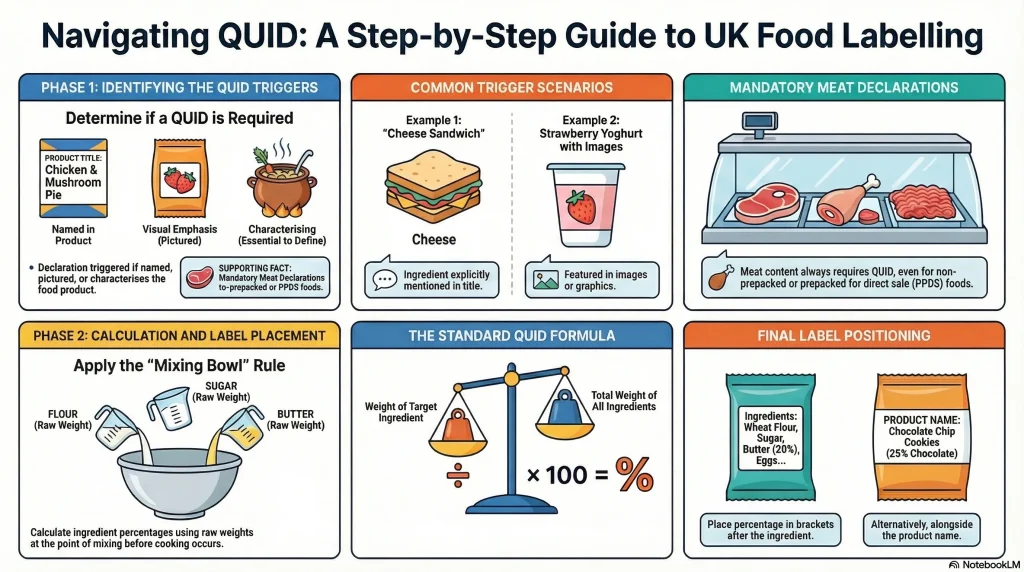
When Is a QUID Required? The Three Triggers
A QUID declaration is required when an ingredient or category of ingredients meets any one of three trigger conditions. If none of these triggers apply, no QUID is needed for that ingredient.
Trigger 1: The Ingredient Appears in the Name of the Food
If an ingredient is named or usually associated with the product name, a QUID is required. This is the most common trigger. Examples include:
- “Cheese Sandwich” – requires a QUID for the cheese
- “Chicken and Mushroom Pie” – requires a QUID for both chicken and mushroom
- “Strawberry Yoghurt” – requires a QUID for the strawberries
- “Pork Sausages” – requires a QUID for the pork
- “Tuna Mayonnaise” – requires a QUID for both tuna and mayonnaise
This trigger also covers ingredients that consumers commonly associate with a product name, even if the ingredient is not explicitly stated. For example, “Shepherd’s Pie” does not mention lamb, but consumers commonly associate the product with lamb, so a QUID for the lamb content would be required. Similarly, “Summer Pudding” would require a QUID for the fruit content.
Trigger 2: The Ingredient Is Emphasised on the Label
If an ingredient is highlighted or drawn to the consumer’s attention through words, pictures or graphics on the label, a QUID is required. This includes:
- Promotional flashes such as “with extra cream” or “made with real butter”
- Images showing a specific ingredient, such as a picture of prawns on a seafood product
- Marketing claims that highlight a particular ingredient, such as “Now with more chocolate”
Be careful with label imagery. If your mixed fruit yoghurt label features a large photograph of strawberries but the product also contains other fruits, you may trigger a QUID requirement for the strawberries specifically, even if “strawberry” does not appear in the product name.
Note that allergen warnings (such as “contains milk”) do not trigger a QUID requirement. These are mandatory safety declarations, not promotional emphasis.
Trigger 3: The Ingredient Characterises the Food
If an ingredient is essential to characterise a food and to distinguish it from other products with a similar name or appearance, a QUID is required. This trigger is less common but important when products could otherwise be confused.
For example, a lasagne made with pork rather than the traditional beef would need a QUID for the pork, because the type of meat characterises the product and distinguishes it from a standard beef lasagne. Similarly, a “chocolate cake” made with carob instead of cocoa would need to be clearly distinguished, potentially triggering a QUID requirement.
Practical Examples of Each Trigger
To illustrate how the three triggers work in practice, here are some common food products and the QUID requirements that apply:
| Product | Trigger | QUID Required For |
|---|---|---|
| Ham and Cheese Toastie | Named in product name | Ham (X%), Cheese (X%) |
| Vegetable Soup | Named in product name | Vegetables (X%) as a category |
| Cornish Pasty “with extra beef” | Name + emphasis | Beef (X%) |
| Mixed Berry Jam with label showing raspberries | Emphasis (image) | Raspberries (X%) |
| Lancashire Hot Pot | Consumer association | Mutton or Lamb (X%) |
| Pork Lasagne | Characterises the food | Pork (X%) |
| Plain Flour Tortilla | No trigger met | No QUID needed for flour |
How to Calculate a QUID Percentage
QUID is calculated at the “mixing bowl” stage of production, meaning you use the weight of the ingredients at the point they go into the product, before any cooking takes place.
The formula is straightforward:
QUID % = (Weight of the ingredient / Total weight of all ingredients) x 100
Worked Example: Cheese Sandwich
A simple cheese sandwich contains three ingredients by weight:
| Ingredient | Weight | Calculation | QUID % |
|---|---|---|---|
| Bread | 80g | 80 / 130 x 100 | 62% |
| Margarine | 15g | 15 / 130 x 100 | 12% |
| Cheddar Cheese | 35g | 35 / 130 x 100 | 27% |
| Total | 130g |
Because the product is called a “Cheese Sandwich”, only the cheese triggers a QUID requirement. The ingredients list would show: “…Cheddar CHEESE (27%)…”
You are permitted to declare QUID percentages for all ingredients (a “full declaration”), even where only one or two ingredients trigger the requirement. This is not compulsory, but some businesses prefer to do it for transparency and because it avoids the complexity of determining which ingredients need a declaration and which do not.
Worked Example: Chicken and Bacon Sandwich
| Ingredient | Weight | QUID % |
|---|---|---|
| Bread | 80g | 47% |
| Chicken Breast | 45g | 26% |
| Mayonnaise | 20g | 12% |
| Smoked Bacon | 15g | 9% |
| Lettuce | 10g | 6% |
| Total | 170g |
The product name “Chicken and Bacon Sandwich” triggers QUID for both chicken and bacon. The ingredients list would show the percentages for each: “…Chicken Breast (26%)… Smoked Bacon (9%)…”
QUID for Cooked Foods and Products That Lose Weight
Cooking typically causes moisture loss, which means the finished product weighs less than the combined weight of the raw ingredients. This creates a particular challenge for QUID calculations.
The general rule is that QUID is calculated at the mixing bowl stage, using the raw ingredient weights before cooking. However, where the product has lost moisture during heat treatment, and the resulting QUID percentage would exceed 100% (because the ingredient weight is being divided by a smaller finished product weight), the regulations provide two options:
- Option A: Express the QUID as a percentage of the raw ingredients going into the product (the mixing bowl approach). This is the default and simplest method.
- Option B: If the percentage would exceed 100% when all QUID ingredients are totalled, express the quantity on the basis of the weight of ingredients used to prepare 100g of finished product.
In practice, Option A works for most products. The key point is to be consistent in your approach and ensure the percentage accurately reflects the proportion of the ingredient used.
For example, if you make a bolognese sauce with 400g of minced beef and 600g of other ingredients (tomatoes, onions, herbs, etc.) totalling 1,000g of raw ingredients, and the sauce reduces to 800g after cooking:
- Mixing bowl QUID: Beef = 400g / 1,000g x 100 = 40%
- This is perfectly valid because the total QUID percentages do not exceed 100% using the raw weights.
QUID for Concentrated and Dehydrated Products
For products made with concentrated or dehydrated ingredients that are reconstituted during manufacture (such as fruit juice concentrate added to a drink), the QUID may be calculated based on the weight of the ingredient before concentration or dehydration.
For concentrated or dehydrated foods intended to be reconstituted by the consumer (such as dried soup mixes or squash), the QUID can be given based on the proportions as reconstituted, provided the directions for reconstitution are given on the label.
Where to Display the QUID on Your Label
The QUID percentage can appear in one of two places on your food label:
- In the ingredients list: In brackets immediately after the ingredient name. This is the most common approach. For example: “…Chicken Breast (26%), Smoked Bacon (9%)…”
- In or next to the name of the food: The percentage can accompany the product name instead. For example: “Sausage Roll (20% Pork)”
Either placement is legally acceptable. Most manufacturers use the ingredients list approach as it keeps all quantitative information in one place, making the label easier to read. Whichever approach you choose, be consistent across your product range.
When QUID Is Not Required: Exemptions
Not every ingredient that appears on a label needs a QUID declaration. There are several important exemptions:
Flavouring Ingredients Used in Small Quantities
Ingredients used only in small quantities for flavouring purposes do not require a QUID. For example, a “Lemon Drizzle Cake” might use lemon juice purely as a flavouring in small quantities. However, this exemption is narrow: if the lemon is a significant component of the product rather than just a flavouring, a QUID would be required.
Variable-Proportion Mixed Ingredients
Where a product contains a mixture of fruits, vegetables, mushrooms, herbs, or spices, and none of these significantly predominates in terms of weight, and the proportions are likely to vary between batches, no QUID is required for the individual components. This exemption commonly applies to products such as “Vegetable Soup” where the mix of vegetables changes, or “Mixed Herb Seasoning” where no single herb dominates.
Sweeteners in Mandatory Statements
If the only reason sweeteners appear in the product name is because of the mandatory statement “with sweeteners” (required by law), no QUID is needed. However, if you voluntarily draw attention to a specific sweetener (such as “Now with stevia”), a QUID for that sweetener would be required.
Quantities Already Declared Under Other Legislation
If the quantity of an ingredient must already be declared under other specific legislation, a separate QUID is not required. Examples include cocoa solids in chocolate (governed by the Cocoa and Chocolate Products Regulations) and fruit and sugar content in jam (governed by the Jam and Similar Products Regulations).
Vitamins and Minerals in Nutrition Declarations
If vitamins and minerals are emphasised on the label, any nutrition or health claim triggers the need for a nutrition declaration, which will include the relevant amounts. A separate QUID is not required in this case.
Drained Weight Products
Where a drained net weight is already indicated on the label (for products in liquid, such as olives in brine), a QUID for that ingredient is not required.
Naturally Present Constituents
QUID does not apply to constituents that are naturally present in a food and have not been added as ingredients. For example, caffeine is naturally present in coffee and does not require a QUID declaration.
Non-Prepacked and PPDS Foods (Except Meat)
QUID requirements generally apply only to prepacked food. Non-prepacked foods and prepacked for direct sale (PPDS) foods do not need QUID declarations, with the sole exception of meat content (see below). But just because it may not be required is not a reason not to include it – Positive ID Labelling supplies food labelling software solutions that automate the inclusion of QUID values and ingredient ordering in your ingredient lists free of charge to labelling customers.
Special Rules: QUID for Meat Products
Meat has unique QUID rules that go beyond the standard requirements for other ingredients:
QUID for Meat in Non-Prepacked and PPDS Food
The percentage of meat must be declared for any food containing meat, regardless of whether it is prepacked, non-prepacked, or prepacked for direct sale. This is the only QUID requirement that extends beyond prepacked food. It means that a sandwich shop selling sandwiches prepacked for direct sale must declare the meat content as a QUID, even though no other QUID declarations are needed for PPDS food.
The information must appear either on a label on the food or on a notice in close proximity to the product (such as a shelf-edge label or chalk board).
What Counts as “Meat” for QUID Purposes
The definition of meat for QUID purposes is specific. It means the skeletal muscle of an animal, including naturally attached or embedded fat and connective tissue, but only up to defined maximum limits. Fat and connective tissue above these limits is not counted as “meat” and, if the limits are exceeded, must be declared separately in the ingredients list.
Mechanically separated meat (MSM) cannot be counted in the QUID for meat content. Where more than one type of meat is used, the content of each must be declared separately, for example: “Chicken (26%), Pork (8%)”.
QUID and Compound Ingredients
A compound ingredient is an ingredient that is itself made up of multiple ingredients, such as bread (which contains flour, water, yeast, salt, etc.) or mayonnaise (which contains oil, egg, vinegar, etc.).
If a compound ingredient appears in the name of the food, the compound ingredient itself requires a QUID, not necessarily its individual components. For example, “Seafood Lasagne” requires a QUID for the “seafood” as a whole. However, if the product name specifies individual components within the compound ingredient, those components would need their own QUID declarations.
When listing compound ingredients in the ingredients list, you must break them down into their component parts, with the compound ingredient’s QUID appearing alongside its name and the sub-ingredients listed in brackets. For example:
“…Cheddar CHEESE (27%) [Pasteurised MILK, Salt, Rennet]…”
Rounding and Accuracy
QUID percentages may be rounded to the nearest whole number, or to the nearest 0.5% if greater precision is preferred. Most food businesses round to the nearest whole number for simplicity.
The percentage should reflect the typical composition of the product. Where ingredient proportions vary slightly between batches (as is common in artisan food production), the declared QUID should represent the average or typical value rather than the exact figure for a particular batch.
Be aware that rounding can occasionally cause the total of all declared percentages to exceed or fall short of 100%. This is acceptable and expected. Trading Standards officers understand that rounding will produce these small discrepancies.
Common QUID Mistakes to Avoid
- Forgetting to update QUID after recipe changes: If you change your recipe, even slightly, the QUID percentages will change. A common enforcement finding is labels with outdated QUID figures that no longer match the actual recipe. Always recalculate when recipes are amended.
- Missing QUID for pictorial emphasis: Many businesses forget that images on labels can trigger a QUID requirement. If your label shows a picture of a specific ingredient, you may need a QUID for it, even if the ingredient is not mentioned in the product name.
- Using finished weight instead of mixing bowl weight: QUID is calculated using the weight of ingredients as they go into the product, not the weight of the finished product after cooking. Using finished weights will overstate the percentage and could be misleading.
- Omitting meat QUID from PPDS foods: Even if your sandwiches are prepacked for direct sale, any that contain meat must still declare the meat content as a QUID. This is the one QUID requirement that applies to PPDS food.
- Confusing QUID with ingredients list order: QUID declarations and the order of the ingredients list are related but different things. The ingredients list is ordered by weight (heaviest first). The QUID declaration is a separate percentage figure for specific triggered ingredients. You can have an ingredient that appears low in the list order but still requires a QUID because it is named in the product title.
- Not declaring QUID for associated ingredients: Remember that consumer association can trigger QUID, not just the literal product name. “Shepherd’s Pie” requires a QUID for lamb, and “Fish and Chips” requires a QUID for fish, even if the specific ingredient is not spelled out in the name.
- Declaring QUID for allergen warnings: Mandatory allergen declarations (such as “contains: milk, eggs”) do not trigger QUID. These are safety statements, not ingredient emphasis. Do not add QUID percentages to allergen warnings.
Frequently Asked Questions
Do I have to declare QUID for every ingredient?
No. QUID is only required for ingredients that meet one of the three triggers: appearing in the product name (or being commonly associated with it), being emphasised on the label through words or pictures, or being essential to characterise the food and distinguish it from similar products. However, you are free to voluntarily declare QUID for all ingredients if you prefer, and some businesses choose to do this.
Is QUID the same as listing ingredients in weight order?
No. The requirement to list ingredients in descending order of weight is a separate obligation under the food labelling regulations. QUID is an additional requirement to declare specific percentage figures for certain ingredients. You must do both: list ingredients in weight order and provide QUID percentages where triggered.
Do I need QUID on sandwiches made for direct sale?
Generally, no. QUID requirements apply to prepacked food, not prepacked for direct sale (PPDS). The sole exception is meat content: if your PPDS sandwich contains chicken, bacon, ham or any other meat, you must declare the percentage of meat. Other ingredients in PPDS foods do not require QUID declarations.
How accurate does the QUID percentage need to be?
The QUID should accurately represent the typical composition of the product. You may round to the nearest whole number or to 0.5%. Minor batch-to-batch variation is expected and acceptable, but the declared QUID should reflect the normal recipe proportions. If a Trading Standards officer tests your product and the actual percentage is significantly different from the declared QUID, this could be considered non-compliant.
What about water added during manufacturing?
Added water is treated as an ingredient and should be included in the total weight when calculating QUID. However, water or other volatile ingredients need not have a QUID of their own. Water used to reconstitute a concentrated or dehydrated ingredient is generally not listed separately, as the reconstituted ingredient is the one that appears in the ingredients list.
Does QUID apply to single-ingredient foods?
No. Single-ingredient foods (such as a packet of rice, a bag of sugar, or a jar of honey) do not require a QUID declaration because the product is inherently 100% of that ingredient. Products that are not required to carry an ingredients list are similarly exempt from QUID, although if a QUID trigger is met, the declaration would still be required even without a full ingredients list.
Can software help with QUID calculations?
Yes. Calculating QUID manually for products with many ingredients can be time-consuming and error-prone. Our Nutridata software automatically calculates QUID percentages from your recipes, listing all ingredients in the correct quantitative order with accurate percentage declarations. This eliminates manual calculation errors and ensures your labels stay compliant when recipes change.
Get Your QUID Declarations Right with PID Labelling
Accurate QUID declarations are just one part of compliant food labelling. At PID Labelling, we help food businesses across the UK produce labels that meet all regulatory requirements, from ingredient lists and allergen declarations to QUID percentages and nutrition information.
Our Nutridata software takes the pain out of QUID calculations by automatically computing percentages from your recipes and ordering ingredients correctly. Combined with our thermal printing systems and custom food labels, we provide a complete labelling solution for food businesses of all sizes.
Whether you produce sandwiches, bakery products, meat products, or any other prepacked food, we can help you get your labels right.
Call us on 01332 864895 to discuss your labelling requirements, or fill in our contact form and we will get back to you.
Related products and guides
- For deeper background, see our ingredients labelling guide.
- The full technical detail sits in our net quantity.

I had an amazing experience working with Positive ID Labelling, especially Natalie. The labels were absolutely brilliant quality and exceeded my expectations. Natalie was fantastic throughout the whole process. Communication was amazing from start to finish. She was so helpful, guided me through everything, and made the whole experience stress free and enjoyable. She was also genuinely funny and a pleasure to work with, which made everything even better. I’ll definitely be working with Natalie again on future projects and would highly recommend Positive ID Labelling to anyone looking for high-quality labels and excellent customer service.

Fantastic label printing service. Labels to a very high specification. Helen was great at sorting out our requirements, quotes, and order.

We’ve had a great experience working with this supplier, especially with Natalie - she is always very responsive, professional, and friendly. The pricing is highly competitive and the sales service has been excellent from start to finish.If I could offer one suggestion, it would be to improve the account and invoice management process. It would be really helpful if there were a system for clients to easily track their past orders and invoices in one place.Overall, very pleased with the service and look forward to continuing our collaboration.

I inadvertently ordered the incorrect label guns which was quickly sorted by Natalie. She was excellent, customer service at its best! Thank you once again

All food labelling guides are provided in good faith for information purposes only and do not constitute legal advice. For specific compliance questions about specific labelling laws, contact a specialist or contact your local Trading Standards authority. Read our Regulatory Information Disclaimer