
Ingredients Labelling Guide: Complete UK Compliance Guide
Getting ingredients labelling wrong is one of the easiest ways to fall foul of Trading Standards. A missing additive, an undeclared compound ingredient, allergens without emphasis — any of these can trigger enforcement action, costly recalls, and serious reputational damage.
This guide explains what UK food law requires, who it applies to, and how to write a compliant ingredients list. At Positive ID Labels, supply food labelling software and we produce food labels for businesses of all sizes. Call 01332 864895 if you need help turning these requirements into labels that work.
What Is Ingredients Labelling — and Who Must Comply?
Ingredients labelling is the legal requirement to list every ingredient in a multi-ingredient food product on its packaging. It is governed by the Food Information Regulations 2014, which retained EU Regulation No 1169/2011 (the FIC Regulation) into UK law.
Any food business supplying prepacked food with two or more ingredients — including additives — must provide a compliant ingredients list. That covers manufacturers, retailers, online sellers, and importers. Single-ingredient foods and certain fresh, unprocessed products may be exempt — verify with your local Trading Standards service.
How to Structure a Compliant Ingredients List
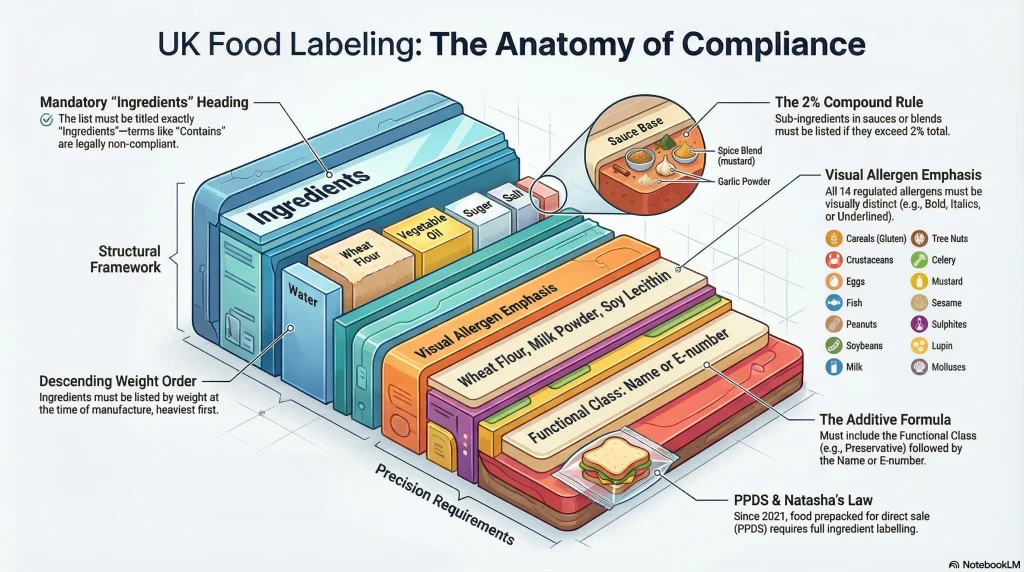
The heading must read “Ingredients” — not “Contains” or any variation. The list must then follow these rules.
Descending Weight Order — the Core Ingredients Labelling Rule
All ingredients must appear in descending order of weight at the time of manufacture — heaviest first. Ingredients present at 2% or less may be listed in any order, but only after all “above 2%” ingredients have appeared. This gives manufacturers flexibility with minor additives and preservatives.
Water added to a product must be declared. The only exception is water in a separately declared brine or marinade, or water fully driven off during cooking.
Compound Ingredients: What Must Be Broken Down
A compound ingredient — a sauce, spice blend, or dressing — is made up of multiple components. Under food labelling law, compound ingredients must have their sub-ingredients listed within the main ingredients list, unless the compound makes up less than 2% of the finished product.
Example: If a pizza topping contains tomato sauce, its sub-ingredients (tomatoes, olive oil, garlic, basil) must appear in the full list if the sauce exceeds 2% of the pizza.
Additives in Your Ingredients List: Function, Name, and E Number
Additives cannot be listed by name alone. Ingredients labelling law requires the functional class (e.g., “Preservative”, “Emulsifier”) followed by either the specific name or the E number — both are required together, neither alone is sufficient.
Example: “Preservative: Sodium Nitrite” or “Preservative: E250.”
You can read all about E-Numbers in our E-Numbers Labelling Guide or investigate E Numbers in our search tool here:
UK Food Additive & E Number Search Tool
Search by E number (e.g. E102) or by name (e.g. tartrazine, lecithin, aspartame)
This tool is provided for reference only. Always verify additive status and labelling requirements against the FSA approved additives list and assimilated Regulation (EC) 1333/2008. Need compliant food labels? Call Positive ID Labels on 01332 864895.
Flavourings may be listed simply as “Flavouring” without disclosing specific names. Modified starches may be declared as “Modified Starch” unless the source is a potential allergen, in which case it must be named.
Allergen Emphasis Within the Ingredients List
The 14 allergens must appear and be visually emphasised to stand out from surrounding text. Bold, italics, underlining, capitalisation, or a different background colour all satisfy the requirement. Emphasis applies every time an allergen appears — including within compound ingredient declarations.
The 14 allergens are: cereals containing gluten (wheat, rye, barley, oats), crustaceans, eggs, fish, peanuts, soybeans, milk, tree nuts, celery, mustard, sesame seeds, sulphur dioxide/sulphites (above 10mg/kg or litre), lupin, and molluscs.
Read more about allergen labelling in our Comprehensive Allergen Labelling Guide
PPDS and Natasha’s Law: What Changed for Ingredients Labelling
Before October 2021, prepacked for direct sale (PPDS) foods — sandwiches wrapped in-store, on-site bakery items, deli products packaged on the premises — were not required to carry a full ingredients list. That changed with Natasha’s Law. Read more in our Natasha’s Law Labelling Guide.
Since October 2021, all PPDS food must carry a full ingredients list with allergens emphasised, in line with standard prepacked food requirements. For small bakeries, delis, and food-to-go businesses, this was a significant operational change.
Ingredients Labelling Exemptions: When Is No List Required?
A full ingredients list is not required for: single-ingredient foods where the name makes the content obvious; unprocessed fresh fruit and vegetables sold loose; carbonated water where the name is clear; and certain cheeses, butter, and fermented milks or creams.
Ingredients Labelling for Non-Prepacked Foods
Loose and non-prepacked foods — sold from a deli counter, bakery display, or market stall — do not require a written ingredients list. However, allergen information must still be made available in writing, verbally, or via signposting. Many businesses opt for written formats to reduce risk and remove reliance on staff knowledge.
Frequently Asked Questions
Must water appear in the ingredients list?
Yes — if added water is present in the finished product, it must be listed in weight order. The exception is water fully evaporated during cooking or used in a separately declared marinade or brine.
Can I list compound ingredients without breaking them down?
Only if the compound makes up less than 2% of the finished product. Above that threshold, sub-ingredients must be declared.
What if I use an E number but don’t state the function?
Your label would be non-compliant. Both the functional class and the specific name or E number are required together.
Do allergens need emphasis inside compound ingredient declarations?
Yes. Emphasis applies throughout the entire ingredients list, including within compound ingredient breakdowns.
My product is PPDS — do I still need a full ingredients list?
Yes. Since October 2021, all PPDS foods require a complete ingredients list with allergens emphasised, regardless of business size.
What is the difference between ingredients labelling and QUID?
The ingredients list tells consumers what is in the product. QUID goes further, requiring you to state the percentage of certain characterising ingredients. Read our QUID declaration guide for full details.
Get Labels That Tick Every Compliance Box
Ingredients labelling is detailed — but it does not need to be stressful. Positive ID Labels produces compliant food labels built around your specific requirements, at 1200dpi on the Xeikon for premium food brands or on our high-volume Screen UV press for high-run production.
Not sure whether your current labels are compliant? Call 01332 864895 or complete our enquiry form — our team will walk you through your obligations and help you get to a label that works.
Positive ID Labels Ltd | Derby | 01332 864895 | sales@pid-labelling.co.uk
All food labelling guides are provided in good faith for information purposes only and do not constitute legal advice. For specific compliance questions about specific labelling laws, contact a specialist or contact your local Trading Standards authority. Read our Regulatory Information Disclaimer
Related products and guides
- The full technical detail sits in our food name rules.
- Useful background reading: net quantity declarations.
- Our nutrition claims walks through the groundwork.