
Net Quantity Labelling Guide for UK Food Products
Shoppers use weight and volume information every day – to compare products, check value for money, and portion correctly. Net quantity labelling is the legal mechanism that makes this possible, and UK food law is precise about how it must be presented.
Get it wrong – wrong units, wrong position on the pack, missing drained weight – and you are in breach of two separate pieces of legislation. This guide covers everything food businesses need to know.
Positive ID Labels produces compliant food labels for businesses across the UK. Call 01332 864895 for a quote, or read on to understand your obligations.
What Is Net Quantity and Which Law Governs It?
Net quantity is the weight or volume of the food itself, excluding the packaging. It tells consumers what they are actually buying, not how much the sealed pack weighs.
The requirement sits under two pieces of legislation:
- The Food Information Regulations 2014 – requiring the declaration to appear on prepacked food labels
- The Weights and Measures (Food) (Amendment) Regulations 2014 – governing accuracy and the specific format
This split matters. Unlike most food labelling offences, weight declaration contraventions cannot be addressed with an improvement notice – they go straight to prosecution. There is no opportunity to remedy the error first.
When Is Net Quantity Labelling Required?
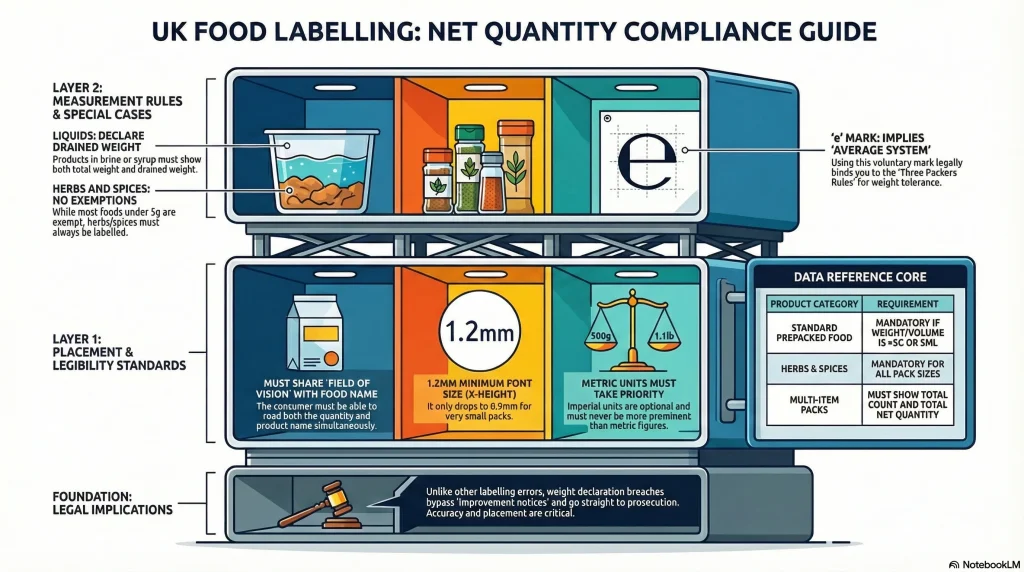
Mandatory for all prepacked food sold to consumers or mass caterers above 5g or 5ml. Products below this are generally exempt — with two important exceptions.
Herbs and spices: Must carry a declaration regardless of pack size. The small-pack exemption does not apply.
Sold by number: Products normally sold by count – individual rolls, loose eggs – do not need a weight or volume declaration if the number can be clearly seen from the outside. If not, the count must appear on the label.
Units: Metric Required, Imperial as Supplement Only
The declaration must be expressed in metric units:
- Solid foods: grams (g) or kilograms (kg)
- Liquid foods: millilitres (ml), centilitres (cl), or litres (l)
- Viscous foods such as honey or jam: either mass or volume, per product-specific regulations
Imperial measurements may appear as a supplement, but must not be given greater prominence than the metric figure. Displaying ounces or pounds more visibly than the metric equivalent is a breach of net quantity labelling requirements.
Drained Weight: When Two Figures Are Required
If food is packed in liquid that must be removed before eating – brine, syrup, water, juice – you must state both:
- The net quantity (food plus liquid combined)
- The drained weight (food alone, after liquid removal)
This applies to canned vegetables, tinned fish, fruit in syrup, olives, and similar products. For some frozen products with an ice glaze, the drained weight reflects the weight after the glaze has melted and drained. Many producers label only the combined figure and omit drained weight. Trading Standards treat this as non-compliant.
Minimum Font Size Requirements
Weight and volume declarations must meet minimum legibility standards. The required minimum x-height (height of a lowercase ‘x’ in the chosen font) is:
- 1.2mm — for standard packaging – about 7pt for most fonts
- 0.9mm — where the largest surface area is less than 80cm² – about 5pt for most fonts
These are absolute minimums. If voluntary label information is pushing mandatory declarations below minimum font size, the voluntary content must be removed or reduced – not the mandatory declaration.
Field of Vision: Quantity and Food Name Must Be Visible Together
The net quantity must appear in the same field of vision as the food name. A consumer holding the pack normally must be able to read both at the same time — they cannot appear on opposite faces of the packaging. For alcoholic drinks above 1.2% ABV, the alcohol strength declaration must also share this field of vision.
Multi-Item Packs: Both Count and Total Weight Required
Where a pack contains two or more items not intended for separate sale, the label must show both the total number of items and the total net quantity — for example “4 = 200g”. Neither figure alone satisfies the requirement.
The ‘e’ Mark: Optional, but Binding Once Used
The ‘e’ mark — a stylised lowercase e — is a voluntary declaration that the quantity has been determined using the average quantity system under the Weights and Measures (Packaged Goods) Regulations 2006.
Displaying the ‘e’ mark is optional. But once displayed, it carries legal obligations. Products bearing the mark must comply with the Three Packers Rules, which govern acceptable tolerances between declared and actual quantity. Displaying the mark without meeting the standard is a breach.
Frequently Asked Questions
Does the weight declaration need to be on the front of the pack?
No fixed position is required, but it must share a field of vision with the food name — wherever that appears.
Can I declare in pounds and ounces only?
No. Metric is mandatory. Imperial may appear as a supplement but must not be more prominent.
My product is in brine — do I need to show drained weight?
Yes. Food packed in liquid that is removed before eating requires both figures: combined net quantity and drained weight.
Are herbs and spices exempt from net quantity labelling if under 5g?
No — herbs and spices are excluded from the 5g/5ml exemption and must carry a declaration at any pack size.
What is the enforcement route for weight declaration errors?
Unlike most food labelling issues, quantity contraventions go directly to prosecution — there is no improvement notice stage first.
What is ‘net quantity’ on a product label?
Net quantity is the weight or volume of the product itself, excluding any packaging. It is shown in metric units (g, kg, ml or l). Where the product is presented in a liquid medium that is not normally consumed (such as brine or vinegar), the drained net weight must also be shown. Net quantity is a mandatory item of information under UK food labelling law and must appear in the same field of vision as the name of the food.
Food Labels Delivered in 3-5 Working Days
Need labels quickly? Most orders leave us within 3-5 working days. Call 01332 864895 and we’ll have pricing to you within minutes. We can ensure your weight and volume declarations — and every other mandatory element — are correctly positioned and printed at the required minimum font size.
Positive ID Labels Ltd | Derby | 01332 864895 | sales@pid-labelling.co.uk
All food labelling guides are provided in good faith for information purposes only and do not constitute legal advice. For specific compliance questions about specific labelling laws, contact a specialist or contact your local Trading Standards authority. Read our Regulatory Information Disclaimer