
What Are E Numbers? A Plain-English Guide for Food Labels
What are e numbers? Pick up almost any packaged food and you’ll find a string of codes in the ingredients list — E102, E471, E330. Most shoppers gloss over them. For food businesses, understanding what they are and how they must appear on labels is a legal requirement. This guide cuts through the confusion.
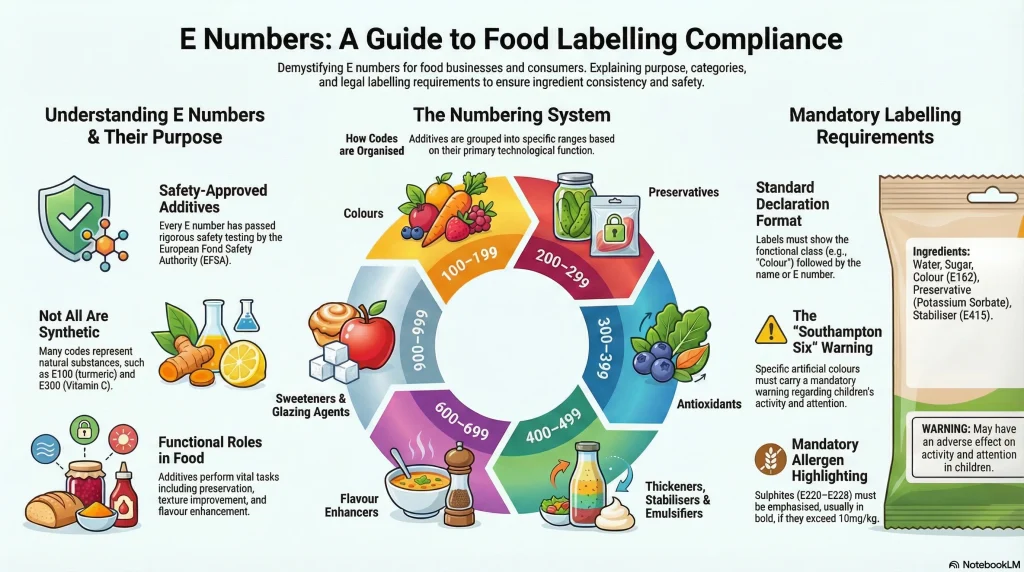
What Are E Numbers?
E numbers are codes assigned to approved food additives across the UK and European Union. The “E” stands for Europe. Each code identifies a substance that has passed safety testing by the European Food Safety Authority (EFSA) and been authorised for use in food products.
The system began in 1962 with food colourings. Preservatives joined in 1964, antioxidants in 1970, and emulsifiers and stabilisers in 1974. Today, over 300 substances appear on the approved list.
Why Use Codes Instead of Names?
Chemical names are long, complex, and vary across languages. Ascorbic acid — vitamin C — simply becomes E300, whether the label is printed in Derby or Düsseldorf. It makes ingredient declarations consistent and legally recognisable across borders.
Why Are Food Additives Used?
Manufacturers don’t add substances to food arbitrarily. Every approved additive performs a specific technological function:
- Preservation — slowing spoilage and extending shelf life
- Colour — restoring or enhancing appearance after processing
- Texture — improving mouthfeel, consistency, or structure
- Stability — preventing ingredients from separating
- Flavour enhancement — boosting taste without extra salt or sugar
- Safety — inhibiting bacteria that could cause food poisoning
UK Food Additive & E Number Search Tool
Search by E number (e.g. E102) or by name (e.g. tartrazine, lecithin, aspartame)
This tool is provided for reference only. Always verify additive status and labelling requirements against the FSA approved additives list and assimilated Regulation (EC) 1333/2008. Need compliant food labels? Call Positive ID Labels on 01332 864895.
Categories of Food Additives and Their Codes
How the Numbering System Is Organised
E Number Ranges and What They Cover
| Range | Category | Common Examples |
|---|---|---|
| 100-199 | Colours | E100 Curcumin (turmeric), E150a Caramel, E160c Paprika |
| 200-299 | Preservatives | E200 Sorbic acid, E220 Sulphur dioxide, E250 Sodium nitrite |
| 300-399 | Antioxidants | E300 Ascorbic acid (vitamin C), E330 Citric acid |
| 400-499 | Thickeners, stabilisers, emulsifiers | E415 Xanthan gum, E471 Mono- and diglycerides |
| 500-599 | Acidity regulators, anti-caking agents | E500 Sodium bicarbonate |
| 600-699 | Flavour enhancers | E621 Monosodium glutamate (MSG) |
| 900-999 | Sweeteners, gases, glazing agents | E951 Aspartame, E941 Nitrogen |
| 1000-1599 | Additional additives | E1422 Acetylated distarch adipate |
Are All Additives Synthetic?
No — and this surprises many people. Curcumin (E100) comes from turmeric, lecithin (E322) from sunflower or soya, and riboflavin (E101) is vitamin B2. Citric acid (E330) occurs naturally in lemons. The code doesn’t indicate whether a substance is natural or synthetic; you have to look up the specific additive.
Are Food Additives Safe?
What EFSA Approval Actually Means
An additive reaches the approved list only after rigorous testing. EFSA evaluates toxicity, likely consumption levels, and long-term effects before authorising anything. Approval isn’t permanent — substances can be reviewed and removed if new evidence emerges.
The term “E number” has developed an unfair reputation as shorthand for “artificial” or “harmful.” Many approved additives are entirely natural, and several — vitamin C and citric acid among them — are things you’d find in any kitchen. That said, some additives do carry specific labelling requirements, and food businesses need to understand which ones and why.
Higher-Profile Additives and What They Mean for Your Labels
The Southampton Six
The “Southampton Six” refers to six artificial food colours linked to increased hyperactivity in some children by a 2007 University of Southampton study. The six are tartrazine (E102), quinoline yellow (E104), sunset yellow (E110), carmoisine (E122), ponceau 4R (E124), and allura red (E129).
None are banned in the UK, but UK law requires any product containing one or more of them to carry this mandatory warning alongside the ingredients list: “May have an adverse effect on activity and attention in children.” This is not optional. If your product contains any of these colours, the warning must appear on the label.
Businesses reformulating to remove these colours typically switch to natural alternatives — beetroot red (E162), paprika extract (E160c) or anthocyanins (E163) for reds, and beta-carotene (E160a) or curcumin (E100) for yellows.
Other Additives With Mandatory Label Statements
Aspartame (E951) — any product containing aspartame must carry: “Contains a source of phenylalanine.” This is essential for people with phenylketonuria (PKU), a metabolic condition affecting phenylalanine processing. Applies to sweeteners, diet drinks and any other format.
Sulphites and sulphur dioxide (E220–E228) — declared allergens under UK food law. If present at or above 10 mg/kg in the finished product (as SO₂), they must be emphasised in the ingredients list — typically in bold. Common in wine, dried fruit, sausages and seafood.
Titanium dioxide (E171) — still permitted in Great Britain but banned across the EU since August 2022. If you sell into EU markets, this requires attention.
What Are E Numbers Required to Show on Food Labels?
UK Labelling Rules for Additive Declarations
UK food law requires every additive to appear in the ingredients list with its functional class name — “colour,” “preservative,” “emulsifier” — followed by either the specific name or its code. A label might read “colour (curcumin)” or “colour (E100).” Both are legally acceptable.
Getting this right matters. Inaccurate or illegible additive declarations can trigger enforcement action from Trading Standards. Minimum text height for food labels under the Food Information to Consumers (FIC) Regulations is 1.2mm — which means print quality genuinely matters.
Positive ID Labels produces food labels where even the smallest declaration text stays sharp and legible. Our Xeikon press runs at 1200dpi — ideal for artisan products and high-volume retail lines alike. Call 01332 864895 or use our enquiry form for a free quote.
Frequently Asked Questions About E Numbers on Food Labels
Why do some products list the name and others use the code?
Both are equally legal. Some manufacturers prefer names for transparency; others use codes to save label space. Either way, the functional class must appear alongside it.
Are UK additive rules the same as EU rules post-Brexit?
For now, yes. The UK retained EU additive legislation on exit, and the approved list remains broadly the same. The Food Standards Agency manages the UK list going forward, and divergence is possible in time.
Can a product be labelled “natural” and still contain additives?
Yes. “Natural” is loosely defined in UK food marketing. An additive from a natural source — like beta-carotene (E160a) from carrots — can appear in products making natural claims, but must still be declared in the ingredients list.
Does the order additives appear in the list matter?
Yes — all ingredients, including additives, must be listed in descending order of weight at the point of use.
What happens if additive declarations are missing or wrong?
Non-compliance can result in enforcement notices, product recalls, or prosecution under the FIC Regulations. Get your labels professionally checked before going to print.
Get Compliant Food Labels — Fast
Food label compliance covers more ground than most producers expect. Allergens, nutrition data, country of origin, additive declarations and mandatory warnings all have to be right — and legible.
Positive ID Labels has over 20 years of experience helping UK food businesses produce accurate, professional labels. Most orders ship within 3-5 days.
Call 01332 864895 or complete our enquiry form to request free samples and a no-obligation quote.

I had an amazing experience working with Positive ID Labelling, especially Natalie. The labels were absolutely brilliant quality and exceeded my expectations. Natalie was fantastic throughout the whole process. Communication was amazing from start to finish. She was so helpful, guided me through everything, and made the whole experience stress free and enjoyable. She was also genuinely funny and a pleasure to work with, which made everything even better. I’ll definitely be working with Natalie again on future projects and would highly recommend Positive ID Labelling to anyone looking for high-quality labels and excellent customer service.

Fantastic label printing service. Labels to a very high specification. Helen was great at sorting out our requirements, quotes, and order.

We’ve had a great experience working with this supplier, especially with Natalie - she is always very responsive, professional, and friendly. The pricing is highly competitive and the sales service has been excellent from start to finish.If I could offer one suggestion, it would be to improve the account and invoice management process. It would be really helpful if there were a system for clients to easily track their past orders and invoices in one place.Overall, very pleased with the service and look forward to continuing our collaboration.

I inadvertently ordered the incorrect label guns which was quickly sorted by Natalie. She was excellent, customer service at its best! Thank you once again

All food labelling guides are provided in good faith for information purposes only and do not constitute legal advice. For specific compliance questions about specific labelling laws, contact a specialist or contact your local Trading Standards authority. Read our Regulatory Information Disclaimer