
Nutrition and Health Claims on Food Labels: A Complete UK Guide
Every word on your food label carries legal weight. Make nutrition and health claims without meeting the rules – “low sugar,” “high in protein,” “supports normal heart function” – and you’re exposed to enforcement action, fines, and brand damage. This guide cuts through the complexity to explain exactly what UK food businesses need to know about nutrition and health claims in 2025 and beyond.
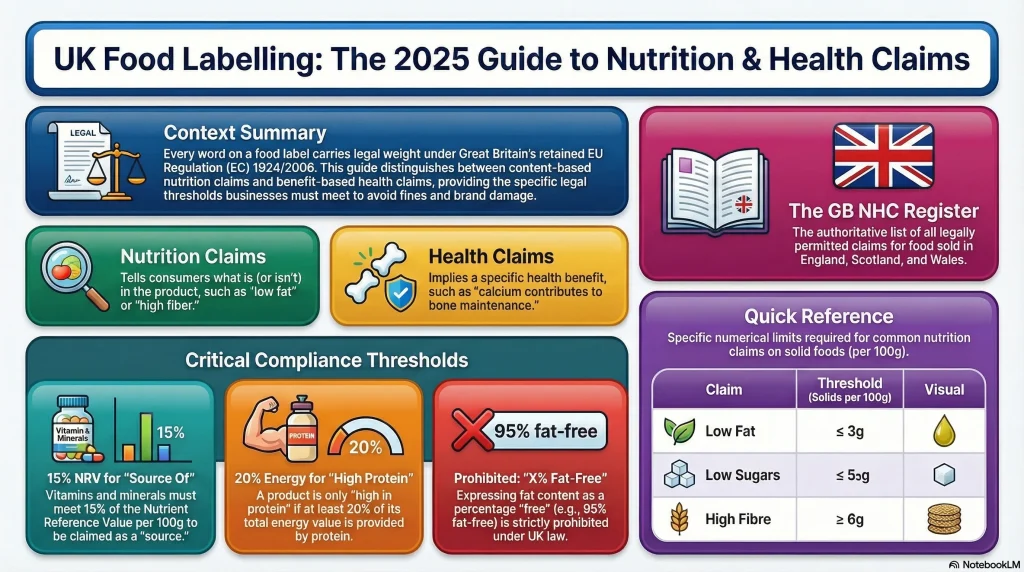
What Are Nutrition and Health Claims?
There are two distinct types, and the difference matters legally.
A nutrition claim is a statement about a food’s nutritional content – for example, “low fat,” “high in fibre,” or “source of protein.” These tell consumers what’s in (or not in) the product. They are permitted, but only if the product meets specific numerical thresholds defined in law. Read our detailed nutrition claims guide here
A health claim goes one step further. It states or implies that eating a food provides a specific health benefit – for example, “calcium contributes to the maintenance of normal bones” or “vitamin C contributes to the reduction of tiredness and fatigue.” Health claims must be scientifically substantiated and pre-authorised before they can appear on your label. Read our detailed health claims guide here
Both types of claim are governed in Great Britain by retained EU Regulation (EC) 1924/2006, as modified by the Nutrition (Amendment etc.) (EU Exit) Regulations 2019. The legal framework closely mirrors what existed under EU membership – but there are some important differences food businesses need to understand.
The GB Register for Nutrition and Health Claims
The Great Britain Nutrition and Health Claims Register (GB NHC Register) is the authoritative list of claims that may legally appear on food sold in England, Scotland, and Wales. It was established on 1 January 2021 and initially mirrored the EU register exactly.
However, the two registers are now diverging. When the EU approves a new health claim, it is not automatically valid in Great Britain. Conversely, GB can authorise claims independently. New applications in Great Britain are assessed by the UK Nutrition and Health Claims Committee (UKNHCC), which replaced EFSA as the scientific advisory body for this purpose.
Important: Northern Ireland is different. Under the Windsor Framework, Northern Ireland continues to use the EU register and EFSA assessments. Businesses selling in both GB and Northern Ireland – or exporting to the EU – need to track both registers.
The UK-EU SPS Agreement (May 2025) changes the picture. The UK government and EU agreed in May 2025 to re-align in a number of nutrition-related areas, including nutrition and health claims. The agreement is expected to take effect in mid-2027. This means the GB and EU registers are likely to converge again. Businesses should monitor DHSC and FSA guidance as implementation details emerge.
Nutrition Claim Thresholds: The Key Numbers
Permitted Nutrition Claims on Food Labels (UK)
To use a nutrition claim legally, your product must meet the specific threshold for that claim. These are assessed per 100g for solid foods, or per 100ml for liquids.
| Claim | Threshold (solids per 100g) | Threshold (liquids per 100ml) |
|---|---|---|
| Low energy | ≤40 kcal | ≤20 kcal |
| Energy-free | ≤4 kcal | ≤4 kcal |
| Low fat | ≤3g | ≤1.5g |
| Fat-free | ≤0.5g | ≤0.5g |
| Low saturated fat | ≤1.5g (and ≤10% of energy) | ≤0.75g (and ≤10% of energy) |
| Low sugars | ≤5g | ≤2.5g |
| Sugars-free | ≤0.5g | ≤0.5g |
| No added sugars | No added mono/disaccharides or sweetening foods | Same |
| Low sodium/salt | ≤0.12g sodium | ≤0.12g sodium |
| Very low sodium/salt | ≤0.04g sodium | ≤0.04g sodium |
| Source of fibre | ≥3g | ≥1.5g |
| High in fibre | ≥6g | ≥3g |
| Source of protein | ≥12% of energy from protein | Same |
| High in protein | ≥20% of energy from protein | Same |
| Reduced [nutrient] | At least 30% less than comparable product | Same |
Note: Claims expressed as “X% fat-free” are prohibited under the regulation.
Comparative Claims
Comparative claims (e.g. “reduced fat,” “light,” “energy-reduced”) require the product to contain at least 30% less of the relevant nutrient than a comparable reference product. The reference product must be clearly identified. Only four comparative claims are listed in the GB NHC Register: increased [nutrient], reduced [nutrient], energy reduced, and light/lite.
Vitamins and Minerals
For vitamins and minerals, the threshold language is:
- “Source of [vitamin/mineral]” – the product must contain at least 15% of the Nutrient Reference Value (NRV) per 100g (or per 100ml for liquids, or per portion for single-serve products)
- “High in [vitamin/mineral]” – the product must contain at least 30% of the NRV per 100g
What Is Not Allowed on Food Labels
Claims That Are Prohibited Outright
- Any claim not listed on the GB NHC Register – it is a criminal offence to use an unauthorised claim
- Claims stating that a food can prevent, treat, or cure any disease or medical condition
- Claims that suggest health risks from not eating a particular food
- Claims referring to the rate or amount of weight loss
- Claims on alcoholic beverages containing more than 1.2% ABV (with narrow exceptions for low-alcohol or reduced-energy statements)
- Claims expressed as “X% fat-free”
Claims in Regulatory Grey Areas
Health claims linked to children’s development and health (Article 14 claims) are subject to additional requirements and can only be made in conformity with specific conditions of authorisation.
Reduction of disease risk claims are permitted but tightly controlled. They must be accompanied by a statement that the disease has multiple risk factors and that changing one of them may or may not have a beneficial effect.
Botanical claims are a particular grey area. Many botanical ingredient claims – for turmeric, ginkgo, ashwagandha, and others – were under review at the time of EU Exit and were listed on the register as “on hold.” In Great Britain, these claims remain in a holding pattern and represent some of the most common sources of non-compliance identified in enforcement reviews.
What “Superfood” and “Healthy” Mean
The regulation controls general references to overall health and wellbeing. Terms like “superfood,” “healthy,” and “natural” are not authorised claims as such, but using them in a way that implies a health benefit without substantiation is a compliance risk. The Advertising Standards Authority (ASA) monitors such usage in marketing communications as well as on-pack.
How to Use Nutrition and Health Claims Correctly
Using an Existing Authorised Claim
The simplest approach. Check the GB NHC Register for nutrition and health claims, confirm your product meets the conditions of use, and use the approved wording exactly. Do not paraphrase or rework the authorised text – it must match the register.
Each claim entry specifies the authorised wording, the nutrient or substance it relates to, the conditions of use including minimum nutrient levels, and any required accompanying statements.
You can use our inline nutrition and health claims search tool here
Great Britain Nutrition & Health Claims Register Search Tool
Search by nutrient, vitamin, mineral or ingredient – e.g. Vitamin D, calcium, omega-3, iron
This tool is provided for reference only. Always verify claim status and conditions of use against the GB Nutrition and Health Claims Register and assimilated Regulation (EC) 1924/2006. Claims must only be used in accordance with their authorised conditions. Need compliant food labels? Call Positive ID Labels on 01332 864895.
Applying for New Nutrition and Health Claims Authorisation
If you believe you have evidence for a claim not currently on the register, the process involves:
- Prepare a scientific dossier – the application must include a systematic review of the scientific evidence demonstrating a causal relationship between the food/nutrient and the claimed health benefit. The standard is robust and requires human intervention studies.
- Submit to DHSC – the application is then referred to the UKNHCC for scientific assessment.
- UKNHCC scientific opinion – the committee reviews the dossier and produces an opinion on whether the science supports the claim.
- Risk management decision – the appropriate authority makes a final decision taking into account the scientific opinion and wider policy considerations.
- Register update – if approved, the claim and its conditions of use are added to the GB NHC Register.
The process is lengthy and costly. Most food businesses rely on existing authorised claims rather than pursuing novel applications. Specialist food law consultants and nutritionists are typically needed to manage a new claim application.
Scientific Evidence Standards for New Nutrition and Health Claims
The UKNHCC looks for robust, reproducible human clinical evidence. Mechanistic studies or animal research alone are insufficient. The evidence must demonstrate a cause-and-effect relationship at realistic dietary intake levels, not at doses only achievable through supplementation. This is the same standard historically applied by EFSA before Brexit and remains the benchmark in GB.
EU/UK Divergence: What to Watch
How the 2025 SPS Agreement Affects Food Label Compliance
How the SPS Agreement Reshapes Nutrition and Health Claims Compliance
Since January 2021, the GB and EU registers have been able to develop independently. Key areas where differences have emerged or may emerge:
- New EU-authorised claims since 2021 are not automatically valid in GB
- Botanical ingredient claims remain unresolved in both jurisdictions but may be handled differently
- Nutrient profiles – the EU has been considering thresholds that would prevent products high in fat, sugar, or salt from making any health claims. GB has not implemented these
- SPS re-alignment (mid-2027) – the May 2025 UK-EU SPS Agreement is expected to bring the two registers back into alignment. Businesses selling in both markets should plan for label updates ahead of this date
For Northern Ireland, EU rules already apply. Food businesses operating across the UK and EU markets need to ensure labels comply with both registers simultaneously until re-alignment.
Regulatory Sources
- GB NHC Register: gov.uk/government/publications/great-britain-nutrition-and-health-claims-nhc-register
- DHSC Compliance Guidance: gov.uk/government/publications/nutrition-and-health-claims-guidance-to-compliance-with-regulation-ec-1924-2006
- FSA Nutrition Labelling Guidance: food.gov.uk/business-guidance/nutrition-labelling
- ASA Guidance on Nutrition Claims in Advertising: asa.org.uk/advice-online/food-nutrition-claims.html
- Retained Regulation EC 1924/2006: legislation.gov.uk/eur/2006/1924
- 2024 Amendment Regulations: legislation.gov.uk/uksi/2024/165
- UK-EU SPS Agreement (May 2025): gov.uk/government/news/uk-eu-sps-agreement-information-for-businesses
Frequently Asked Questions
Can I say my product is “healthy” on the label?
Not without care. “Healthy” is not an authorised health claim, but using it in a context that implies specific health benefits without substantiation can trigger enforcement action. If you want to link your product to health outcomes, use authorised wording from the GB NHC Register.
My product naturally contains a lot of vitamin C. Can I mention this?
Yes, provided your product meets the threshold. To say “source of vitamin C” it must contain at least 15% of the NRV for vitamin C (80mg/day) per 100g – so at least 12mg per 100g. To claim “high in vitamin C” it must contain 30% NRV, or 24mg per 100g. The wording must match the register exactly.
What happens if I use an unauthorised claim by mistake?
It is a criminal offence. However, since the Nutrition and Health Claims (England) (Amendment) Regulations 2024 came into force on 1 October 2024, local authorities can issue an improvement notice as a first step before pursuing criminal prosecution. This gives businesses a chance to rectify non-compliance. It does not remove the risk of prosecution for persistent or deliberate violations.
I sell in both Great Britain and the EU. Do I need two different labels?
Potentially yes, if claims differ between the two registers. Long-established authorised nutrition and health claims are likely to be on both registers. But for any claims authorised after January 2021, you’ll need to check both. Post-2027 SPS alignment should simplify this, but dual-market businesses need careful label management until then.
Can a dietitian recommend my product on social media if it carries a health claim?
In GB, a dietitian can recommend a brand but must keep their professional recommendation clearly separate from any health claim the product makes. The recommendation and the claim must not appear in the same communication in a way that implies the professional is endorsing the claim itself.
What’s the difference between “no added sugar” and “sugar-free”?
Significant. “No added sugar” means no mono- or disaccharides or sweetening foods have been added – but the product may still contain naturally occurring sugars. “Sugar-free” requires total sugars to be ≤0.5g per 100g or 100ml. A fruit juice can legitimately say “no added sugar” while still being relatively high in total sugars.
Are there minimum order quantities for compliant food labels?
No statutory minimum – that is a printing question, not a regulatory one. See below.
How Positive ID Labels Can Help
Getting the claim wording right is your job. Getting it onto the label correctly is ours. We have a range of food industry specific labelling guides
Labels carrying nutrition and health claims need precision. The approved wording, the supporting nutritional declaration, font sizes, and layout all matter. A label that obscures mandatory information or uses the wrong point size is non-compliant regardless of how accurate the underlying claim is. Mandatory label information requires a minimum font size of 1.2mm x-height for lower-case letters – on small packs, that demands careful print planning.
Our Xeikon digital press produces exceptionally sharp small text at 1200dpi – critical where nutritional declarations, NRV percentages, and claim wording must coexist in a tight label area without becoming illegible. For polypropylene labels on bottles, jars, and food-safe containers, our Screen UV inkjet press delivers durable, waterproof labels that hold their clarity in refrigerated or wet conditions.
If you’re updating labels to reflect changing register requirements, we work quickly. Most digital label orders turn around within 3 – 5 days, and our team can advise on print specifications to ensure your label layout works within regulatory requirements.
Call 01332 864895 or complete our enquiry form for a free consultation and quote. We’ve been printing food labels for over 20 years – quality, speed, service, and value, every time.
Related products and guides
- The full technical detail sits in our food name labelling.
- Useful background reading: fortification labelling.
- Our ingredients rules walks through the groundwork.
- For deeper background, see our traffic light labelling.

I had an amazing experience working with Positive ID Labelling, especially Natalie. The labels were absolutely brilliant quality and exceeded my expectations. Natalie was fantastic throughout the whole process. Communication was amazing from start to finish. She was so helpful, guided me through everything, and made the whole experience stress free and enjoyable. She was also genuinely funny and a pleasure to work with, which made everything even better. I’ll definitely be working with Natalie again on future projects and would highly recommend Positive ID Labelling to anyone looking for high-quality labels and excellent customer service.

Fantastic label printing service. Labels to a very high specification. Helen was great at sorting out our requirements, quotes, and order.

We’ve had a great experience working with this supplier, especially with Natalie - she is always very responsive, professional, and friendly. The pricing is highly competitive and the sales service has been excellent from start to finish.If I could offer one suggestion, it would be to improve the account and invoice management process. It would be really helpful if there were a system for clients to easily track their past orders and invoices in one place.Overall, very pleased with the service and look forward to continuing our collaboration.

I inadvertently ordered the incorrect label guns which was quickly sorted by Natalie. She was excellent, customer service at its best! Thank you once again

All food labelling guides are provided in good faith for information purposes only and do not constitute legal advice. For specific compliance questions about specific labelling laws, contact a specialist or contact your local Trading Standards authority. Read our Regulatory Information Disclaimer