
Food Name Labelling Guide: Legal, Customary, and Descriptive Names Explained
What’s in a name? On a food label, quite a lot. The wrong product name – or a brand name without a proper legal description – can put you in breach of UK food name labelling law before a single ingredient has been declared.
This guide covers how to choose the right type of name, the rules on processing descriptions, substituted ingredients, and what counts as misleading. Positive ID Labels produces food labels for businesses across the UK. Call 01332 864895 if you need help translating these rules into a label that works.
Why Food Name Labelling Law Exists
The name of a food is the most visible piece of information on any label. Under the Food Information Regulations 2014 – which retained EU FIC Regulation 1169/2011 into UK law – every prepacked food must carry a name that is accurate, clear, and not misleading.
Falsely describing food is a criminal offence. Trading Standards can prosecute, and consequences range from improvement notices to unlimited fines. Food name labelling compliance is a legal obligation, not a courtesy. There are a myriad of laws you must adhere to to ensure your food labelling is up to scratch.
The Three Types of Food Name in UK Law
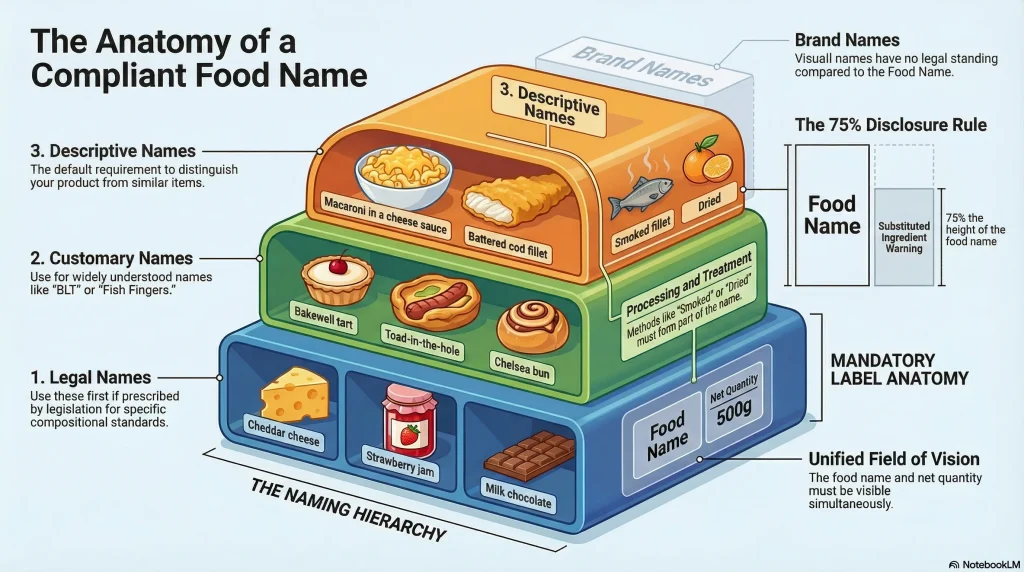
Food name labelling law establishes a clear hierarchy. You must use the first type that applies to your product.
1. Legal Names — Prescribed in Legislation
A legal name is set out in law. If one exists for your product, you must use it – no alternatives. Legal names typically come with compositional standards that must also be met.
Examples of foods with legal names: milk chocolate, strawberry jam, Cheddar cheese, beef burger (minimum beef content applies to each).
Using a legal name for a product that does not meet the compositional standard is a food labelling offence. If your product falls short, you need a descriptive name instead.
2. Customary Names — Widely Understood Without Explanation
Where no legal name exists, a customary name may be used. These are names consumers across the UK accept without further explanation – established over time.
Examples: BLT, Bakewell tart, toad-in-the-hole, fish fingers, Chelsea bun.
A customary name must be broadly understood – not just within a region or community. If it is only locally recognised, you can still use it, but you must add a descriptive name alongside.
3. Descriptive Names — the Default for Most Products
No legal name, no established customary name — then a descriptive name is required. Most food products sit here. The name must be precise enough to tell consumers what they are buying and distinguish it from similar products.
Examples: “Macaroni in a cheese sauce”, “Battered cod fillet”, “Rye bread with sunflower seeds.”
Vague descriptions that leave consumers unclear about the nature of the food do not satisfy food name labelling requirements.
Brand Names Are Not Food Names
A brand or fancy name – however well-known – has no standing in food name labelling law. “Sunrise Crunch” tells a consumer nothing about what they are eating.
If you sell under a brand name, you must also carry the most appropriate legal, customary, or descriptive name. The two can appear together, but the legal food name must be clearly presented and not obscured by branding.
Processing and Treatment in the Food Name
Where food has been processed, that treatment must form part of the name. This catches out many producers.
Examples of required descriptions: “Smoked salmon”, “Dried apricots”, “Powdered milk”, “Concentrated orange juice”, “Frozen prawns.”
Note: you do not need to declare “defrosted” if only some ingredients were previously frozen, or if defrosting does not affect the safety or quality of the finished product.
Substituted Ingredients: Close Proximity Disclosure
If a product normally contains an ingredient consumers would expect – and it has been replaced – that substitution must be disclosed close to the food name. The disclosure font must be at least 75% of the height of the food name itself.
Example: A pesto made with parsley instead of basil must either incorporate this in the name (“parsley pesto”) or declare it prominently alongside.
Field of Vision: Name and Net Quantity Together
The food name must appear in the same field of vision as the net quantity declaration – both must be visible simultaneously when the pack is held normally. They cannot be placed on opposite faces of the packaging.
Frequently Asked Questions
Can I use my brand name as the food name?
No. Brand names have no legal standing as food descriptions. A legal, customary, or descriptive name must always accompany them.
What makes a food name misleading under food name labelling law?
Anything creating a false impression of nature, composition, origin, or processing. “Italian pizza” made in the UK is a well-known example — origin claims embedded in names are actively scrutinised by Trading Standards.
Does “smoked” always appear in the food name?
If the food has been smoked and consumers would not otherwise expect it, yes — the process must be declared in or immediately alongside the name.
My product doesn’t meet the compositional standard for its legal name. What now?
You cannot use that legal name. Use a descriptive name that accurately reflects what the product actually is.
Where on the pack does the food name go?
No fixed position is required, but it must be clearly visible, unbroken by images or other text, and share a field of vision with the net quantity declaration.
Not Sure Whether Your Labels Are Compliant?
Our team can talk through your requirements and help identify any food name labelling issues before Trading Standards does. Call 01332 864895 or complete our enquiry form — no obligation, just expert guidance.
We print food labels across all sectors: 1200dpi on the Xeikon for premium brands, high-volume runs on our Screen UV press, with most orders despatched within 3-5 working days.
Positive ID Labels Ltd | Derby | 01332 864895 | sales@pid-labelling.co.uk
All food labelling guides are provided in good faith for information purposes only and do not constitute legal advice. For specific compliance questions about specific labelling laws, contact a specialist or contact your local Trading Standards authority. Read our Regulatory Information Disclaimer
Related products and guides
- Our ingredients labelling walks through the groundwork.
- For deeper background, see our net quantity.
- The full technical detail sits in our traffic light scheme.