Getting Farm Shop Labels Right: A UK Guide To Food Labelling
Farm Shop Product Categories And Labelling Rules
The rules depend on how you’re selling the product. Understanding these categories is essential.
Your Own-Produced Foods (PPDS)
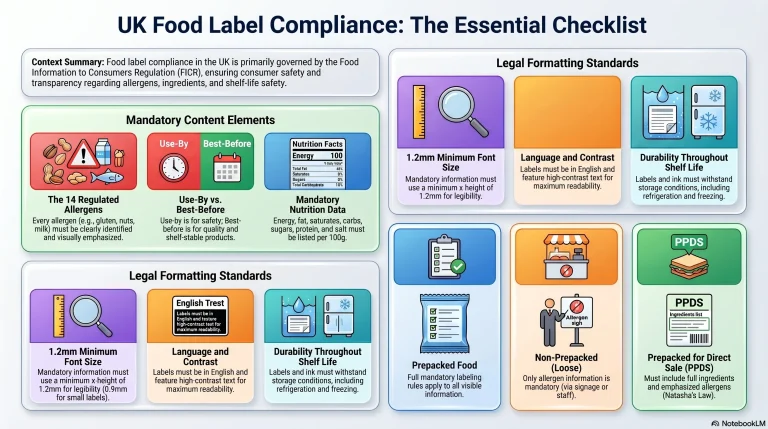
Anything you produce and package on-site such as pies, jams, breads, sandwiches, honey, falls under “Prepacked for Direct Sale” (PPDS) rules. You must provide:
Product name, complete ingredients list, allergen declaration (with clear emphasis on all 14 regulated allergens), use-by or best-before date with storage instructions, net quantity, and your business name and address.
Repackaged Local Producer Products
If you repackage loose processed products into containers with your label, you become responsible for the label. You must get written permission and full ingredient information from the producer, then list all ingredients, allergens, and dates on your label. If the product is unprocessed e.g. fruit, vegetables etc. you do not need to label them.
Pre-Packed Supplier Items
If a supplier delivers pre-packed goods with their own label, you can sell as-is, but you may be liable for their label accuracy. Check that allergen information is clear before stocking.
Loose Products
Loose vegetables, fruit, meat, and flowers don’t require individual labels, but you must display the product name, price per unit, and (for meat) origin. A chalkboard or menu meets this requirement.
What Information Must Be On A Food Label For Farm Shops?
All farm shop labels used for food packaging in the UK must include these mandatory elements:
- Product Name: Descriptive and accurate (e.g., “Strawberry Jam,” not just “Preserve”).
- Ingredients List: Every ingredient in descending weight order, including water, salt, and oil. If you use shop-bought components, include their full ingredient declarations.
- Allergen Declaration: All 14 regulated allergens highlighted if present. For farm shops, common allergens are nuts, gluten, milk, eggs, and sesame. You should consider carefully if cross-contamination risks must be declared.
- Date Marking: Use-by date for chilled products; best-before for shelf-stable items. Include storage instructions if they affect shelf life.
- Net Quantity: Weight or volume (e.g., “400g jar”).
- Business Details: Your farm name and address.
Keeping Farm Shop Labels Accurate As Your Business Changes
The most common farm shop labelling mistake is not updating farm shop labels when recipes or suppliers change. A new ingredient supplier could introduce a new allergen. Implement this simple rule: whenever ingredients or suppliers change, update your label immediately before printing the next batch. Create a master ingredient list for each product and review it regularly. For your own products, you can use our own Nutridata software to achieve this. Supplied free with our sandwich and food labelling printer packages.
Common Farm Shop Labelling Mistakes To Avoid
- Recipe changes not reflected: New supplier introduces a new allergen; label still shows old information.
- Same label used for multiple products: A label intended for cheese pie accidentally used on a cheese and onion pie.
- Non-compliant supplier labels: You buy pre-packed items and sell without checking allergen emphasis.
- Repackaging without full ingredient information: You repackage local producer goods but don’t have complete ingredient lists.
- Missing allergen emphasis: Allergen listed but not clearly distinguished from other text.
- Forgotten allergen categories: You or your suppliers may forget the full allergen list must be highlighted.
Practical Guidance For Your Farm Shop
- Start simple: Create a farm shop label template for each product type. Pre-print with your farm name and address. Hand-write or apply date stickers before display.
- Get supplier info in writing: If repackaging, request full ingredient and allergen declarations from producers in writing.
- Use signage for loose items: A chalkboard listing products, prices, and origins is efficient and compliant.
- Check labels quarterly: Verify ingredients remain current, allergens are listed, and dates are correct.
- Choose the right label source: Pre-printed labels from a manufacturer (3-5 day turnaround) work for stable products. Thermal printers with label software suit variable product ranges. Hand-written labels are legal but labour-intensive.
FAQ: Farm Shop Labelling Questions Answered
Q: Do loose vegetables need individual labels? A: No. Display product name, price per unit, and origin on signage or verbally.
Q: Can I repackage a local producer’s product? A: Only with written permission and full ingredient information. You then become responsible for label accuracy.
Q: What if I don’t know all ingredients in a supplier’s product? A: Request full ingredient declaration. If they can’t provide it, sell only in original packaging with their label.
Q: Can I claim “Gluten-Free” if I bake in a gluten-free kitchen? A: Only if your kitchen is exclusively gluten-free. If you ever bake wheat products there, you must declare “May contain gluten.”
Q: Do I need nutrition information? A: Not usually – small food businesses have exemptions. But verify with your local trading standards if you exceed £850,000 annual turnover.
Q: How big should text be? A: Your can size your text how you like, but mandatory information must be no smaller than 7pt for most fonts (1.2mm minimum ‘x’ height). Allergens: bold, clear emphasis. Check your specific font dimensions. Positive ID Labelling can do this for you when we help design your labels.
Q: What if products are made at one farm shop but sold at another? A: Use labels stating “Produced by [Location A], sold by [Location B]” or a parent company label covering both sites.
Getting Farm Shop Labels Right
Farm shop labelling isn’t complicated once you understand which products need what information. The key is keeping labels updated whenever anything changes – ingredients, suppliers, recipes.
At Positive ID Labels, we create label designs specifically for farm shops. We understand the mix of own-produced and supplier products and know the food packaging labels UK requirements that apply.
Need advice on farm shop labelling or labels designed and printed? Call us on 01332 864895. We’ll review your product range, recommend labelling approaches for each category, and design labels that look professional while meeting compliance. Or fill out our contact form and we’ll call you back.
Your customers trust you to be transparent. Getting labels right reinforces that trust. Use Nutridata software to ensure your farm shop labels meet legal requirements.