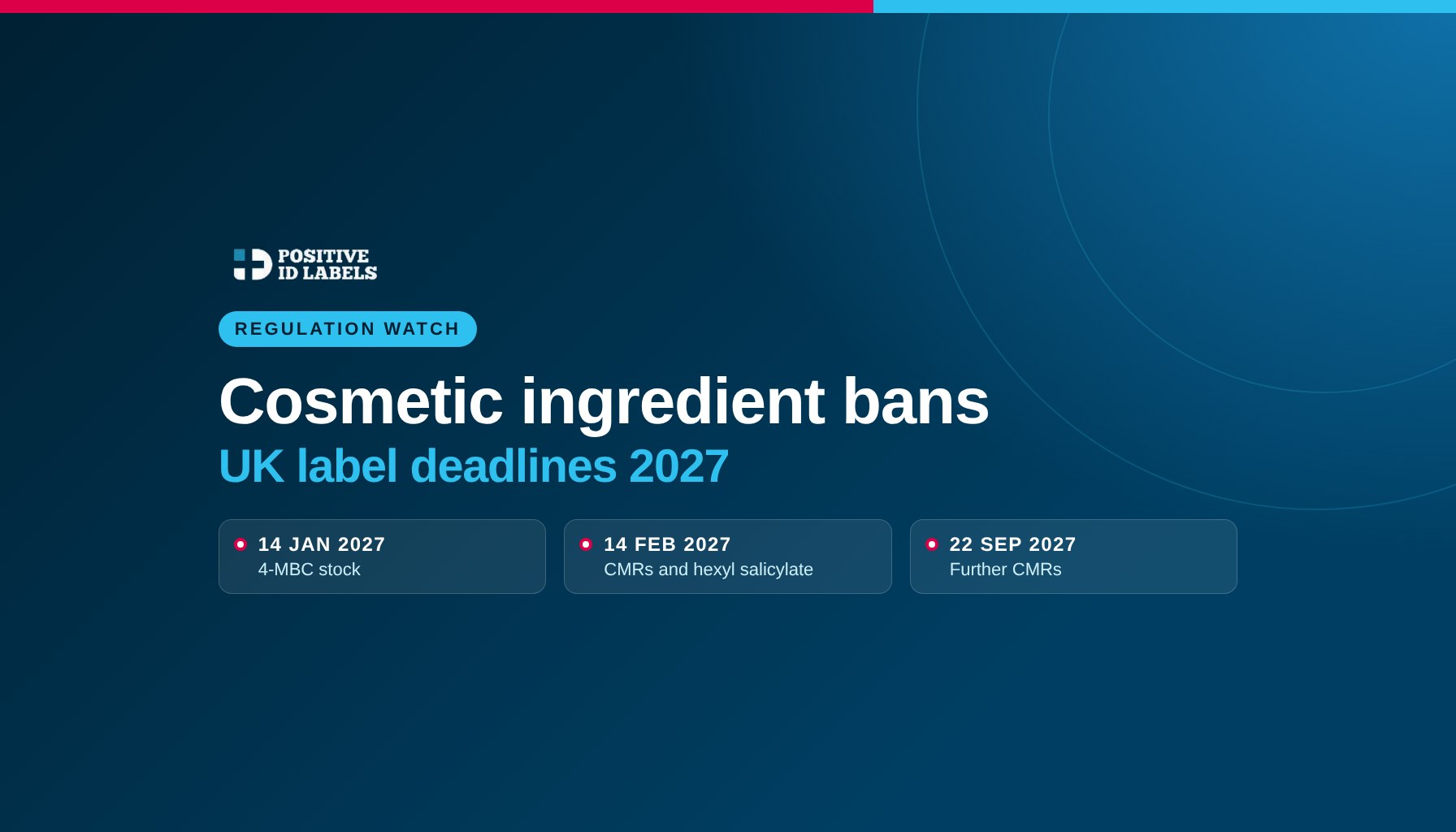
0.001%. That is the new level at which a cosmetic product in Great Britain must carry the warning “releases formaldehyde”. It used to be 0.05%, fifty times higher. It’s one of several cosmetic ingredient bans and restrictions made this year, and the last day to sell older stock is 14 January 2027.
At Positive ID Labels, we print labels for skincare, haircare and beauty brands. This guide covers what has changed, which dates matter and how to plan label reprints so you aren’t left with unsellable stock. It’s general information, not legal advice.
This guide is part of Regulation Watch, where we track UK and EU label rule changes. You’ll find every key date, free printable checklists and topic email alerts in one place.
What the 2026 Cosmetic Ingredient Bans Change
Two sets of regulations amend the UK cosmetics regulation in England, Wales and Scotland. Northern Ireland follows EU rules instead.
The first (SI 2026/23) did three things:
- Banned the UV filter 4-MBC (enzacamene) from 15 July 2026.
- Tightened the formaldehyde warning. Products containing formaldehyde-releasing preservatives must say “releases formaldehyde” where the finished product exceeds 0.001%.
- Banned 16 CMR substances (chemicals that may cause cancer, damage DNA or harm fertility) from 15 August 2026. They include TPO, a common ingredient in UV gel nail polish.
The second (SI 2026/109) restricted hexyl salicylate, a fragrance ingredient, from 15 August 2026. It also bans 13 more CMR substances, including nano silver, ozone and nitrous oxide, from 23 March 2027.
Which Products Do the Cosmetic Ingredient Bans Hit?
Most brands will feel this in four places:
- Sunscreens and SPF products that used 4-MBC.
- Gel nail products that relied on TPO.
- Fragrances, deodorants and leave-on skincare with hexyl salicylate above the new limits.
- Shampoos, washes and creams preserved with formaldehyde releasers such as DMDM hydantoin.
Shelf Deadlines You Can’t Miss
Each ban has two dates. After the first, you can’t place new non-compliant products on the market. After the second, existing stock has to come off the shelf.
| Change | No new products from | Off the shelf by |
|---|---|---|
| 4-MBC ban and old formaldehyde wording | 15 July 2026 | end of 14 January 2027 |
| 16 CMRs including TPO | 15 August 2026 | end of 14 February 2027 |
| Hexyl salicylate limits | 15 August 2026 | end of 14 February 2027 |
| 13 further CMRs, including nano silver | 23 March 2027 | end of 22 September 2027 |
Two of those off-shelf dates are less than three months away. If you still have older stock in warehouses or with retailers, now is the time to check it.
Why Cosmetic Ingredient Bans Mean New Labels
A ban is a formulation problem first. But every reformulated product needs a new label, because the ingredients list must match what is in the pack.
That means a new INCI list, and sometimes new warnings or claims. If a sunscreen loses 4-MBC, its UV filter line changes. If a fragrance cuts hexyl salicylate, its ingredients order may shift.
Cosmetic Ingredient Bans and the Formaldehyde Warning
This is the one that changes label wording directly. The old warning read “contains formaldehyde” above 0.05%. The new warning reads “releases formaldehyde” above 0.001%. Products that never needed a warning before may need one now.
Planning Reprints Around the Cosmetic Ingredient Bans
Work backwards from the off-shelf date. Confirm the new formula, update the artwork, then order labels in quantities that match your production plan. Don’t order a year of labels for a product that may change again.
Need new labels for a reformulated range? Call 01332 864895 for a fixed-price quote.
Free download: Cosmetic ingredient bans checklist (PDF). The actions from this guide as a printable checklist, with the key dates and sources.
How Positive ID Labels Can Help
We print the label. Your safety assessor and responsible person decide what it says. Here’s where we fit:
- Short digital runs. Our Xeikon prints premium paper labels at 1200dpi, and our Screen press prints polypropylene at 600dpi. Both make small runs practical, so you can reorder as formulas settle.
- Labels for the bathroom. White and clear polypropylene resist water, oils and cleaning agents. A laminate adds protection against scuffing.
- More room for text. Long INCI lists and new warnings fight for space on small packs. Multipage and peel-and-reveal labels give you extra panels.
- A premium look on a budget. Silver polypropylene with white ink gives a metallic finish without the cost of foil.
We quote a price, not an estimate, and that’s the price you pay. Call 01332 864895 or send your artwork through our enquiry form.
Frequently Asked Questions
When do the new UK cosmetic ingredient bans apply?
4-MBC and the new formaldehyde wording applied from 15 July 2026, with older stock off the shelf by the end of 14 January 2027. TPO and 15 other CMRs applied from 15 August 2026, with a 14 February 2027 off-shelf date.
What does “releases formaldehyde” mean on a label?
It’s a warning for products containing formaldehyde-releasing preservatives. It’s required where formaldehyde in the finished product exceeds 0.001%. The old wording, “contains formaldehyde”, applied only above 0.05%.
Is TPO banned in UV gel nail polish?
Yes. TPO (trimethylbenzoyl diphenylphosphine oxide) can’t be placed on the GB market in cosmetics from 15 August 2026. Older stock must be off the shelf by the end of 14 February 2027.
Is hexyl salicylate banned in the UK?
No, it’s restricted. SI 2026/109 sets limits by product type, such as 2% in fragrance products for adults and children over three and 0.1% in products for children under three.
Do these rules apply in Northern Ireland?
No. These regulations cover England, Wales and Scotland. Northern Ireland follows the EU Cosmetics Regulation, which has its own dates.
Can I relabel old stock instead of withdrawing it?
A ban on an ingredient can’t be fixed with a new label, because the product itself is no longer allowed. A wording change, like the formaldehyde warning, is different. Ask your responsible person what applies to your stock.
Can salons still use banned products after the deadline?
The trade body CTPA reads the rules as letting professionals use products they already hold on clients after the off-shelf date, but not sell them on. Check with your own adviser.
What label material suits shower and bath products?
Polypropylene works well because it resists water, oils and cleaning agents. For products handled with wet hands, a gloss or matt laminate adds scuff protection.
Sources
- SI 2026/23, Cosmetic Products Regulation (Restriction of Chemical Substances) Regulations 2026: https://www.legislation.gov.uk/uksi/2026/23/made
- SI 2026/109, (No. 2) Regulations 2026: https://www.legislation.gov.uk/uksi/2026/109/made
- CTPA, Amendments to the Annexes of the UKCR published (16 January 2026): https://www.ctpa.org.uk/news/amendments-to-the-annexes-of-the-ukcr-published-8807
- CTPA, Ban of TPO in the EU and GB (updated 13 August 2026): https://www.ctpa.org.uk/news/ban-of-tpo-gel-nail-ingredient-in-the-eu-and-gb-8562
- CTPA, GB interpretation of “making available” dates, professional use: https://www.ctpa.org.uk/news/gb-interpretation-of-making-available-dates-for-banned-ingredients-professional-use-8672
Last checked: 24 November 2026. General information, not legal advice.
Before you print
This post explains the rules as we understood them when it was last edited. It is general information, not legal advice, and we don’t check label content for compliance. The business selling the product is responsible for what its label says. For advice on your product, contact your local Trading Standards or the Office for Product Safety and Standards.
Last edited:
Read our full disclaimer | See the latest rule changes | Get a fixed-price quote or call 01332 864895
Regulation Watch
Get Regulation Watch by email
Plain-English updates when a labelling rule changes for your products, with dates and what to do about your label stock. Pick the topics that matter to you.
- Only the topics you pick
- Key dates and what to do
- Unsubscribe any time