
Meat Labelling Regulations UK: Complete Guide for Butchers and Meat Producers
Whether you run a butcher shop, produce sausages, pack mince for supermarkets, or manufacture ready meals containing meat, UK labelling regulations demand accuracy. Get it wrong and you face enforcement action from Trading Standards, product recalls, or worse — a food safety incident.
This guide breaks down every labelling requirement for fresh meat, minced meat, and products containing meat sold in the UK. It covers country of origin rules, composition standards, date marking, allergen declarations, and the specific regulations that apply to beef, pork, lamb, poultry, and game.
Related products and guides
- A practical example sits in our best-before butcher labels write-up.
- See our complete Resources range.

Contents
- The Legal Framework for Meat Labelling in the UK
- What Legally Counts as “Meat”?
- Labelling Fresh Meat (Prepacked and Loose)
- Country of Origin Requirements
- Beef and Veal: The Compulsory Labelling Scheme
- Pork, Lamb, Goat and Poultry Origin Rules
- Minced Meat Composition and Labelling
- Products Containing Meat: Reserved Descriptions and Minimum Meat Content
- Date Marking for Meat Products
- Allergen Declarations on Meat Labels
- Butcher Shop and Loose Meat Requirements
- Organic, Free-Range and Welfare Claims
- Health and Identification Marks
- Common Labelling Mistakes to Avoid
- Getting Your Meat Labels Right
1. The Legal Framework for Meat Labelling in the UK
Meat labelling in the UK is governed by several overlapping pieces of legislation. Since Brexit, the UK has retained much of the EU food law framework as “assimilated law,” meaning the core regulations remain in force until replaced by new UK-specific legislation.
The key regulations you need to know are:
Assimilated Regulation (EU) No 1169/2011 — the Food Information to Consumers (FIC) Regulation. This is the overarching framework for all food labelling requirements in the UK, including mandatory information, allergen declarations, and nutrition labelling.
The Products Containing Meat etc. (England) Regulations 2014 (with equivalent regulations for Wales, Scotland, and Northern Ireland) — these set out minimum meat content requirements and reserved descriptions for products such as sausages, burgers, and pies.
The Beef and Veal Labelling Regulations 2010 — specific traceability and origin labelling requirements for beef and veal at all stages of the supply chain.
The Country of Origin of Certain Meats (England) Regulations 2015 — mandatory origin labelling for fresh, chilled, and frozen pork, poultry, mutton, lamb, and goat meat.
The Food Information Regulations 2014 — the domestic enforcement regulations for FIC in England (with equivalents for Wales, Scotland, and Northern Ireland).
Enforcement is handled by local authority Trading Standards officers, who have powers to issue improvement notices and prosecute non-compliant businesses.
2. What Legally Counts as “Meat”?
This is one of the most misunderstood areas of meat labelling. Under UK law, “meat” has a very specific definition that differs from everyday use.
Meat is defined as skeletal muscle from mammalian or bird species recognised as fit for human consumption, together with naturally included or adherent tissue. The amount of fat and connective tissue that can be counted as part of the “meat” content is capped at specific levels depending on species.
The maximum fat and connective tissue content that counts towards declared meat content is:
| Species | Maximum Fat (%) | Maximum Connective Tissue (%) |
|---|---|---|
| Mammals (except rabbits and pigs) | 25% | 25% |
| Pigs | 30% | 25% |
| Rabbits | 15% | 10% |
| Poultry and game birds | 15% | 10% |
Any fat or connective tissue that exceeds these limits cannot be counted as “meat” and must be declared separately in the ingredients list (for example, as “pork rind” or “beef fat”).
Crucially, the following do not count as meat:
Offal — this includes organs such as liver, kidneys, heart, tongue, and other viscera. These must be listed as separate ingredients. Mechanically separated meat (MSM) — because the mechanical recovery process destroys the muscle fibre structure, MSM cannot count towards the meat content. If present, it must be declared separately as “mechanically separated [species]” in the ingredients list.
3. Labelling Fresh Meat (Prepacked and Loose)
Fresh meat sold to consumers — whether prepacked in a factory, prepacked for direct sale in a butcher shop, or sold loose over a counter — must carry specific information. The level of detail required depends on how the meat is sold.
Prepacked Fresh Meat
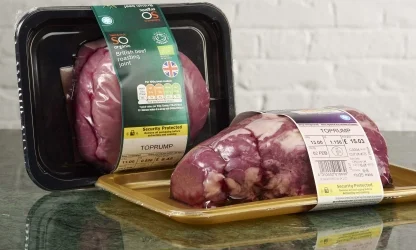
All mandatory food labelling information applies to prepacked fresh meat. This includes the name of the food, a list of ingredients (if more than one ingredient is present), net quantity, date marking, storage conditions, the name and address of the food business operator, country of origin, and a nutrition declaration.
The name of the food must be precise and accurately describe the cut — for example, “sirloin steak,” “loin chops,” or “chicken breast fillets.” Meat that has been treated with proteolytic enzymes must be described as “tenderised.” If the meat has had water added and this accounts for more than 5% of the finished weight, the name must include “with added water” — for example, “bacon with added water.”
From 1 January 2024, food products sold in Great Britain must include a UK, Channel Islands, or Isle of Man address for the food business (or the UK-based importer if the business is overseas).
Prepacked for Direct Sale (PPDS)
Meat that is prepacked on the same premises where it is sold (or from a mobile unit operated by the same business) is classified as “prepacked for direct sale.” Under Natasha’s Law, PPDS food must carry the name of the food plus a full ingredients list with allergens emphasised.
4. Country of Origin Requirements
Country of origin labelling for meat is one of the most complex areas of UK food law. Different rules apply depending on the species, and the requirements have been retained and adapted post-Brexit.
The general principle under FIC is that origin labelling is mandatory where failure to declare it might mislead the consumer. For fresh meat, this has been extended to make origin declarations compulsory for all major species.
The term “Origin” can only be used where the animal was born, reared, and slaughtered in the same country. If these stages took place in different countries, each stage must be listed separately.
5. Beef and Veal: The Compulsory Labelling Scheme
Beef and veal have the most stringent origin labelling requirements of any meat in the UK, governed by the Beef and Veal Labelling Regulations 2010. These rules apply at every stage of the supply chain, from slaughter to final retail sale.
Mandatory Information for All Beef and Veal
Whether fresh, chilled, or frozen, all beef and veal must be labelled with a traceability reference number or code linking the product back to the source animal or group of animals, the country where the animal was born, the country (or countries) where the animal was reared, the country of slaughter (shown as “Slaughtered in: [country name]”), and the country of cutting (shown as “Cut in: [country name]”). Where all stages took place in the same country, this can be simplified to “Origin: [country name].”
Young Bovine Animals
Beef and veal from animals slaughtered at under 12 months old must be categorised at slaughter. Animals under eight months old are assigned a “V” code and must be described as veal at retail. Animals between eight and 12 months old receive a “Z” code and must be described as beef. Meat from “V” and “Z” coded animals cannot be mixed in the same pack.
Prepacked Beef from Multiple Sources
Prepacked cut beef and veal can contain meat from a maximum of three slaughterhouses or cutting plants in the same package. The labelling must show the approval number and country for each slaughterhouse and cutting plant involved.
Protected Designations
Certain beef products carry protected status under UK geographical indication schemes — for example, Scotch Beef (PGI), Welsh Beef (PGI), and Orkney Beef (PDO). Products using these names must meet the registered specification, including breed, geographical origin, and farming method requirements. Full details of UK protected food names are available on the GOV.UK website.
6. Pork, Lamb, Goat and Poultry Origin Rules
Under the Country of Origin of Certain Meats (England) Regulations 2015, fresh, chilled, and frozen pork, poultry, mutton, lamb, and goat meat must be labelled with origin information.
The required information includes where the animal was reared (shown as “Reared in: [country name]”) and where it was slaughtered (shown as “Slaughtered in: [country name]”), along with a reference number or batch code for traceability.
Where an animal has been reared in more than one country, specific rules determine which country or countries to declare. Generally, if the animal spent the last significant period of its life in one country, that country is listed as the country of rearing.
For poultry, if the animal reached slaughter age in one country, that country is listed. If rearing took place across multiple countries and these specific thresholds are not met, all countries of rearing must be listed.
Important: these origin rules apply to unprocessed meat only. Once meat becomes an ingredient in a processed product (such as a pie or ready meal), these specific origin requirements no longer apply — though the general FIC rules about not misleading consumers still do.
7. Minced Meat Composition and Labelling
Minced meat has its own specific composition and labelling rules under Annex VI Part B of the retained FIC Regulation. These are critical for butchers and meat processors to understand.
Composition Standards
Prepacked minced meat sold using standard descriptions must meet the following maximum limits for fat content and collagen-to-meat-protein ratio (checked on a daily average basis):
| Description | Maximum Fat (%) | Maximum Collagen/Meat Protein Ratio (%) |
|---|---|---|
| Lean minced meat | 7% | 12% |
| Minced pure beef | 20% | 15% |
| Minced meat containing pigmeat | 30% | 18% |
| Minced meat of other species | 25% | 15% |
There is no specific fat limit set for “extra lean” mince, but if you use this description it should contain considerably less than 7% fat.
Key Rules for Minced Meat
No additives — minced meat must not contain any additives whatsoever. If you add anything (seasonings, preservatives, breadcrumbs), the product becomes a “product containing meat” rather than “minced meat” and different rules apply.
Single species naming — where a meat is named (for example, “minced beef”), no other meat species can be present.
Fat and collagen declarations — when selling prepacked minced meat using any of the standard descriptions, the label must state the percentage of fat content and the collagen-to-meat-protein ratio.
No mixing origins for minced beef — minced beef from two or more countries of origin cannot be mixed by cutting plants. Minced beef can be mixed with offal from the same country, but must carry all the compulsory beef labelling information.
UK national mark — minced meat that does not meet the standard composition criteria can still be sold in the UK provided it carries the words “For UK market only” and does not use any of the standard descriptions above.
8. Products Containing Meat: Reserved Descriptions and Minimum Meat Content
The Products Containing Meat etc. (England) Regulations 2014 set out “reserved descriptions” — specific product names that can only be used if the product meets minimum meat content requirements. This is a critical area for anyone manufacturing sausages, burgers, pies, or other meat-containing foods.
What is a “Product Containing Meat”?
A “product containing meat” (previously known as a “meat product”) is any food that contains meat, mechanically separated meat, or certain other parts of the carcase as an ingredient, whether or not other ingredients are also present. This includes everything from sausages and burgers to pies, pasties, and ready meals.
Minimum Meat Content for Reserved Descriptions
If you want to use certain product names, your product must contain at least the minimum percentage of meat specified in the regulations. Key examples include:
| Product Description | Minimum Meat Content | Notes |
|---|---|---|
| Burger / hamburger | 62% | Must be named species if specified (e.g. “beef burger”) |
| Economy burger | 47% | Reduced specification permitted |
| Sausage (pork) | 42% | 65% for “pork sausage” with species named |
| Sausage (other meat) | 32% | Must declare species |
| Meat pie | 12.5% | Based on total pie weight including pastry |
| Meat pudding | 12.5% | Based on total weight |
| Pasty / pastie | 12.5% | Higher for named products like Cornish Pasty (PGI) |
| Sausage roll | 12.5% | Based on total weight |
| Corned meat | 120% | Percentage of cooked weight (accounts for moisture loss) |
| Luncheon meat | 67% | Of total product weight |
| Chopped meat | 80% | Of total product weight |
If your product does not meet the minimum meat content for a reserved description, you cannot use that product name. You would need to choose an alternative name that accurately describes the food without implying it meets the reserved standard.
QUID Declarations
Any ingredient mentioned in the product name, emphasised on the label, or generally associated with the product requires a QUID (Quantitative Ingredient Declaration) stating what percentage of the total product it represents. For example, if you sell “Pork Sausages,” you must declare the percentage of pork present.
Added Water and Formed Meat
If an uncooked cured or uncured meat product contains more than 5% added water and has the appearance of a cut, joint, slice, or portion of meat, the name must include “with added water” — for example, “ham with added water.” This does not apply to products like sausages that do not resemble a cut of meat.
Products that look like a single piece of meat but are actually made from multiple pieces joined together must be labelled as “formed meat.”
Added Proteins from Different Species
If a meat product contains added protein from a different animal species, this must be declared in the product name. For example, “chicken breast with added pork protein” or “beef escalopes with chicken egg protein.” This applies to all forms of added protein, including hydrolysed proteins.
Restricted Ingredients in Uncooked Products
Certain parts of the carcase from mammalian species cannot be used in uncooked meat-containing products. These include brains, feet, small and large intestine, lungs, oesophagus (gullet), rectum, spinal cord, spleen, stomach, testicles, and udder. Uncooked intestines may only be used as sausage casings, and if those casings are inedible, this must be stated on the label.
Additives in Meat Products
Additives in products containing meat are tightly controlled. Sulphur dioxide, for example, is only permitted in burger meat that contains a minimum 4% rusk or vegetable content, or in sausages, and only at a maximum level of 450 mg/kg. Because sulphites are one of the 14 declarable allergens, their presence must always be declared on the label.
9. Date Marking for Meat Products
Correct date marking on meat is a food safety essential. The type of date mark you use depends on the product.
Use by dates are mandatory for perishable fresh meat, mince, offal, and chilled meat products. These are safety dates — food must not be consumed after the use-by date as it could pose a health risk. The business applying the date is responsible for determining the correct shelf life.
Best before dates relate to quality rather than safety and are used for less perishable items such as cured meats, canned meats, and some frozen products.
Frozen meat has a specific additional requirement: prepacked frozen meat must show the date of freezing (or the date of first freezing where the product has been frozen more than once). Where a product or preparation contains food from batches frozen on different dates, you must give the oldest date of freezing. However, you do not need to give the date of first freezing if the meat is included as an ingredient in a composite product (such as a frozen chicken pie).
Storage conditions must accompany the date mark. For fresh meat this typically includes a statement such as “Keep refrigerated below 5°C” and, where relevant, “Suitable for freezing” with guidance on how to thaw and consume.
10. Allergen Declarations on Meat Labels
While fresh, unprocessed meat is not itself one of the 14 declarable allergens, many meat products contain allergenic ingredients that must be declared. Common allergens found in meat products include:
Cereals containing gluten — present in breadcrumbs, rusk (a common binder in sausages and burgers), flour coatings, and batter. Eggs — used as a binding agent in burgers, meatballs, and coated products. Milk — found in cream sauces, cheese fillings, and some marinated meats. Mustard — a common ingredient in sausage spice blends and marinades. Celery — frequently present in stock cubes, gravy mixes, spice blends, and ready meal sauces. Sulphur dioxide (sulphites) — used as a preservative in sausages and certain burgers, and must be declared when present at levels above 10 mg/kg or 10 mg/litre. Soya — found in some processed meat products as a protein extender or in soy-based marinades.
Allergens must be emphasised within the ingredients list — typically by using bold text, uppercase, or a different colour. A statement such as “For allergens see ingredients in bold” must accompany the ingredients list.
Under Natasha’s Law, food that is prepacked for direct sale (PPDS) — including meat products packed in-store — must carry a full ingredients list with allergens emphasised. This is particularly relevant for butchers who pack and label their own products on the premises.
Check every ingredient carefully. Pre-mixed spice blends, marinades, and seasonings frequently contain allergens that are easy to overlook. Recipes should be documented and ingredients lists reviewed whenever a supplier changes.
11. Butcher Shop and Loose Meat Requirements
Butchers selling loose (non-prepacked) meat have different labelling obligations compared to factory-prepacked products, but they are still substantial.
Loose Fresh Meat
Loose fresh meat displayed for sale must be labelled with the name of the food. This should be precise, stating the type of meat and accurately describing any cut — for example, “lamb loin chops,” “pork belly slices,” or “chicken thigh fillets.”
Country of origin information must be available to the consumer, displayed in writing at the point of sale. For beef, all the compulsory traceability information (reference code, country of birth, rearing, slaughter, and cutting) must be visible. Meat from different countries must be clearly separated in the display.
Allergen information for non-prepacked food must be available to the consumer at the point of sale. While there is some flexibility in how this is communicated (verbally is permitted in some circumstances, with appropriate signposting), best practice is to provide written information for each product.
Loose Meat Products
Loose (non-prepacked) products containing meat — such as sausages, burgers, and pies sold over the counter — must be accompanied by the name of the food, the percentage of meat content, a QUID declaration for any meat-containing ingredients, and allergen information.
The compositional requirements (minimum meat content for reserved descriptions) apply equally to loose products. A sausage sold over the counter must meet the same minimum meat content as one sold prepacked.
Butchers who operate daily records should note that for non-prepacked beef and veal, operators must keep a daily, dated record of the licence numbers of slaughterhouses and cutting plants relating to meat for sale, and must show this to consumers on request.
12. Organic, Free-Range and Welfare Claims
Claims about farming methods on meat labels are strictly regulated, and using them incorrectly is a criminal offence.
Organic — meat can only be labelled as “organic” if it has been produced and certified in accordance with UK organic standards by an approved control body. The certification body must be named on the label. Since Brexit, the UK has its own organic standards and recognition agreements with certain countries.
Free-range — for poultry, the term “free-range” has legal definitions under marketing standards regulations. Chickens labelled as free-range must have had continuous daytime access to open-air runs for at least half their lifetime, with specific minimum space allowances. Similar standards apply to other poultry species. For other meats (such as pork), “free-range” does not have a specific legal definition in the same way, but any claim must be truthful and not misleading under general food law.
Other welfare claims — terms such as “farm fresh,” “country fresh,” or “natural” can mislead consumers into thinking the meat comes from higher welfare systems than it actually does. The Advertising Standards Authority (ASA) and Trading Standards have both taken action against misleading imagery and wording on meat packaging. If you use welfare-related claims or imagery (such as pictures of animals in fields), be prepared to substantiate them.
The UK Government has considered introducing mandatory animal welfare labelling but has shelved formal consultation for the time being. Defra continues to explore how to improve food information and raise animal welfare standards, so this remains an area to watch.
13. Health and Identification Marks
Products of animal origin (including meat, minced meat, and meat preparations) must carry either a health mark or an identification mark to show they have been produced in an approved establishment.
Health marks are applied directly to carcases and large cuts of meat at the slaughterhouse after ante-mortem and post-mortem inspection by an official veterinarian. The oval stamp contains the approval number of the establishment, the country code (UK), and the recognised food safety authority initials.
Identification marks are applied to products that have undergone further processing (cutting, packaging) at approved establishments. These must be applied before the product leaves the establishment and must be clearly legible.
Since 1 January 2021, health and identification marks on products produced in Great Britain use the “UK” country identifier rather than the EU-style markings. Products from Northern Ireland may use “UK(NI)” markings.
14. Common Labelling Mistakes to Avoid
Based on enforcement actions and industry experience, these are the most frequent meat labelling errors we see:
Using a product name without meeting minimum meat content. Calling something a “pork sausage” when it contains less than 65% pork meat, or labelling a product as a “beef burger” with less than 62% beef, is a breach of the reserved descriptions regulations.
Missing or incomplete origin labelling. All fresh beef, pork, lamb, and poultry must carry origin information. Forgetting to update labels when suppliers change is a common problem.
Allergens not emphasised in the ingredients list. Simply listing “wheat flour” is not enough — the allergenic component (“wheat flour”) must be highlighted. Spice blends and pre-mixed seasonings are frequent sources of undeclared allergens.
Using “use by” and “best before” interchangeably. Fresh meat and mince are perishable and require a use-by date (a safety date), not a best-before date (a quality date). Confusing these can create genuine food safety risks.
Incorrect or missing QUID declarations. If your product name mentions a specific ingredient (“chicken and mushroom pie”), you must declare the percentage of both chicken and mushroom.
Misleading welfare or origin claims. Terms like “farm fresh” with imagery of rolling green fields on intensively-reared meat will attract enforcement attention.
Describing offal as “meat.” Liver, kidney, heart, and tongue are not “meat” under the legal definition and cannot be counted towards meat content declarations.
Adding additives to minced meat. Minced meat must contain no additives. Once you add seasoning, rusk, or preservatives, it becomes a “product containing meat” and must be labelled accordingly.
15. Getting Your Meat Labels Right
Meat labelling regulations are complex, but getting them right protects your business, your customers, and your reputation. At PID Labelling, we have decades of experience producing compliant meat labels and butchers labels for businesses of every size — from independent high-street butchers to large-scale meat processing operations.
We can advise on label specifications, materials suitable for chilled and frozen food environments, and adhesives that perform reliably in cold-chain conditions. Whether you need pre-printed labels, thermal printing solutions for variable data like use-by dates and batch codes, or a complete labelling system, we can help.
For more detailed guidance on specific aspects of food labelling, see our guides to UK food labelling requirements, allergen labelling, and nutrition declarations.
Need compliant meat labels? Call us on 01332 864895 to discuss your requirements, or fill in our contact form and we will get back to you.