RAM Rating: How Your Label Affects Your EPR Fee
One rule in the UK’s new packaging guidance should make every brand owner pause. If your label adhesive does not let go in a 70 to 90°C hot wash, a plastic bottle or tub is rated red. That single detail can decide your RAM rating, and with it the fee you pay under extended producer responsibility (EPR).
At Positive ID Labels, we print labels for food, drink, chemical and cosmetics brands across the UK. This guide explains what RAM is, the label rules that matter, and what to check before your next print run.
What Is a RAM Rating and Why Does It Matter?
RAM stands for the recyclability assessment methodology. Large producers under UK packaging EPR must use it to rate the household packaging they supply as red, amber or green. They report those results to the environmental regulators.
Your RAM rating feeds straight into fees. Red-rated packaging pays higher disposal fees than amber or green. This is called fee modulation.
Smaller producers do not have to run the assessment. Many will still be asked for the data, because their customers and retailers need it to complete their own reports.
How a RAM Rating Is Worked Out
The method has four parts:
- Whole item or separate parts. Decide whether the pack is assessed as one item of joined components, or as separate pieces. A label stuck on with adhesive that stays on through sorting counts as part of the pack.
- Material category. Place it in a category such as rigid plastic, flexible plastic, paper and board, glass, steel or aluminium.
- Four stages. Rate it at collection, sortation, reprocessing and application.
- Automatic reds. Check the rules that make a pack red regardless.
The guidance gives a useful example. A plastic label assessed on its own would be red. Stuck to a glass jar, it can be assessed as part of a green jar.
When Your RAM Rating Applies
Two versions matter right now:
- The 2026 reporting year (1 January to 31 December 2026) uses RAM version 1.1.
- RAM 2027 covers 1 January to 31 December 2027. It was first published on 1 July 2026 and updated on 20 August 2026.
A new version is published each year, so check the current one before you sign off a new pack.
Label Rules That Can Change a RAM Rating
Here is where labels come in. These rules come from the RAM 2027 materials guidance on gov.uk.
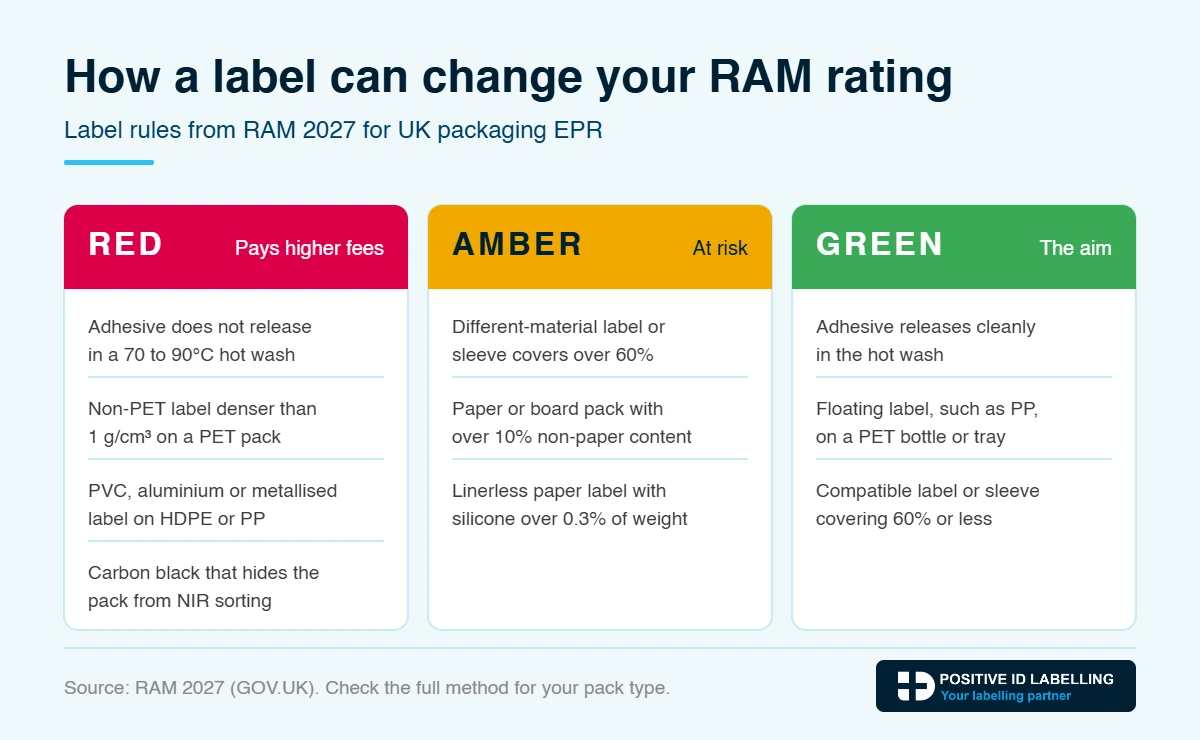
Rigid Plastic Bottles, Tubs and Trays
Paper and Board Packs
- More than 10% non-paper content by weight makes the pack amber.
- Linerless paper labels are amber if their silicone release coating is more than 0.3% of the label’s weight.
Glass, Steel and Aluminium
Soda-lime glass has no label rules at all. Steel and aluminium turn amber only above 30% non-metal content by weight, which a label rarely reaches.
Automatic Reds Every Label Buyer Should Know
Some triggers turn a pack red whatever else is true:
- Inks not manufactured in line with the European Printing Ink Association (EuPIA) exclusion policy.
- PFAS above 1 ppm in total, or above 25 ppb of any single PFAS (or of total PFAS) in food packaging.
- Packaging that has not been assessed, or lacks the detail needed to assess it.
That last point is easy to miss. No supplier data can mean red by default.
What This Means for Your Label Specification
Your label choice now has a cost attached. Face material, adhesive, inks and coverage all feed into the rating. Getting them right early beats redesigning after your fee invoice arrives.
Questions to Ask Before Your Next RAM Rating Review
Are Recycling Labels Now Mandatory?
Not yet. Reports from OPRL and the trade press say mandatory recyclability labelling will not be part of the first stage of UK packaging EPR, and the planned 1 April 2027 requirement will not be enforced. Defra has said it will look at options once the EU’s approach is clearer. We are treating this as reported until gov.uk confirms it.
So for now, the pressure on labels comes through fees, not on-pack logos.
How Positive ID Labels Can Help
We are gathering recyclability data from our ink, labelstock and adhesive suppliers, so we can answer your RAM rating questions with documents, not guesswork. Until that data is in, we will not tell you a material is “green”. We will tell you what we know and what we are still checking.
Today, we can talk through your pack: the container material, the coverage, the conditions your label faces, and the adhesive options. The right combination depends on your container.
Call 01332 864895 or use our enquiry form to tell us about your pack. We’ll share the material information we hold for your EPR report, and give you a fixed-price quote.

I had an amazing experience working with Positive ID Labelling, especially Natalie. The labels were absolutely brilliant quality and exceeded my expectations. Natalie was fantastic throughout the whole process. Communication was amazing from start to finish. She was so helpful, guided me through everything, and made the whole experience stress free and enjoyable. She was also genuinely funny and a pleasure to work with, which made everything even better. I’ll definitely be working with Natalie again on future projects and would highly recommend Positive ID Labelling to anyone looking for high-quality labels and excellent customer service.

Fantastic label printing service. Labels to a very high specification. Helen was great at sorting out our requirements, quotes, and order.

We’ve had a great experience working with this supplier, especially with Natalie - she is always very responsive, professional, and friendly. The pricing is highly competitive and the sales service has been excellent from start to finish.If I could offer one suggestion, it would be to improve the account and invoice management process. It would be really helpful if there were a system for clients to easily track their past orders and invoices in one place.Overall, very pleased with the service and look forward to continuing our collaboration.

Natalie and Positive ID labelling were amazing. I have some really beautiful egg box labels that were exactly what I asked for. Brilliant communication and undertanding from everyone i dealt with. Pricing was good and I will not look any further for all my labelling needs. Thank you again!

Frequently Asked Questions
What does RAM stand for in packaging EPR?
RAM stands for the recyclability assessment methodology. It is the UK method large producers use to rate household packaging red, amber or green under extended producer responsibility. The rating affects the disposal fees they pay.
Do small producers need a RAM rating?
Small producers do not have to carry out or report the assessment. However, large producers and retailers you supply may ask you for material data so they can complete their own reports.
Can a label make my packaging red?
Yes. On rigid plastic packs, a label adhesive that does not release in a 70 to 90°C hot wash makes the pack red. Labels made of PVC, aluminium, metallised PET or metallised PS on HDPE or PP packs also make them red.
Why does label density matter on PET bottles?
PET recycling plants separate labels in water. Labels made from a polymer other than PET that sink (density above 1 g/cm3) make the pack red. Floating materials such as polypropylene separate from the PET flakes.
Does label coverage affect recyclability?
On rigid plastic packs, a label or sleeve of a different material covering more than 60% of the surface makes the pack amber. Smaller labels help sorting machines identify the container.
Are there label rules for glass jars and bottles?
No. RAM 2027 sets no label rules for soda-lime glass. A plastic label stuck to a glass jar is assessed as part of the jar.
What is the EuPIA exclusion policy and why does it matter?
It is the European Printing Ink Association’s list of raw materials that should not be used in printing inks. Under RAM, inks not made in line with it turn packaging red automatically, so ask your printer to confirm compliance in writing.
Do linerless labels affect my RAM rating?
They can on paper packaging. Paper labels are amber if their silicone release coating is more than 0.3% of the label’s weight, so check the specification with your supplier.
Is recyclability labelling mandatory in the UK?
Not in the first stage of packaging EPR, according to OPRL and trade press reports. The planned April 2027 requirement will not be enforced, and Defra is reviewing options. When your artwork is ready, call 01332 864895 for a fixed-price quote.
Free download: pEPR RAM label checklist (PDF). The actions from this guide as a printable checklist, with the key dates and sources.
Sources
- GOV.UK: RAM 2027 overview: https://www.gov.uk/government/publications/assess-packaging-recyclability-recyclability-assessment-methodology-ram-2027/ram-2027-overview
- GOV.UK: RAM 2027 materials assessment guidance: https://www.gov.uk/government/publications/assess-packaging-recyclability-recyclability-assessment-methodology-ram-2027/ram-2027-materials-assessment-guidance
- GOV.UK: Recyclability assessment methodology: how to assess your packaging waste: https://www.gov.uk/guidance/recycling-assessment-methodology-how-to-assess-your-packaging-waste
- OPRL help centre: mandatory labelling under pEPR (reported): https://help.oprl.org.uk/en/knowledge/what-are-the-mandatory-requirements-for-labelling-under-epr
Before you print
This post explains the rules as we understood them when it was last checked. It is general information, not legal advice, and we don’t check label content for compliance. The business selling the product is responsible for what its label says. For advice on your product, see Defra’s packaging EPR guidance or ask a compliance specialist.
Last checked: 23 November 2026
Last edited:
Read our full disclaimer | See the latest rule changes | Get a fixed-price quote or call 01332 864895