Alcohol-Free Wine Labels: New EU Rules From 2027
On 19 September 2027, the words on every de-alcoholised wine label sold in the EU and Northern Ireland have to change. If you make alcohol-free wine, or a lighter version of a classic, that date matters. Positive ID Labels prints wine labels for UK brands selling at home and abroad. This guide explains what Regulation (EU) 2026/471 changes, who it affects, and how to plan a clean switch without wasting stock.
The good news? You have time. The rule is fixed, the terms are clear, and old stock can sell through. You just need a plan.
What Changes for Alcohol-Free Wine in the EU
The EU’s “wine package” became law on 18 March 2026. Its main label change applies from 19 September 2027. From then, the old terms “de-alcoholised” and “partially de-alcoholised” are replaced.
Here is the new wording:
That last phrase is new. It becomes a compulsory particular, so it must appear on the label of every de-alcoholised wine.
How the Alcohol-Free Wine Terms Work in Practice
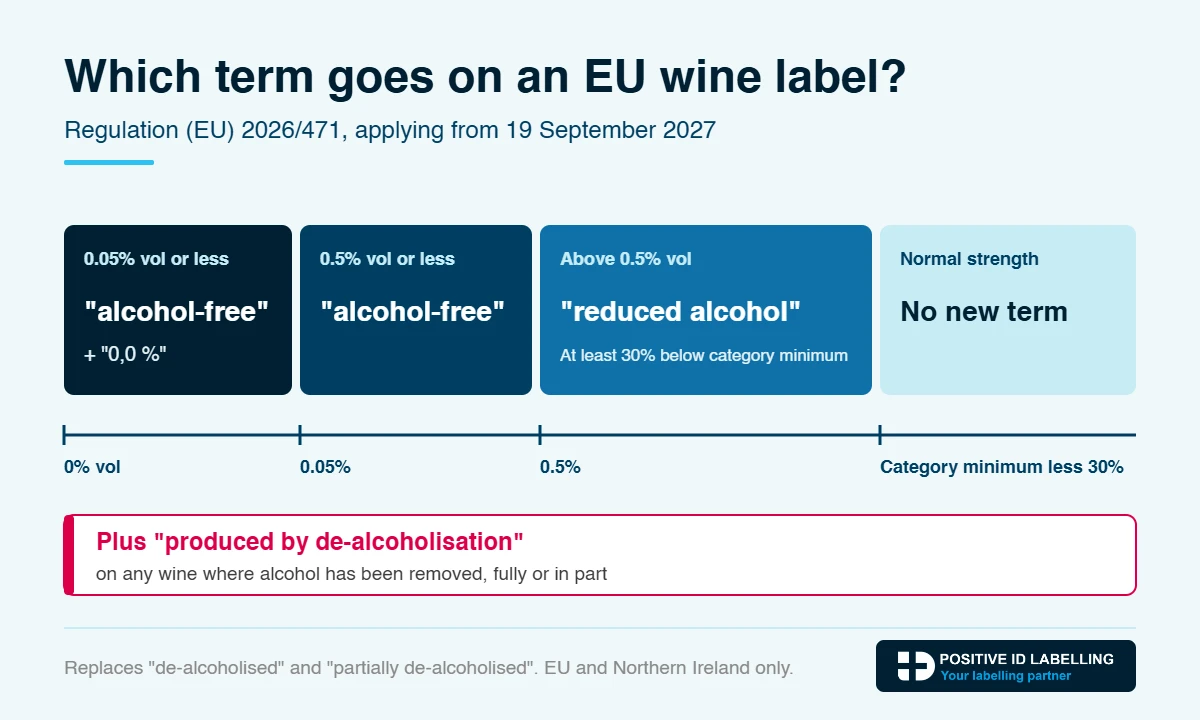
The new terms sit with the category name, such as “wine”. So a 0.0% product would read something like “alcohol-free wine, 0,0 %”, with “produced by de-alcoholisation” elsewhere on the pack. Ask your regulatory adviser to confirm exact placement.
The 30% rule needs care. Take a category with an 8.5% minimum strength. Thirty per cent below that is 5.95%. So “reduced alcohol” fits a wine between 0.5% and 5.95% vol. Every category has its own minimum, so check yours.
One Helpful Change for Alcohol-Free Wine Packs
Compulsory particulars now only need to appear once per pack. On front, back and neck label designs, that can free up real space. Use it for clearer branding, a QR code or better legibility.
Alcohol-Free Wine and E-Labels
The Commission can now set a common pictogram or symbol to flag e-labels on pack. No rule exists yet. DAERA reported that six wine-sector acts were planned for Q4 2026, and we had not seen any adopted by 20 October 2026. If you plan a QR code for your ingredients and nutrition e-label, leave room for a possible symbol.
Who Needs New Labels, and Who Doesn’t
The rules differ between Great Britain, Northern Ireland and the EU.
You are in scope if you:
You are not affected if you:
- sell only in England, Scotland or Wales, because GB law has not changed
- move goods to Northern Ireland under the Retail Movement Scheme
- make beer, cider or spirits, because the terms cover wine-category and aromatised wine products only
Northern Ireland follows these EU rules automatically under the Windsor Framework. Great Britain does not. GB rules still set a minimum strength for wine, and naming for low and no wine in GB remains uncertain.
So a brand selling the same product in Manchester and Madrid will need two label versions.
Planning Your Wine Label Switch
Use Up Old Stock the Smart Way
Products labelled under the old terms before 19 September 2027 can stay on sale until stocks run out. That is good news for anything already bottled and labelled.
Be careful with labels printed but not yet applied. The wording covers products that are labelled, not label rolls in a store room. Treat unapplied old-style labels as unusable for EU and NI sales after the deadline, and order quantities to match.
Order Little and Often Before the Deadline
This is where digital print earns its keep. Shorter runs let you match label stock to bottling plans, so you are not left with thousands of old labels in September 2027.
To help plan quantities, we can set a reorder reminder based on how fast you use labels. You run down EU stock on time and switch cleanly.
Not sure how many versions you need? Call 01332 864895 and talk it through.
Choose Materials That Suit Your Wine
- Tintoretto textured paper on our Xeikon press, printed at 1200dpi, gives premium wine a crafted, tactile feel. It is moisture-resistant and handles chilled conditions well. It is not fully waterproof, so it isn’t for ice buckets.
- Clear polypropylene gives a “no-label look”, as if the design is printed straight onto the glass.
- Matt laminate, available on our Xeikon and Screen presses, adds scuff protection in transit. It is a popular choice for high-end wine labels.
We can also print QR codes as part of your artwork, ready for e-labels.
Export-Only Wine
EU wine made only for export no longer needs the EU ingredients list or nutrition declaration. On the corrected text, that has applied since March 2026. The destination country’s rules apply instead.
Ready for 19 September 2027?
Three dates matter here:
- 18 March 2026: the regulation came into force.
- Q4 2026: further wine acts were planned, possibly including an e-label symbol.
- 19 September 2027: the new terms apply in the EU and Northern Ireland.
You don’t need to reprint today. You should know which SKUs go where, how much old-style stock you hold, and when your last old-term print run should be.
Got a split GB and EU range? Call 01332 864895 or send us a message through our enquiry form. We’ll give you a fixed-price quote and help you plan quantities for the switch. We print labels, not legal advice, so check the wording with your regulatory adviser.

I had an amazing experience working with Positive ID Labelling, especially Natalie. The labels were absolutely brilliant quality and exceeded my expectations. Natalie was fantastic throughout the whole process. Communication was amazing from start to finish. She was so helpful, guided me through everything, and made the whole experience stress free and enjoyable. She was also genuinely funny and a pleasure to work with, which made everything even better. I’ll definitely be working with Natalie again on future projects and would highly recommend Positive ID Labelling to anyone looking for high-quality labels and excellent customer service.

Fantastic label printing service. Labels to a very high specification. Helen was great at sorting out our requirements, quotes, and order.

We’ve had a great experience working with this supplier, especially with Natalie - she is always very responsive, professional, and friendly. The pricing is highly competitive and the sales service has been excellent from start to finish.If I could offer one suggestion, it would be to improve the account and invoice management process. It would be really helpful if there were a system for clients to easily track their past orders and invoices in one place.Overall, very pleased with the service and look forward to continuing our collaboration.

Natalie and Positive ID labelling were amazing. I have some really beautiful egg box labels that were exactly what I asked for. Brilliant communication and undertanding from everyone i dealt with. Pricing was good and I will not look any further for all my labelling needs. Thank you again!

FAQs
What does “alcohol-free” mean on an EU wine label from 2027?
It means the wine is 0.5% vol or less. If the wine is 0.05% vol or less, “0,0 %” must be added. These terms replace “de-alcoholised” from 19 September 2027.
When must the new wine label terms be used?
From 19 September 2027 in the EU and Northern Ireland. Products labelled under the old terms before that date can stay on sale until stocks run out.
What does “produced by de-alcoholisation” mean?
It is a new compulsory particular. Any wine where alcohol has been removed, fully or in part, must carry it from 19 September 2027.
When can a wine say “reduced alcohol”?
When it is above 0.5% vol and at least 30% below its category’s minimum strength. For a category with an 8.5% minimum, that means 5.95% vol or less.
Do UK-only wine brands need to change their labels?
No. GB law has not changed. You only need the new terms on products sold in the EU, or in Northern Ireland outside the Retail Movement Scheme.
Does this apply to low-alcohol beer or cider?
No. The terms cover wine-category products and aromatised wine products, such as low-alcohol sangria-style drinks. Beer, cider and spirits are not included.
Can I use labels I printed before September 2027?
Only if they are on bottles before 19 September 2027. The sell-through rule covers labelled products. Unapplied old-style labels should not be used for EU or NI sales after that date.
Will wine labels need an e-label symbol?
Possibly. The Commission now has the power to set one. DAERA reported that further acts were planned for Q4 2026. No symbol had been adopted as at 20 October 2026.
Which label material is best for premium wine bottles?
Tintoretto textured paper suits premium wine with a tactile, crafted feel. Clear polypropylene gives a “no-label look”. Matt laminate adds scuff protection in transit.
How quickly can you print a split GB and EU label run?
Call 01332 864895 with your quantities and deadline, and we’ll tell you honestly what we can do.
Free download: EU alcohol-free wine label checklist (PDF). The actions from this guide as a printable checklist, with the key dates and sources.
Sources
- Regulation (EU) 2026/471, Official Journal, 26 February 2026: https://eur-lex.europa.eu/eli/reg/2026/471/oj/eng
- Council of the EU, corrigendum ST 7754/26, 30 April 2026: https://data.consilium.europa.eu/doc/document/ST-7754-2026-INIT/en/pdf
- AGRINFO, Labelling of low-alcohol wines: https://agrinfo.eu/book-of-reports/labelling-of-low-alcohol-wines/
- Defra Explanatory Memorandum on COM(2025) 137, 27 May 2025: https://assets.publishing.service.gov.uk/media/684039fbcb73e8b12647b3e1/COM_2025__137_final_.pdf
- DAERA impact assessment DSC/06/2026, 27 February 2026: https://www.niassembly.gov.uk/globalassets/committee-blocks/windsor-framework-democratic-scrutiny-committee/reg-eu-2026471/g-20260227-daera-aoi.pdf
- WSTA, EU Wine Reform and the UK, 5 March 2026: https://wsta.co.uk/eu-wine-reform-and-the-uk-what-it-means-for-the-low-and-no-sector/
Before you print
This post explains the rules as we understood them when it was last checked. It is general information, not legal advice, and we don’t check label content for compliance. The business selling the product is responsible for what its label says. For advice on your product, contact the Food Standards Agency or the regulator in the EU country you sell into.
Last checked: 23 November 2026
Last edited:
Read our full disclaimer | See the latest rule changes | Get a fixed-price quote or call 01332 864895