Allergen Warning Labels: Do not use ‘May Contain’ Statements Incorrectly
‘May contain nuts’ statements appear on food labels all over the place, but they’re often applied carelessly. A blanket “may contain nuts warning label” caution, rather than a risk-based assessment, is the wrong approach. This creates two problems:
- Customers with allergies can’t trust the warning as it is just noise, and
- food businesses expose themselves to liability.
This guide explains when ‘may contain’ warnings are appropriate on food labels and how to apply them in a way that’s honest to customers and legally defensible as allergen warning labels.
The Legal Distinction: Mandatory Allergies vs Advisory Warnings
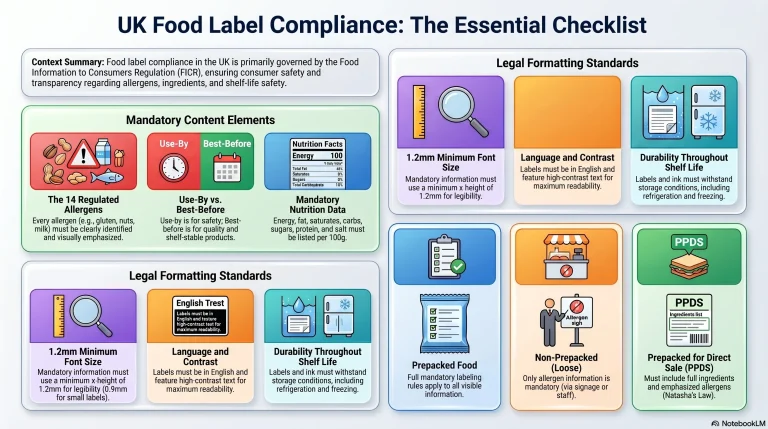
Mandatory allergen declarations must appear when allergens are deliberate ingredients. All 14 regulated allergens must be clearly declared in the ingredients list with visual emphasis (uppercase, bold, colour, italics).
Precautionary ‘may contain’ statements communicate potential unintended allergen presence through cross-contamination. These are not legally mandated in the same way, but they serve a critical function: they inform consumers of assessed risks as part of your allergen warning labels.
A ‘may contain’ statement should only appear if cross-contamination is a genuine, documented risk, it should not be used as a blanket precaution.
Food Allergy Labels: When ‘May Contain’ Statements Are Appropriate
Scenario 1: Shared Equipment, Assessed Cross-Contamination
Your facility makes peanut-free biscuits on equipment that also processes peanut products. Even after thorough cleaning, trace residue could remain.
Assessment: Test your cleaning process. Can you reliably remove all peanut residue? If post-cleaning swabs show detectable residue, a ‘may contain peanuts’ warning is appropriate.
Allergen warning label: “May contain peanuts due to shared processing equipment,” or “Made in a kitchen/facility that also processes peanuts.”
Scenario 2: Unverified Ingredient Sourcing
You use vanilla extract from a supplier who sources from facilities that also process tree nuts. Cross-contamination could enter the supply.
Assessment: Contact the supplier. Can they guarantee nut-free processing? If not verified, a warning is appropriate.
Their labelling, if done correctly, should highlight the cross-contamination risk, and that should be conveyed on their labels, enabling you to give correct allergen warning labels yourself.
Scenario 3: Lack Of Ingredient Certainty
You use a shop-bought component whose allergen status hasn’t been verified. You cannot confidently exclude allergens.
Assessment: Request full allergen information from the supplier. Until verified, a precautionary statement may be necessary to be safe with your allergen warning labels.
Common Misuses Of ‘May Contain’ Warnings
Misuse 1: Generic precaution without assessment. A bakery states ‘may contain all allergens’ as allergen warning labels on every product because their facility uses all allergen-containing ingredients somewhere, without assessing whether specific products have cross-contamination risk.
Result: A customer with a tree nut allergy cannot determine if a specific product is safe. The warning becomes meaningless and/or excludes the customer from using any products.
Misuse 2: Overcautious labelling. Adding the generic ‘may contain nuts’ warnings to everything to avoid liability, regardless of actual risk.
Result: Not suitable for allergen warning labels. If you’re adding warnings you don’t genuinely believe are necessary, it suggests you either don’t understand your risks or are being deliberately vague. This is again excludes allergen-suffering customers from consuming products that may be otherwise perfectly safe.
How To Assess Cross-Contamination Risk on Food Allergen Labels: A Process
Step 1: Identify allergen entry points. List every ingredient containing the 14 regulated allergens that enters your facility. For each one, note where it’s stored, which products use it, which equipment it contacts, and what cleaning follows.
Step 2: Assess cross-contamination points. For each product NOT containing nuts, identify where cross-contamination could occur: equipment contact, ingredient sourcing, staff handling, storage proximity.
Step 3: Assign risk level. Is the risk negligible (thorough cleaning eliminates detectable residue) or documented (trace residue remains after cleaning)? Base the decision on actual testing or documented risk.
Step 4: Document your assessment. This is your proof that ‘may contain’ labelling is based on a real assessment. If an incident occurs later, this documentation shows you acted responsibly.
For specific advice on your food allergy labels, you should discuss with your local trading standards and environmental health teams. They will be able to give advice on how they enforce the regulations in your area. (This may vary from officer to officer and area to area, so ensure you get written documentation of their advice.)
Using ‘May Contain’ Language Correctly
Use specific language: “May contain peanuts” — not “may contain trace allergens” or vague references.
State the reason: “May contain peanuts due to shared processing equipment.” This helps consumers understand and trust the warning.
Be consistent: If you warn on one product but not another made on the same equipment, you’re inconsistent, or your risk assessment needs clarification.
Common Causes Of Incorrect ‘May Contain’ Use
No risk assessment done. Labels carry precautionary statements based on assumptions rather than testing or documented risk.
Ingredient uncertainty. Suppliers haven’t provided full allergen information, so precautionary statements are added as a catch-all.
Inconsistent application. Similar products have different ‘may contain’ statements based on different staff interpretations rather than documented risk. If you have more than one person involved in the allergen labelling process, they need to work from the same standards to ensure your allergen warning labels are adequate.
Confusing risk types. Mixing mandatory allergen declarations (ingredient is present) with precautionary statements (cross-contamination risk) on the same product without clear distinction.
FAQ: Allergen Warning Label Questions Answered
Q: If a supplier certifies their ingredient as allergen-free, do I still need a ‘may contain’ warning? A: Not if the certification is reliable and covers your concern. However, verify it’s from a reputable third party. If you then process the ingredient and introduce a risk of cross-contamination, you need to evaluate against that risk.
Q: Can I use ‘may contain’ as a blanket precaution? A: Not defensibly. Base warnings on actual risk assessment or documented cross-contamination risk, not generic caution. It is an easy response, but a lazy response, and is technically an inaccurate allergen advisory label.
Q: What counts as adequate risk assessment? A: Testing your cleaning process (swab testing for residue), supplier verification of ingredient sourcing, or documented incidents.
Q: Can I remove a ‘may contain’ warning if I improve my process? A: Only if your risk assessment changes (process improves, testing shows no residue, suppliers verify safety). Document the change.
Q: What if a customer has an allergic reaction and my ‘may contain’ warning was wrong? A: If you warned of a risk that didn’t exist (overcautious), liability is less clear. If you failed to warn of a real risk, liability is substantial.
Q: Should ‘may contain’ statements be on the front or back of the label? A: Best practice is prominently displayed alongside mandatory allergen information. Don’t hide precautionary statements in small print. You can easily tag the precautionary statement onto the end of your allergy-highlighted ingredient list.
Q: How often should I review ‘may contain’ statements? A: Whenever processes change or suppliers change. At a minimum, review all your labelling annually and document the review.
Building Trust Through Honest Allergen Warning Labels
Consumers with allergies want honest, specific information. A customer who sees ‘may contain’ warnings on everything loses confidence. A customer who sees evidence that your products are carefully managed feels secure buying from you.
Assess real risks. Label honestly based on that assessment. This builds trust and is legally defensible.
At Positive ID Labels, we help food businesses build allergen labelling and allergen warning labels that are legally sound and customer-friendly. We advise on risk assessment, design labels with clear allergen emphasis, and ensure precautionary statements are based on documented risk.
We have plans to improve our NutriData software to include allergen warning statements alongside the mandatory allergen labelling features and nutrition calculation features.
Want to review your ‘may contain’ labelling approach or get advice on allergen assessment? Call us on 01332 864895. We’ll discuss your production environment, help you assess real cross-contamination risks, and ensure your food allergy labels communicate honestly. Or fill out our contact form and we’ll call you back.
Honest allergen labelling protects your customers and your business.
Disclaimer
All guides are provided in good faith for information purposes only and do not constitute legal advice. For specific compliance questions about specific labelling laws, contact a specialist or contact your local Trading Standards authority. Read our Regulatory Information Disclaimer