
Traffic Light Food Labelling: A Guide for UK Food Producers
Around two thirds of pre-packed products on UK supermarket shelves now carry traffic light food labelling. If you manufacture food for retail sale – sandwiches, ready meals, snacks, or artisan goods – your buyers will almost certainly expect it. This guide explains how the system works, what the colour thresholds are, and how to get it right.
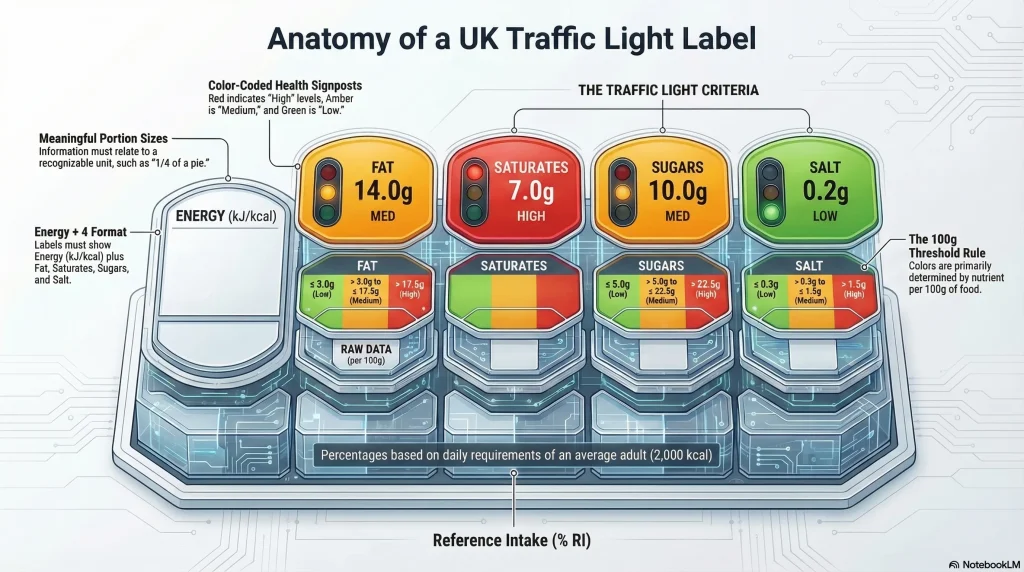
What Is Traffic Light Food Labelling?
Traffic light food labelling is a voluntary, colour-coded system applied to the front of pre-packed food and drink products. Using red, amber, and green, it gives shoppers an at-a-glance view of how much fat, saturated fat, sugars, and salt a product contains per portion.
The scheme was recommended by the UK Government in June 2013 and has since been adopted by every major supermarket. It sits alongside the mandatory back-of-pack nutrition table, which is required under retained EU Regulation No. 1169/2011 for all pre-packed foods. The front-of-pack colour system is the voluntary layer on top of that.
Which Nutrients Does Traffic Light Food Labelling Cover?
Traffic light food labelling must cover four specific nutrients: fat, saturated fat (shown on labels as “saturates”), total sugars, and salt. Energy in kilojoules (kJ) and kilocalories (kcal) must also appear – but energy does not receive a colour code.
You cannot cherry-pick nutrients. If you use the colour system, you must declare energy and all four nutrients together – known in the regulations as the “energy + 4” format. Partial declarations are not permitted.
How the Colour Coding Works
Each nutrient is assessed independently and receives its own colour based on the amount present per 100g of food (or per 100ml for drinks). The three possible ratings are:
- Green – LOW: a level considered healthy for regular consumption
- Amber – MEDIUM: moderate amounts, fine as part of a balanced diet
- Red – HIGH: present in significant amounts; consume less often or in smaller quantities
You may optionally add the words HIGH, MEDIUM, and LOW alongside the colours. This is useful for accessibility and consumer clarity, particularly for shoppers with colour vision deficiencies.
Understanding the Red, Amber and Green Thresholds
Thresholds differ for food and drinks. For solid food, cut-off values are measured per 100g. If your portion size exceeds 100g, run a second check against per-portion RED thresholds: fat >21g, saturates >6g, sugars >27g, or salt >1.8g. Any nutrient exceeding these must be coded red regardless of the per-100g value.
Traffic Light Food Labelling Thresholds for Foods (per 100g)
| Nutrient | Green (LOW) | Amber (MEDIUM) | Red (HIGH) |
|---|---|---|---|
| Fat | ≤3.0g | >3.0g to ≤17.5g | >17.5g |
| Saturates | ≤1.5g | >1.5g to ≤5.0g | >5.0g |
| Sugars | ≤5.0g | >5.0g to ≤22.5g | >22.5g |
| Salt | ≤0.3g | >0.3g to ≤1.5g | >1.5g |
Applying Traffic Light Food Labelling to Drinks
Drinks use lower thresholds – for example, fat must be ≤1.5g per 100ml for a green rating, and sugars ≤2.5g per 100ml. Portions exceeding 150ml require an additional per-portion check against RED thresholds: fat >10.5g, saturates >3g, sugars >13.5g, salt >0.9g.
Is Traffic Light Food Labelling Mandatory?
No. Traffic light food labelling is voluntary under UK law. What is mandatory for pre-packed food is the full back-of-pack nutrition declaration – energy, fat, saturates, carbohydrates, sugars, protein, and salt – expressed per 100g or 100ml.
That said, roughly two thirds of UK supermarket products carry it, and major retailers often require it from suppliers as a condition of listing. If you supply supermarkets or multiples, colour-coded front-of-pack nutrition information is likely non-negotiable.
What Retailers Expect from Food Producers
Producers selling through farm shops, delis, or direct to consumers have more flexibility. Even so, including traffic light food labels demonstrates genuine transparency and builds shopper confidence. In a market where consumers scrutinise ingredients and nutrition closely, it is rarely a disadvantage. Call 01332 864895 if you need guidance on what your specific buyers require.
Reference Intakes and Percentage %RI
Most traffic light food labelling also includes the percentage reference intake (%RI) per portion. Reference intakes are based on an average adult’s recommended daily amounts:
- Energy: 8,400kJ / 2,000kcal
- Fat: 70g | Saturates: 20g | Sugars: 90g | Salt: 6g
The statement “Reference intake of an average adult (8,400kJ/2,000kcal)” must appear on or close to the label. Percentage figures should be rounded to the nearest whole number. Nutrients present at less than 1% of the RI may be shown as “<1%”.
Frequently Asked Questions
Do I need verified nutritional data to apply colour coding?
Yes. Values must be based on laboratory analysis, a recognised database such as McCance & Widdowson’s Composition of Foods, or calculation from verified ingredient data. Inaccurate values create compliance risk and reputational exposure.
What Pantone colours must I use?
The recommended standards are Green (PMS 375), Amber (PMS 143), and Red (Red 032). Colours must be vibrant – pastel shades are not acceptable.
Can I show colour coding per 100g and per portion?
Yes. You can declare per 100g, per portion, or both. If you show the four nutrients per portion only, you must also include energy per 100g.
Do the traffic light panels need to appear on the front of pack?
They must appear in the “principal field of vision” – the part of the packaging most likely to be seen at point of purchase. In most cases that means the front face.
Can I apply colour coding to large-format drinks?
Yes, but portions exceeding 150ml trigger additional per-portion checks. If any nutrient exceeds the RED per-portion threshold, it must be coded red regardless of the per-100ml value.
Getting Your Food Labels Printed
Once your nutritional data and colour coding are confirmed, you need labels that reproduce traffic light colours accurately and legibly – with text meeting the UK minimum x-height of 1.2mm.
Positive ID Labels has been producing food labels for over 20 years. Our Xeikon digital press delivers 1200dpi print quality for precise colour reproduction on traffic light food labelling panels – ideal for premium and artisan products. For high-volume runs on polypropylene or paper, our Screen UV inkjet press delivers speed and cost efficiency. Shorter development runs? The Jetrion with built-in laser die cutting handles those comfortably.
Call 01332 864895 for a free, no-obligation quote – or complete our enquiry form. We’ll have pricing back to you fast.
All food labelling guides are provided in good faith for information purposes only and do not constitute legal advice. For specific compliance questions about specific labelling laws, contact a specialist or contact your local Trading Standards authority. Read our Regulatory Information Disclaimer
Related products and guides
- For deeper background, see our 2027 compliance changes.
- The full technical detail sits in our ingredients labelling.