The Cosmetic Products Regulation: A Guide to Cosmetic Labelling Requirements
To meet the cosmetic products regulation you need to know what needs to appear on a UK cosmetic label to be legal, and how do you fit all of it on a small bottle without sacrificing brand? Every product on a UK shelf, from boutique skincare to mass-market shampoo, faces the same cosmetic labelling requirements. The regulation sets what appears on pack, in what language, in what minimum legible size. Positive ID Labels works with cosmetic brands to build labels that satisfy the rules and look the part.
This guide breaks down what the regulation expects, the symbols that have to appear, and the practical label-making decisions that follow.
What the Cosmetic Products Regulation Demands
The UK Cosmetic Products Regulation (sometimes called the UKCR) is the post-Brexit version of EU Regulation (EC) No 1223/2009 . It sits in UK law under Schedule 34 of the Product Safety and Metrology etc. (Amendment etc.) (EU Exit) Regulations 2019. The Office for Product Safety and Standards (OPSS) is the competent authority for cosmetic products regulation.
Every cosmetic product placed on the UK market must carry specific information. The name and address of the UK Responsible Person. The nominal content at the time of packaging. The minimum durability date or the Period After Opening symbol. Particular precautions for use. The batch number. The function of the product if it is not obvious. And the complete ingredient list in INCI format.
Labels must be in English. Imported products must state the country of origin. Get any of these wrong and OPSS can require product removal from the market.
Ingredient Lists and Cosmetic Labelling Requirements
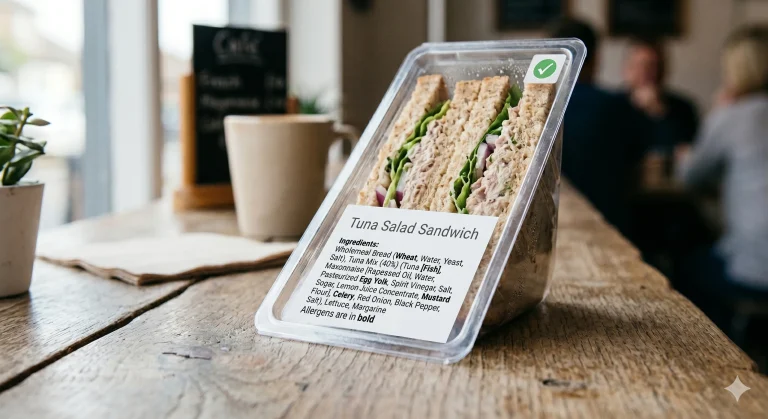
The ingredient list is where most cosmetic labels live or die. Ingredients are declared in descending order of weight at the point of incorporation, using INCI names, the standardised international nomenclature. Ingredients below 1% can be listed in any order after the others. Colourants come at the end, prefixed with their CI numbers.
Allergens listed in Annex III must be declared by INCI name once they exceed the threshold concentrations, currently 0.001% for leave-on products and 0.01% for rinse-off. The allergen list runs to dozens of named substances. Getting this right is not negotiable to meet the cosmetic products regulation.
For brands with complex formulations, actives, botanicals, multiple allergens, the ingredient list alone can exceed the available label surface area. That is a labelling problem with a labelling solution.
Symbols in Cosmetic Labelling Requirements
Three regulated symbols appear on most UK cosmetic labels.
The Period After Opening symbol (an open jar with a number followed by “M”) tells consumers how many months the product remains safe after opening. The minimum durability hourglass, or “Best Used Before End” wording, applies to products with a shelf life under 30 months. The “refer to enclosed information” symbol, a hand pointing at an open book, signals that important information is on a leaflet or outer carton.
All three must be reproduced clearly, at a size where consumers can actually read them in order to satisfy the cosmetic products regulation. Smudged or undersized symbols are a compliance failure waiting to be flagged.
Print Legibility for Cosmetic Labelling Requirements
The regulation requires “indelible, easily legible and visible” labelling rather than specifying a minimum point size. In practice, INCI lists below 5pt become a readability risk. Our Xeikon press prints at 1200dpi, so the smallest legal text reproduces sharply enough to satisfy both readability and OPSS expectations.
Choosing Materials for Cosmetic Labelling Requirements
Cosmetic labels live in challenging conditions. Bathroom humidity. Skin contact. Repeated handling. Storage near heat. The label has to keep the rules visible and the brand looking right for the product’s entire shelf life.
For premium positioning, Tintoretto textured paper carries a tactile luxury that mass-produced labels cannot match. For wet environments and clear-bottle aesthetics, polypropylene (white, clear, or silver) is the workhorse. For genuine foil finishes, our flexographic press applies metallic foil inline on longer runs.
Talk to us on 01332 864895 to discuss which build suits your range.
Whatever the substrate, the label is the first thing a customer sees before they decide to buy. The rules of the cosmetic products regulation determine what it must carry; the rest is brand.
Common Cosmetic Labelling Questions
How do I fit a long INCI ingredient list on a small bottle?
Multipage and peel-and-reveal labels are the standard answer. A booklet label can carry several times the surface area of a flat label, giving you room for the full ingredient declaration without crowding the brand design.
Can you print labels that survive a steamy bathroom?
Yes. Polypropylene labels, applied with the right permanent adhesive, handle humidity and water splashes without lifting or fading. For a premium brand feel that still resists moisture, our Xeikon press prints Tintoretto textured paper that is moisture-resistant and tested for chilled-display environments.
What metallic finishes can you produce for premium cosmetic brands?
Two routes. For high-volume runs, genuine cold foil applied inline on our flexographic press gives true metallic finish. For short to medium runs, faux foiling, silver polypropylene printed with white ink, delivers a striking metallic appearance at significantly lower cost.
Can you handle UK Responsible Person address changes across an existing range?
Yes. We hold artwork files and can update Responsible Person details across a product range efficiently. Useful if your RP arrangement changes or if you are managing dual UK and EU compliance.
Do you supply clear “no label” finish labels for premium glass bottles?
Yes. Clear polypropylene gives a printed-on-bottle appearance that suits minimalist premium positioning. Pair it with white ink for opaque text and selective transparency for brand elements.
How fast can you produce a new cosmetic label run?
80% of our orders despatch within 5 working days. For digital work on Xeikon or Screen, the typical window is 3 to 5 working days from artwork sign-off.
Need Labels That Comply and Convert?
Want to see the quality before committing to a print run? Call 01332 864895 or complete the enquiry form to discuss your cosmetic product specification. We will talk you through materials, finishes, and regulatory detail, with a fixed-price quote within minutes.