
Alcohol Labelling Regulations UK: Complete Guide for Drinks Producers
Labelling alcoholic drinks in the UK means navigating a patchwork of food law, drink-specific regulations, and voluntary best practice standards. Whether you produce beer, wine, spirits, or cider, getting your labels right protects your business from enforcement action and builds trust with retailers and consumers.
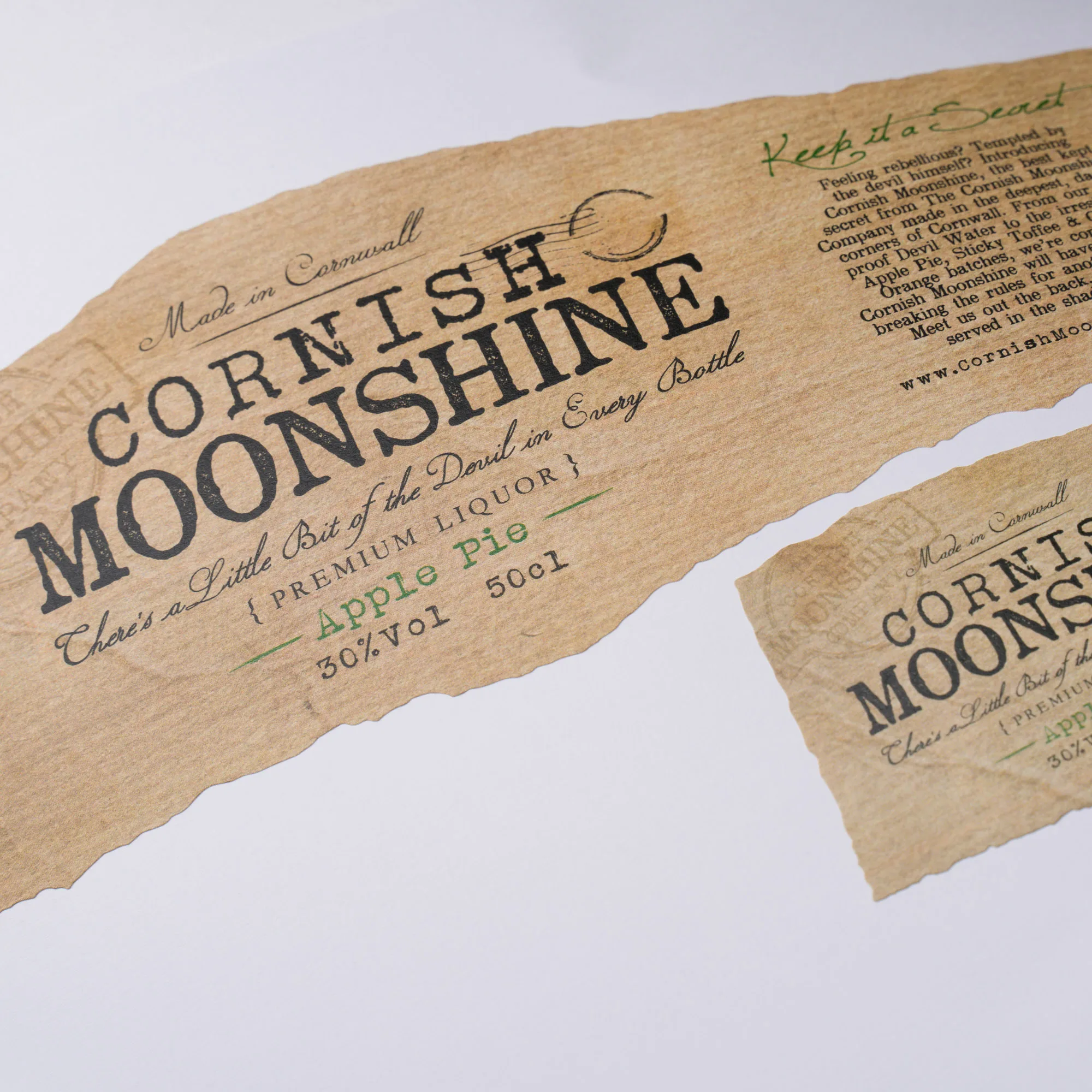
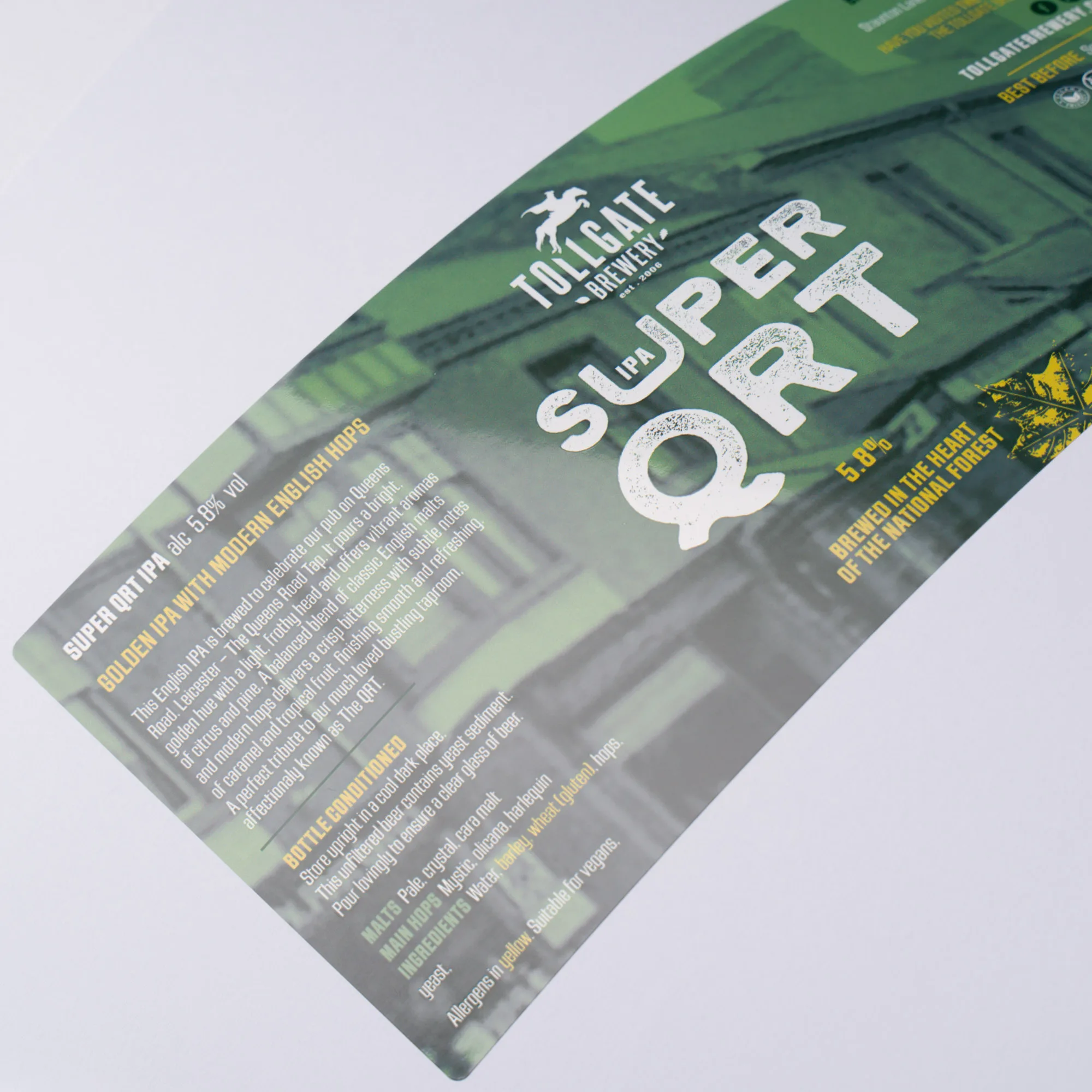
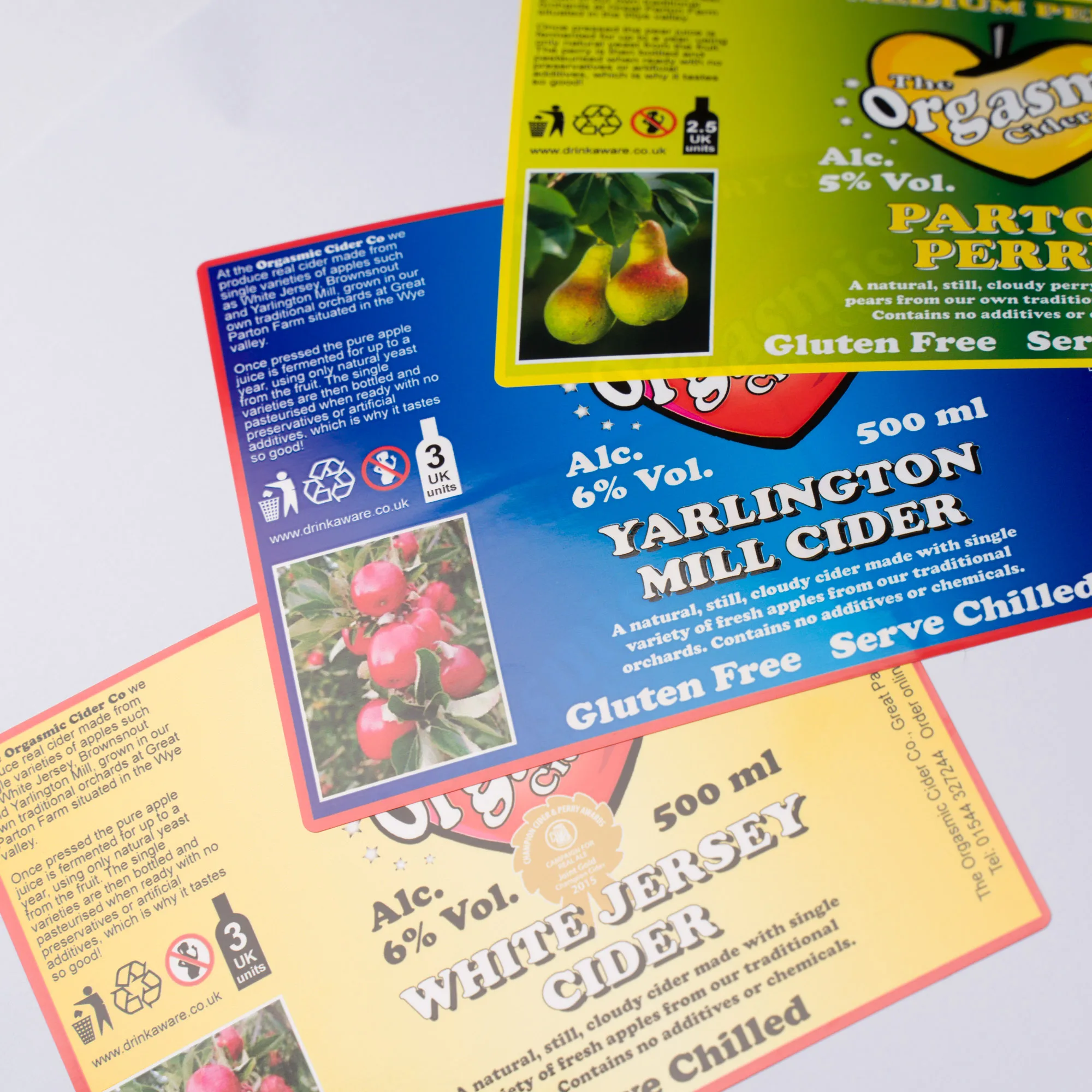
This guide covers everything UK drinks producers need to know about alcohol labelling requirements in 2025 and beyond, including mandatory information, drink-specific rules, allergen declarations, the Portman Group best practice standards, and the forthcoming mandatory health and nutrition labelling changes announced by the UK Government.
Who Regulates Alcohol Labelling in the UK?
Alcohol labelling in the UK sits under the oversight of several bodies. The Food Standards Agency (FSA) sets the overarching food labelling rules that apply to alcoholic drinks as food products. Trading Standards officers in local authorities carry out enforcement on the ground, inspecting labels and taking action against non-compliant products.
The key legislation governing alcohol labelling in the UK includes:
Alongside the law, the Portman Group acts as the alcohol industry’s self-regulatory body for marketing and labelling. Their Code of Practice and Alcohol Labelling Guidelines set voluntary best practice standards that the vast majority of UK producers follow. While not legally binding, breaching the Portman Group Code can result in a retailer alert bulletin that effectively removes your product from major retailers.
Mandatory Information on All Alcohol Labels
Every pre-packed alcoholic drink sold in the UK must display certain information on its label. The mandatory requirements apply regardless of whether you produce beer, wine, spirits, cider, or ready-to-drink products.
Information required on all alcoholic drink labels:
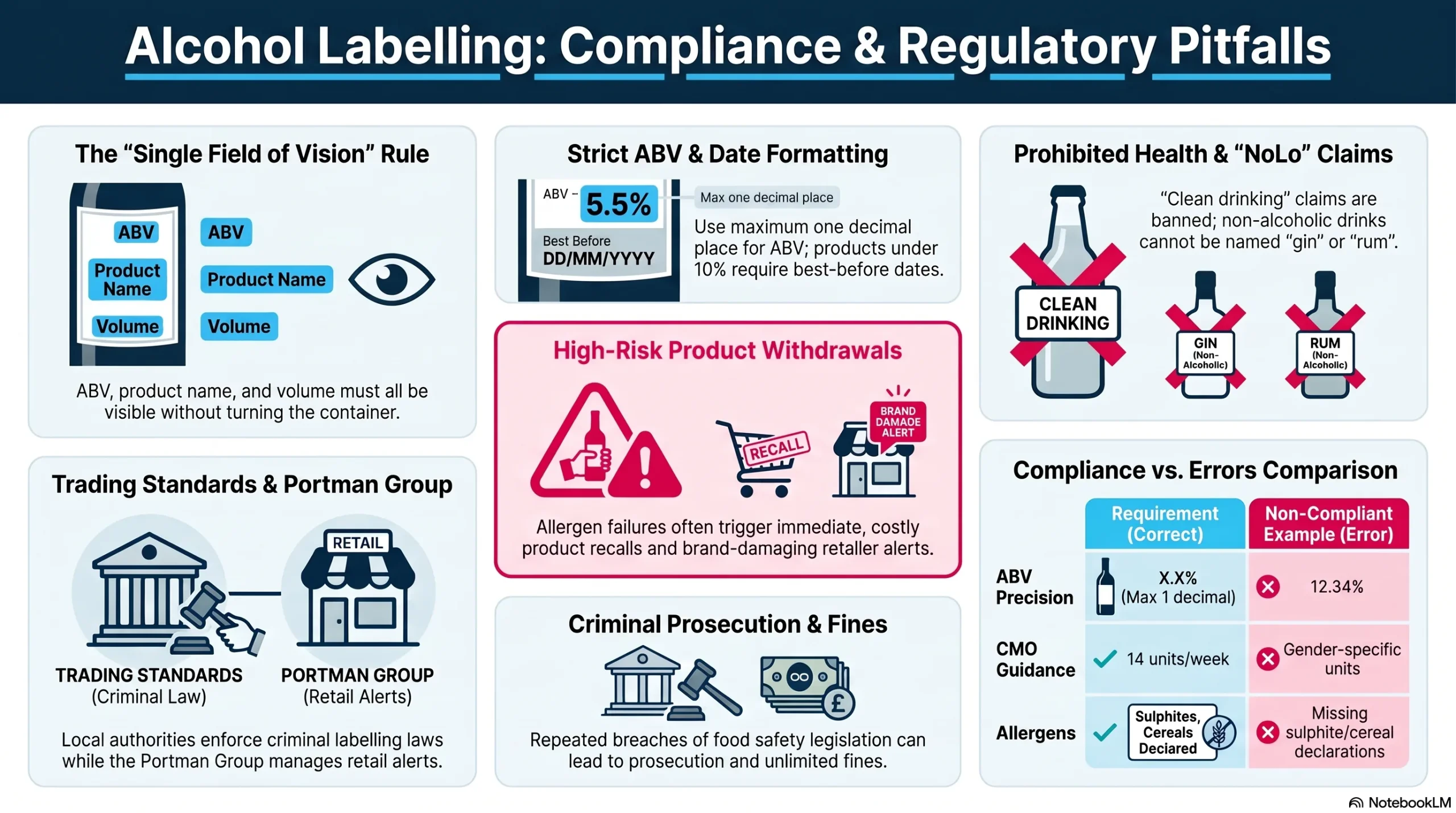
The product name, ABV, and net quantity must appear in the same field of vision on the label. This means a consumer should be able to see all three pieces of information without having to turn the container. All mandatory information must be in English, clearly legible, and indelible – it cannot be on packaging that would be discarded before the product is consumed.
This last point matters practically. If you sell a beer in a presentation box, the label on the bottle itself must carry the mandatory information. The outer box alone is not sufficient because it may be thrown away before the product is consumed.
For more on general food labelling requirements that also apply to alcoholic drinks, see our UK food labelling rules guide.
ABV Display Rules and Tolerances
The alcoholic strength by volume (ABV) is one of the most important elements on any alcohol label. Every pre-packed drink with an ABV above 1.2% must display its strength as a percentage figure to not more than one decimal place.
Acceptable ABV formats
Following the Alcoholic Beverages (Amendment)(England) Regulations 2023, which were introduced as a result of the UK-New Zealand free trade agreement, producers in Great Britain now have more flexibility in how they display ABV. The following formats are all acceptable:
There is no requirement to change from the older formats. The new option simply gives producers additional flexibility, particularly useful for products sold across multiple international markets.
ABV tolerance levels
The stated ABV must be accurate, but the law allows small tolerances to account for natural variation in production. The acceptable variance depends on the type and strength of the drink:
Regular testing during production is essential to ensure your declared ABV remains within tolerance. A product found outside these limits during enforcement testing could result in prosecution.
An additional change from the 2023 regulations: wine producers can now declare ABV to any decimal place (e.g. 12.2% or 13.7%), whereas previously only whole or half units were permitted (e.g. 12% or 12.5%).
Allergen Declarations on Alcoholic Drinks
Allergen labelling is a mandatory requirement for alcoholic drinks, just as it is for all food products. Any of the 14 major allergens present in the product must be clearly declared on the label with the allergen emphasised (typically in bold) within the allergen information or ingredients list.
The allergens most commonly encountered in alcoholic drinks include:
Even where a full ingredients list is not provided (which is permitted for drinks above 1.2% ABV), allergens must still be declared. The typical approach is to include an allergen statement such as “Contains: sulphites” or “Contains: barley, wheat“.
For a detailed guide on all 14 major allergens and how to declare them correctly, see our allergen labelling guide. Businesses dealing with allergen compliance across their product range may also benefit from understanding Natasha’s Law requirements.
Ingredients Lists and Nutrition Information
One of the most significant differences between alcohol labelling and general food labelling is the current exemption from certain information requirements.
Ingredients list
Pre-packed food products normally require a full ingredients list. However, alcoholic drinks above 1.2% ABV are currently exempt from the requirement to provide an ingredients list. This is a longstanding exemption in food law. You can choose to provide an ingredients list voluntarily, and an increasing number of producers do so for transparency, but it is not legally required.
The critical exception: even without a full ingredients list, you must still declare any allergens present (see the section above).
Nutrition declaration
Alcoholic drinks above 1.2% ABV are also currently exempt from mandatory nutrition labelling. This means you do not need to display energy values, fat, saturates, carbohydrate, sugars, protein, or salt information.
However, you may voluntarily include nutrition information. If you choose to do so:
- You can provide just the energy value (in kJ and kcal) on a per 100ml basis, with the option to also show per portion
- Alternatively, you can provide a full back-of-pack nutrition declaration per 100ml, with the option to also show per portion
- Energy from alcohol must be calculated using the conversion factors of 29kJ/g and 7kcal/g for ethanol
Important restriction: only nutrition claims related to alcohol content or energy value are permitted on alcoholic drinks. Health claims are entirely forbidden. Claims like “only 90 calories per can” or “no carbs or sugar” on alcoholic drinks have been challenged and banned by the Advertising Standards Authority. Even implied claims such as “better for you” are prohibited.
This exemption from mandatory nutrition labelling is set to change – see the forthcoming changes section below.
For more on nutrition declarations generally, see our nutrition declaration guide.
Beer Labelling Requirements
Beer, ale, lager, stout, and similar products must comply with all the general mandatory requirements above. There are some additional considerations specific to beer producers.
Whether you are a major brewery or a small craft operation, we can help you create compliant, attractive beer labels that meet all regulatory requirements while expressing your brand identity.
Wine Labelling Requirements
Wine is arguably the most heavily regulated category when it comes to alcohol labelling. The Wine Regulations 2011 (as amended) set specific requirements that go well beyond general food law.
Mandatory information for wine labels
In addition to the standard requirements (name, ABV, net quantity, allergens, business name/address), wine labels must include:
Grape variety and vintage
Naming a single grape variety on the label is permitted if at least 85% of the wine comes from that variety. Following the 2023 amendments, when two or more grape varieties are named, they must now total at least 95% of the wine (reduced from the previous 100% requirement in retained EU law, giving winemakers more blending flexibility). Vintage wines must contain at least 85% of the stated vintage and meet PDO or PGI requirements.
Traditional terms
Production terms such as Reserva, Gran Reserva, or Chateau may be used on wine labels to indicate the production method, provided they are used in accordance with the rules for the relevant designation and region.
PID Labelling produces high-resolution wine labels using our Xeikon digital press at 1200dpi – ideal for the premium finish wine brands demand.
Spirits Labelling Requirements
Spirit drink labelling in the UK is governed by retained EU Regulation 2019/787 and the Spirits Drinks Regulations 2008 (as amended), alongside general food labelling law.
Legal denomination
Every spirit must display its legal or sales denomination as defined in the regulations. This is the category name – such as “gin”, “vodka”, “rum”, “whisky”, “brandy” – and it must be used correctly. Each category has defined production methods and minimum ABV requirements:
- Whisky – minimum 40% ABV
- Brandy/Cognac – minimum 40% ABV
- Gin – minimum 37.5% ABV
- Vodka – minimum 37.5% ABV
- Rum – minimum 37.5% ABV
- Spirit drinks generally – minimum 15% ABV (with some exceptions at 14% ABV)
If using compound terms (e.g. “spiced rum” or “sloe gin”), they must be formatted correctly and must not mislead consumers about the product’s nature or composition.
Date marking for spirits
Most spirits are above 10% ABV and are therefore exempt from the requirement to include a best before date. A lot or batch number is still required for traceability.
Allergens in spirits
While many base spirits are allergen-free, flavoured spirits, liqueurs, and cream-based products may contain allergens including milk, nuts, cereals with gluten, and eggs. These must be clearly declared.
Our spirits labels combine regulatory compliance with the premium look your brand deserves.
Cider Labelling Requirements
Cider and perry follow the general mandatory labelling rules for alcoholic drinks. There is no single overarching “cider regulation” equivalent to the Wine Regulations, but cider producers must comply with general food law and any relevant compositional standards.
Key considerations for cider labels
We produce durable, waterproof cider labels designed to withstand chilling and condensation.
No and Low Alcohol Drinks
The no and low alcohol (NoLo) market is growing rapidly in the UK, and labelling rules for these products are evolving. Current definitions in England are:
- Alcohol-free – products with an ABV not exceeding 0.05%
- Low alcohol – products with an ABV not exceeding 1.2%
The UK Government’s 10 Year Health Plan (published July 2025) includes a proposal to raise the alcohol-free threshold to 0.5% ABV, aligning with international standards and many other countries. This change has not yet been enacted but is under active consultation.
There are important naming restrictions for NoLo drinks:
- Products cannot be labelled “low alcohol wine” or “alcohol-free wine” – wines that have had alcohol removed must use terms like “wine-based drink”
- Spirit category names (gin, vodka, rum, etc.) cannot be used for alcohol-free or low-alcohol versions. Terms like “alcohol-free rum” or “gin alternative” are not permitted for labelling purposes
- NoLo beers have more flexibility with naming, though they should clearly indicate their reduced or zero alcohol status
Unlike drinks above 1.2% ABV, no and low alcohol drinks are treated as standard food products and must include a full ingredients list and nutrition declaration.
We produce labels for the full range of drinks products, including the growing NoLo category.
Portman Group Best Practice Standards
The Portman Group is the UK alcohol industry’s self-regulatory body, founded in 1989. Their Alcohol Labelling Guidelines (updated May 2022) set the voluntary best practice standards that the vast majority of UK producers follow. While not legally mandatory, these guidelines are widely regarded as essential for any serious drinks producer.
The Portman Group guidelines recommend that all alcohol labels include four minimum elements:
- Unit alcohol content – the number of UK alcohol units per container, and optionally per typical serving
- Pregnancy warning – either an approved logo (the pregnant woman symbol with a line through it) or a text statement warning against drinking during pregnancy
- Chief Medical Officer’s low risk drinking guidelines – the recommendation that to keep health risks from alcohol low, it is safest not to drink more than 14 units per week on a regular basis
- Drinkaware reference – a direction to bedrinkaware.co.uk for further information about responsible drinking
The Portman Group recommends presenting this information in a clearly separated box on the label. Their latest market review (2024) found near-universal uptake: over 99% of products carry a pregnancy warning, 96% show unit content, 86% carry the CMO guidelines, and 92% include a Drinkaware reference.
Many producers now go beyond these minimums. Around 51% of products now voluntarily display calorie information, 38% include drink-driving warnings, and 36% carry age restriction messaging.
The Portman Group offers a free Advisory Service that provides confidential guidance on label compliance before you go to print. This is a valuable resource, particularly for new producers or those launching new products.
Responsible Drinking Information
UK Chief Medical Officer’s guidelines
Since 2016, the UK CMO guidelines state that to keep health risks from alcohol to a low level, it is safest for both men and women not to drink more than 14 units per week on a regular basis. If you do drink 14 units per week, it is best to spread this evenly over three or more days.
Producers are expected to reproduce this wording accurately on their labels. No deviation in wording is permitted if you include it.
Alcohol units
Alcohol units help consumers understand how much alcohol they are consuming. One unit equals 10ml (or 8g) of pure alcohol. The number of units in a container is calculated by multiplying the volume (in ml) by the ABV and dividing by 1,000.
For products containing multiple servings (such as a 75cl bottle of wine), best practice is to show both the total units in the container and the units per typical serving (e.g. a 125ml glass).
Pregnancy warning
Alcohol can cause serious harm to unborn babies. The recommended approach is to display the internationally recognised pregnant woman symbol (silhouette with a drink, crossed through with a red line) or include a clear text warning. The Portman Group provides approved logo designs through its marketing toolkit.
Drinkaware
Drinkaware is a charity funded by the alcohol industry that provides information to help people make better choices about drinking. Most producers include the Drinkaware logo or a reference to bedrinkaware.co.uk on their labels. If you wish to use the logo, you need to obtain a licence from Drinkaware. Smaller producers (annual alcohol sales turnover under 2.5 million pounds excluding VAT) can access the logo licence for 50 pounds plus VAT per year.
Country of Origin and Provenance
Country of origin labelling requirements vary by drink category:
- Wine – country of origin is always mandatory. For blended wines from multiple countries, all contributing countries must be named.
- Spirits – certain categories have geographical indications built into their names (Scotch whisky, Irish whiskey, Cognac, Champagne). Beyond these, origin labelling is required where its absence would mislead the consumer.
- Beer – no specific mandatory origin requirement, but the general rule applies: if omitting origin would mislead the consumer, it must be declared. A beer brewed in the UK using a foreign brand name or styling might need origin clarification.
- Cider – similar to beer, no specific mandatory requirement but the general misleading test applies.
Post-Brexit, the UK maintains its own framework for geographical indications (GIs). Products with UK GI status (such as Scotch whisky or Welsh whisky) receive legal protection for their names and origins.
Naming, Marketing and the Portman Group Code
Beyond the information that must appear on a label, the Portman Group’s Code of Practice on the Naming, Packaging and Promotion of Alcoholic Drinks (now in its sixth edition) sets rules on what alcohol marketing and labelling should not do.
Under the Code, alcoholic drink labelling and packaging must not:
- Have particular appeal to under-18s – this includes cartoon characters, imagery associated with youth culture, confectionery-like packaging, or names that would attract children
- Suggest any association with illegal behaviour – including drug use or criminal activity
- Promote immoderate consumption – packaging must not encourage binge drinking or present excessive drinking positively
- Suggest that alcohol can enhance sexual attractiveness or success – names like “Super Stud” beer would not be permitted
- Promote antisocial behaviour – including violence or bravado
- Downplay the alcoholic strength – the only exception is where a product genuinely has lower alcohol content than its category average
- Cause serious or widespread offence
- Suggest mind-altering qualities beyond the effects of alcohol
Read more about craft beer labelling and compliance.
Complaints against products are assessed by an Independent Complaints Panel, and upheld complaints can result in a Retailer Alert Bulletin. This effectively asks retailers to stop stocking the product until the issue is resolved, which can be commercially devastating.
Craft breweries and independent producers should pay particular attention to these rules. Creative brand names and artwork are excellent for standing out, but they must not cross the lines set out in the Code.
Forthcoming Changes: Mandatory Health and Nutrition Labelling
The most significant change on the horizon for alcohol labelling in the UK is the Government’s commitment to mandatory nutritional information and health warning messages on all alcoholic drinks.
Announced as part of the “Fit for the Future” 10 Year Health Plan for England in July 2025, the Government stated it would “strengthen and expand on existing voluntary guidelines for alcohol labelling by introducing a mandatory requirement for alcoholic drinks to display consistent nutritional information and health warning messages.”
What this means in practice:
- Calorie and nutrition information will become mandatory on alcohol labels, bringing alcoholic drinks in line with the requirements already placed on food and non-alcoholic drinks
- Health warning messages will be required, though the exact wording and format is yet to be specified through consultation
- The Government has commissioned a National Institute for Health and Care Research (NIHR) study on the impact of alcohol calorie labelling, due to report in 2026
- A consultation on the details is expected, but no implementation date has been confirmed yet
This move is partly inspired by the Republic of Ireland, which passed legislation in 2023 requiring alcoholic products to display health warnings (including cancer warnings), pregnancy warnings, calorie content, and grams of alcohol. The Irish requirements come into force from May 2026.
What producers should do now: while the mandatory requirements are not yet in force, forward-thinking producers should start planning for these changes. Building calorie and nutrition information into your label design now, even on a voluntary basis, will ease the transition when the rules take effect. Consider how your current label layout can accommodate additional text and whether you need to adjust your artwork or label size.
Common Labelling Mistakes to Avoid
Based on our experience producing thousands of alcohol labels, these are the most common compliance errors we see:
- ABV not in the same field of vision as product name and volume – all three must be visible together without turning the container
- Missing allergen declarations – particularly sulphites in wine and cereals in beer. Even without a full ingredients list, allergens must be declared
- Incorrect ABV format – the ABV must be to one decimal place maximum. Showing “12.34%” is not compliant
- Missing or outdated CMO guidelines – the current guideline is 14 units per week for both men and women, not the older gender-specific figures
- Making health claims – any health claims on alcoholic drinks are prohibited, including implied claims like “better for you” or “clean drinking”
- Mandatory information on secondary packaging only – if the outer packaging is discarded before consumption, the label on the bottle or can must carry all required information
- No date marking on products under 10% ABV – beers, most wines, ciders, and RTDs below 10% ABV need a best before date
- Using spirit category names on NoLo products – you cannot call a non-alcoholic product “gin” or “rum”
Enforcement and Penalties
Alcohol labelling is enforced primarily by Trading Standards officers within local authorities. Non-compliance with food labelling regulations is a criminal offence, and penalties can include:
- Improvement notices – requiring you to correct labelling within a specified period
- Product withdrawal or recall – particularly for allergen failures that pose a safety risk
- Prosecution – for serious or repeated breaches, with potential fines
- Portman Group Retailer Alert Bulletin – not a legal penalty, but effectively removes your product from major retail shelves until resolved
Falsely describing food products (including alcoholic drinks) is a criminal offence under food safety legislation. The reputational damage from a labelling failure can be far more costly than any fine, particularly for premium and craft brands where consumer trust is paramount.
Practical Compliance Checklist
Use this checklist when reviewing your alcohol labels before they go to print:
Legal requirements (mandatory)
- Product name/legal denomination clearly stated
- ABV displayed correctly (one decimal place max, correct format)
- Net quantity in metric units (ml or litres)
- Product name, ABV, and volume in the same field of vision
- Name and address of responsible business (producer, bottler, or importer)
- Allergens declared and emphasised (even without a full ingredients list)
- Country of origin (where required by product-specific rules or to prevent misleading)
- Best before date (for products below 10% ABV)
- Lot/batch number
- All text in English, legible, and indelible
Portman Group best practice (strongly recommended)
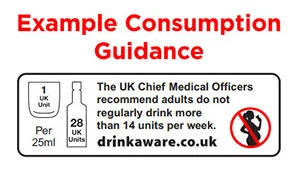
- Unit content per container (and per serving where applicable)
- Pregnancy warning logo or statement
- UK CMO low risk drinking guidelines (14 units/week)
- Drinkaware reference or logo
- Information grouped in a clearly separated box
Additional recommended elements
- Calorie/energy information per 100ml and per serving
- Drink-driving warning
- Age restriction messaging (over 18s only)
- Storage instructions where relevant
- Recycling information
Frequently Asked Questions
Do alcoholic drinks need an ingredients list under UK law?
Drinks with an alcoholic strength of more than 1.2 percent by volume are not currently required by law to carry a full ingredients list. However, allergenic ingredients must still be declared, normally by emphasis within an ingredients list or, where no ingredients list is given, by the word ‘contains’ followed by the name of the allergen. Drinks at or below 1.2 percent ABV are treated as standard food and must carry a full ingredients list.
What information is mandatory on a UK alcohol label?
Alcoholic beverages over 1.2 percent ABV must show the name of the drink, the alcoholic strength to a maximum of one decimal place, the net quantity, the name and UK address of the food business operator (from 1 January 2024), allergen information, and a durability date if the strength is 10 percent or below. From 1 October 2023, the ‘Not for EU’ indication may also be required on certain products. Wine and spirit drinks have additional category-specific labelling rules.
Need Alcohol Labels? Talk to PID Labelling
At PID Labelling, we have decades of experience producing labels for the UK drinks industry. From premium wine labels and spirits labels printed at 1200dpi on our Xeikon digital press, to cost-effective runs of beer labels and cider labels, we combine print quality with regulatory know-how.
We produce labels for every type of alcoholic beverage, including drinks labels and soft drinks labels for the growing no and low alcohol market. Every label is manufactured in our Derby facility with fast turnaround and competitive pricing for production runs.
Whether you are launching a new product and need advice on label layout, or you are an established producer updating your labels for regulatory changes, we are here to help.

I had an amazing experience working with Positive ID Labelling, especially Natalie. The labels were absolutely brilliant quality and exceeded my expectations. Natalie was fantastic throughout the whole process. Communication was amazing from start to finish. She was so helpful, guided me through everything, and made the whole experience stress free and enjoyable. She was also genuinely funny and a pleasure to work with, which made everything even better. I’ll definitely be working with Natalie again on future projects and would highly recommend Positive ID Labelling to anyone looking for high-quality labels and excellent customer service.

Fantastic label printing service. Labels to a very high specification. Helen was great at sorting out our requirements, quotes, and order.

We’ve had a great experience working with this supplier, especially with Natalie - she is always very responsive, professional, and friendly. The pricing is highly competitive and the sales service has been excellent from start to finish.If I could offer one suggestion, it would be to improve the account and invoice management process. It would be really helpful if there were a system for clients to easily track their past orders and invoices in one place.Overall, very pleased with the service and look forward to continuing our collaboration.

I inadvertently ordered the incorrect label guns which was quickly sorted by Natalie. She was excellent, customer service at its best! Thank you once again

All food labelling guides are provided in good faith for information purposes only and do not constitute legal advice. For specific compliance questions about specific labelling laws, contact a specialist or contact your local Trading Standards authority. Read our Regulatory Information Disclaimer