
UK Deposit Return Scheme 2027 Explained
From 1 October 2027, every PET plastic bottle and every metal can you sell in the UK must carry two new mandatory label elements — and if they’re missing or unreadable, your customers won’t get their deposit back. That’s not a theoretical compliance problem. It’s a consumer-facing failure that damages your brand at the point of return.
The UK’s Deposit Return Scheme is the most significant change to drinks packaging in a generation. Managed by Exchange for Change — the official UK Deposit Management Organisation — it will affect billions of containers every year and require every drinks producer in scope to redesign their labels before the October 2027 go-live date.
Related products and guides
- Useful background reading: DRS implementation guide.
- Our double compliance guide walks through the groundwork.
- Browse the full Resources range for related products.
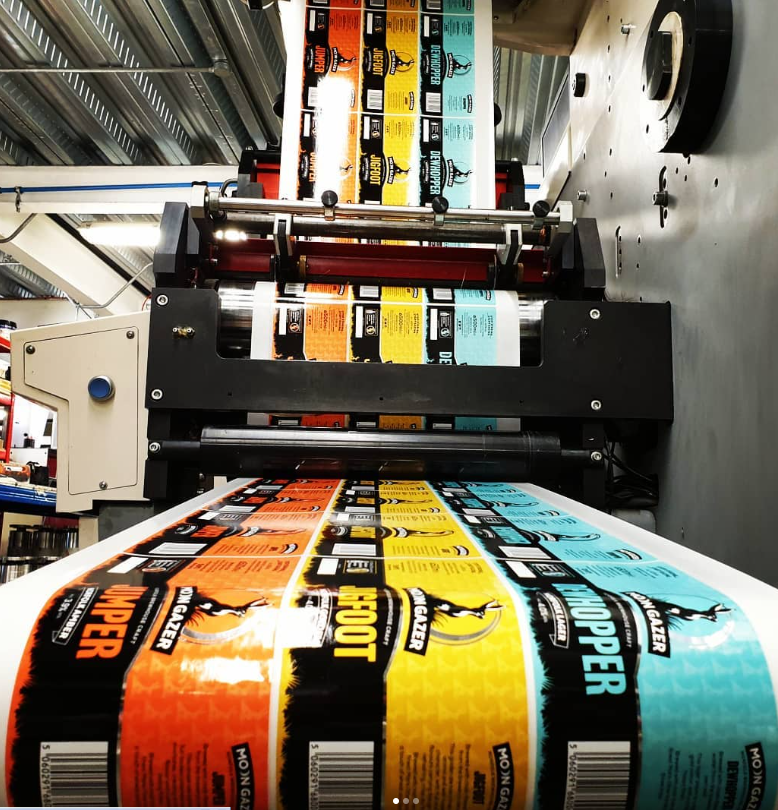
Here’s exactly what the scheme requires, what it means for your labels, and why 2026 is the year you need to act — not 2027.
What Is the UK Deposit Return Scheme?
A Deposit Return Scheme (DRS) adds a small refundable deposit to the price of drinks sold in single-use containers. Consumers pay the deposit at checkout and reclaim it by returning the empty container to a designated return point — either manually at a retail counter or automatically via a Reverse Vending Machine (RVM).
The UK scheme — formally branded Exchange for Change — launches on 1 October 2027 across England, Northern Ireland, and Scotland. Wales is aligning to the same timetable with a parallel scheme that includes glass bottles.
In scope:
- Single-use PET plastic bottles between 150ml and 3 litres
- Aluminium and steel cans between 150ml and 3 litres
- All drinks categories: soft drinks, water, beer, cider, ready-to-drink
Out of scope (England, Northern Ireland, Scotland):
- Glass bottles (excluded due to safety and recycling quality concerns)
- HDPE milk bottles
- Liquid medicines and certain specialist categories
- Multi-use containers
Wales is different: The Welsh scheme includes glass bottles. If you sell into Welsh retail, your glass container labels need to meet DRS requirements too.
The Two Mandatory Labelling Elements
Every in-scope container — including individual containers sold inside multipacks — must carry two specific label elements from October 2027.
1. The Exchange for Change Scheme Logo
Exchange for Change published its approved scheme logo and regulatory requirements in late 2025. The logo must be displayed on each in-scope container to confirm it is part of the scheme and eligible for a deposit refund. Specific size, placement, and colour requirements are set by the DMO and must be followed precisely.
Critically: the logo cannot simply be printed on a multipack wrapper and considered done. Each individual container within the multipack must carry its own logo. A six-pack of cans means six individual deposit logos.
2. A Machine-Readable Identifier
Every in-scope container must also carry a barcode or QR code that reverse vending machines can scan to validate the container as eligible for a refund, confirm the producer’s registration, track the return in the central DMO data system, and prevent fraud by ensuring each container is only credited once.
Both elements must be present and readable for a refund to be issued. A container carrying the logo but with a damaged or unreadable barcode will be rejected by the RVM. A container with a readable barcode but no scheme logo will also be rejected. There is no partial compliance.
The Technical Challenge: Labels That Survive Real-World Returns
This is the part that most brands — and many label suppliers — underestimate.
A DRS label doesn’t just need to look right on a fresh container sitting on a shelf. It needs to be scannable by an RVM after a consumer has finished the drink, squashed the bottle, dropped it in a bag, carried it to the supermarket, and fed it into a machine.
The DMO’s published RVM specifications set out minimum criteria for container recognition accuracy and label readability. An RVM must be able to identify the correct barcode, validate the container, and transmit data to central systems — all in a matter of seconds, with a partially crushed container in variable orientations.
What this means for your label specification:
Contrast: The barcode modules need sufficient print contrast to scan reliably under machine lighting conditions after the label has been subject to moisture, handling, and deformation. Under-inked or faded barcodes will fail.
Substrate: Standard self-adhesive paper labels may not perform well enough on containers that are returned wet or crushed. Film-based substrates with higher dimensional stability and moisture resistance are likely to be necessary for many applications.
Adhesive: The label must stay adhered to the container through the consumer use cycle — including chilling, condensation, and handling. Adhesive failure before the return point means a non-refundable container.
Placement: The machine-readable element must remain accessible even on a partially crushed container. Placement on a heavily curved or recessed area may compromise readability under RVM scanning conditions.
Quiet zones: As with all barcodes, the machine-readable DRS identifier requires clear blank space around it. Artwork that crowds the barcode with graphics or text will increase rejection rates at return points.
Labels that look compliant on a print proof but fail at an RVM create consumer frustration, reputational damage, and — depending on the volumes involved — potential enforcement action by regulators. Testing labels against prototype RVM equipment during 2026 is critical.
The Low-Volume Producer Exemption — Do You Qualify?
There is an important exemption that many small producers aren’t aware of.
If you place fewer than 5,000 units per SKU per year on the UK market (or 6,250 units in the first 15 months of the scheme), you are exempt from paying producer fees and are not required to apply scheme labelling to those product lines.
However — and this is important — you are still required to register with Exchange for Change and report your volumes. The exemption removes the labelling obligation for qualifying low-volume lines, but it doesn’t remove the registration requirement.
For small craft brewers, independent soft drink producers, and artisan brands with limited distribution, this exemption may cover a significant part of your range. Check your annual volumes by SKU before assuming you need to redesign everything.
Registration with Exchange for Change opens in Q3 2026. You should know your volume position well before then.
Wales — The Wildcard Nobody Is Planning For
If your products are sold into Welsh retail, the DRS picture is different and more complex.
Wales is running a parallel scheme to the rest of the UK — with one key difference: it includes glass bottles. While England, Northern Ireland, and Scotland have excluded glass from their schemes, Wales is pressing ahead with an all-in approach.
This means that if you sell glass-packaged drinks into Welsh supermarkets, off-licences, or food service channels, you face a glass container labelling requirement that doesn’t apply to the same product sold in England.
The Welsh scheme is still finalising its detailed labelling guidance, and the interoperability arrangements between the Welsh DMO and Exchange for Change are still being worked through. But if you have a Welsh distribution footprint and glass containers in your range, you need to be tracking this separately.
The 2027 Label Redesign You’re Probably Already Late to Start
Here’s the timeline that most producers haven’t yet internalised:
Now — Q2 2026: The artwork freeze window. Any container going to market in late 2026 will still be in circulation when the scheme goes live in October 2027. That means it needs to be DRS-compliant at print. Pre-printed label runs placed in the second half of 2026 should already be carrying scheme markings.
Q3 2026: DRS producer registration opens. Exchange for Change will be expecting producers to be registered, with compliant labelling confirmed or in final production. This is not the time to start the design process — it’s the time to finish it.
2026 generally: Exchange for Change has flagged that producers should be testing labels against prototype RVM equipment during 2026 to identify any readability failures before committing to full production volumes.
October 2027: Scheme goes live. Containers placed on the market without compliant scheme labelling will not qualify for deposit refunds. Consumers will be unable to redeem deposits on non-compliant containers, creating immediate friction and brand damage.
The practical planning deadline is mid-2026 for label redesign completion. For brands with complex packaging or large product ranges, the briefing process needs to start now.
DRS and GS1 Sunrise — One Redesign, Not Two
Drinks manufacturers face a double compliance challenge in 2027. Both the Deposit Return Scheme and GS1 Sunrise 2027 require label changes, both affect many of the same products, and both have the same October 2027 deadline.
The smart approach is to treat this as a single, coordinated label redesign rather than two separate projects. A 2027-compliant drinks label needs to accommodate:
- The GS1 2D barcode (Data Matrix or QR, positioned within 50mm of the EAN-13)
- The Exchange for Change scheme logo
- The DRS machine-readable identifier
- All existing mandatory label content: allergens, nutritional data, country of origin, alcohol content, recycling icons
Doing this once, thoughtfully, with a label supplier who understands both sets of requirements, is far more efficient than two rushed amends approaching the same deadline from opposite directions.
We’ve written a companion guide to GS1 Sunrise specifically, which you can read alongside this article.
What You Should Do Right Now
Step 1 — Scope your range. Which products are in-scope for DRS? Which of those also need GS1 Sunrise changes? Which go into Welsh retail and may have glass in scope? Get a clear picture of the full redesign requirement before anything else.
Step 2 — Check your volumes. Identify any SKUs that fall below the 5,000-unit annual threshold. Those may qualify for the low-volume exemption and can be deprioritised or handled separately.
Step 3 — Brief your label supplier. Share the exchange for Change labelling requirements and your current label specifications. Ask specifically about substrate suitability for RVM scanning durability, barcode placement on your container shapes, and quiet zone compliance given your existing artwork.
Step 4 — Download our free 2027 Label Compliance Checklist. We've produced a practical, free checklist covering both DRS and GS1 Sunrise requirements — designed to be used in your packaging team brief and your conversation with your label printer. Download it at pid-labelling.co.uk/.
Step 5 — Register with Exchange for Change. Registration opens Q3 2026. Have your product register and volume data ready in advance so registration is a formality, not a scramble.