Digital vs Flexographic Labels: What’s Right For Your Product?
Digital vs Flexographic Labels: What’s Right For Your Product?Choosing between digital and flexographic label printing feels technical because it is. But the decision ultimately comes down to three practical questions: How many labels do you need? How often do your designs change? And what’s your budget per unit?
Get this right and your labels arrive fast, cost less per item, and don’t disrupt your supply chain. Get it wrong and you’re either paying too much for small runs, or waiting longer because flexographic printing needs plates and dies before production can start. This guide explains how both technologies work, where each excels, and how to choose the right one for your specific needs.
How Digital Label Printing Works
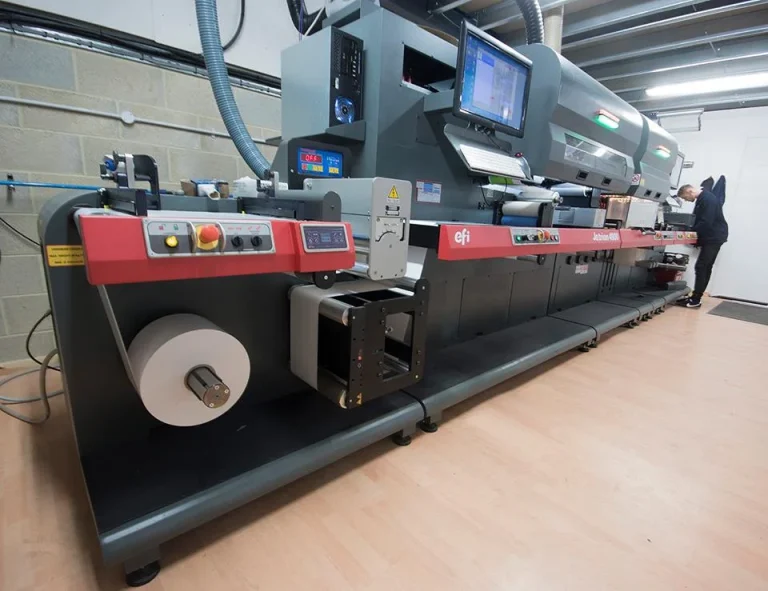
Digital label presses like the Xeikon and Screen UV printers work similar to industrial inkjet machines. There are no printing plates. No rotary dies. No lead time waiting for print tooling.
Here’s the process: Your artwork arrives as a PDF or image file. We check your files and prepare them into ‘production ready’ format so we can process and print them. Software called a “rip” (raster image processor) reads the artwork and tells the printer where to apply ink. The printhead sprays ink directly onto the label material as it passes underneath. The material then moves through optional finishing (varnish or laminate if needed) and into a laser based or die-cutting station to create the label from the master roll.
Setup: Minimal. No tooling, no plates, no cutter dies required on the laser based system. You need artwork files in the right format and resolution (typically 300dpi minimum). Positive ID Labels will help with this.
Print quality: 1200dpi on the Xeikon (highest resolution available). 600dpi on the Screen UV printer (still excellent for most applications). 360dpi on the Jetrion with the laser die-cutting station. Colours are vibrant and consistent.
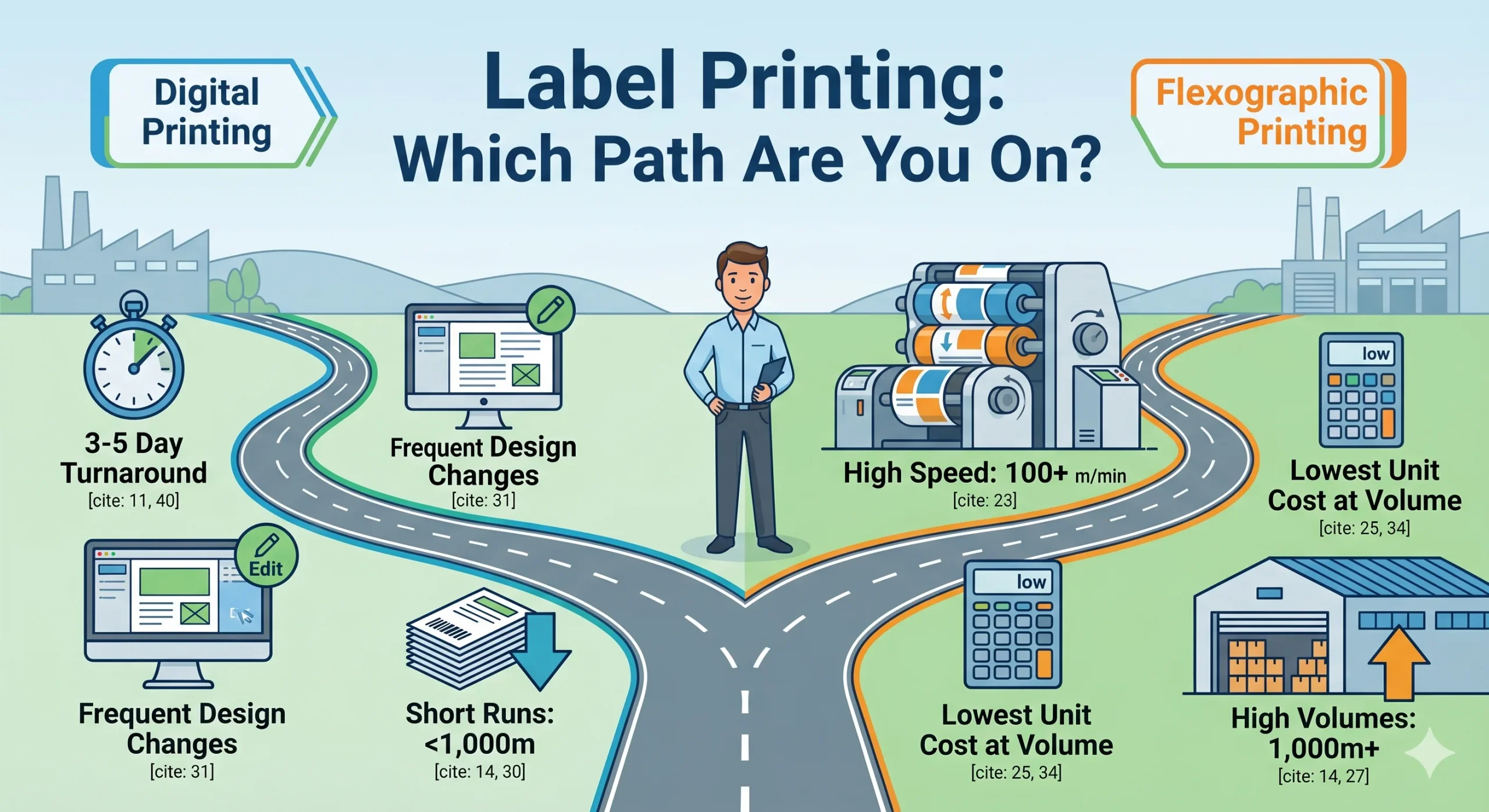
Speed: Digital presses run slower than flexographic presses, typically 30-50 metres per minute depending on the press and material. But because there’s no setup time, overall turnaround is fast – in the best case scenario, using our proprietary ODIN imposition engine, files can be ready to print in as little as 10 minutes from confirmation of your order.
Turnaround time: 3-5 days is standard, often quicker for smaller orders.
Minimum order: Economically viable from a few hundred labels. Digital excels at short runs.
Cost structure: Unit price is higher than flexographic for very large volumes, but there’s no upfront tooling cost, so initial investment is lower. As a general rule, digital is effective for runs under 1000 linear metres but flexographic printing becomes more cost effective – but if you have multiple SKUs, digital is generally better.
How Flexographic Label Printing Works
Flexographic printing is the high-volume method. It’s been used in label printing for decades and remains the standard for large-scale production. The process works with a rotary printing system – cylinders rolling to create a continuous output.
The process requires three separate steps upfront: First, a printing plate is made for each colour in your design. The Pantone colour palette is separated into individual colour layers (cyan, magenta, yellow, black – CMYK – or additional spot colours). Each colour needs its own plate. A four-colour design requires four plates, each costing £30-50 for each plate.
Second, the plates are wrapped around printing cylinders on the flexographic press. The press can run at a very high speed of up to 120 metres per minute or more.
Third, if you need a custom label shape, a rotary die cutter must be manufactured. A metal flexible die is made to fit on the cutting cylinder that matches your exact label dimensions. This cutter costs £80-200 depending on complexity and is a one-time investment for repeat orders.
Once tooling is complete, the press runs. The high speed means per-unit costs drop dramatically compared to digital printing.
Setup: Significant. Plates (£120-200 for full-colour), dies (£80-200), and lead time (3 working days for plate and die manufacture).
Print quality: Excellent crisp colour for straightforward designs. Slight dot pattern visible if you zoom in (halftone screening), but unnoticeable at normal viewing distance. Colour accuracy is good – particularly where pantone colours are chosen.
Speed: Once running, flexographic presses are fast, at 100+ metres per minute. But the upfront tooling delays offset this. If you intend to order again and again over many years, this upfront cost is a good investment.
Turnaround time: 7-10 working days total (including tooling manufacture). Can be quicker if dies already exist.
Minimum order: Economically effective from 1,000 linear metres upward
Cost structure: High upfront tooling cost, but unit price is significantly cheaper at volume.
Head-To-Head Comparison: Which Is Right For Your Situation?
Digital Label Printing Is Better If You:
Need short runs (fewer than 1,000 linear metres). Digital pricing makes sense because there’s no tooling cost.
Change designs frequently. No need to remake plates or dies. Update your artwork file and reprint – pre-press changes are done in a computer and can be tweaked easily.
Require variable data. Different batch codes, pack dates, or serial numbers within the same run. Digital handles this easily; flexographic is expensive because each variation requires separate plates.
Have urgent deadlines. 3-5 day turnaround beats 7-10 days every time.
Wanting custom shapes. The laser die-cutting station lets you cut any shape you can draw. Flexographic requires expensive custom dies which increase in price with complexity.
Are testing a new product. Print 200 labels, test the market, make changes, reprint. Minimal waste from over-producing.
Have limited storage space. Smaller orders mean you hold less inventory.
Flexographic Label Printing Is Better If You:
Need high volumes (1,000+ linear metres regularly). The unit cost savings are substantial, often 60% cheaper per label than digital.
Have a stable design. If your label doesn’t change, the upfront tooling investment pays back quickly in savings.
Print the same design repeatedly. Once dies and plates exist, subsequent runs cost only printing and finishing, not tooling again.
Can wait 7-10 days. If urgent turnaround isn’t critical, flexo’s economics are superior. Positive ID Labels set up reminders to help you order in time for your next batch.
Wanting special finishes. Inline cold foiling, spot varnishes, and advanced colour control are easier with flexographic.
Need ultra-high-volume production. Millions of labels per year? Flexographic is the only economically viable choice.
The Real Decision: How Many Labels Per Year?
The choice becomes clearer if you think in annual volume:
2,000- 10,000 labels per order: Digital, almost certainly. The tooling cost of flexo isn’t justified by the volume.
8,000 – 15,000 labels per year: Borderline. If you’re reprinting the same design multiple times, flexo might make sense. If you change designs frequently, stick with digital.
12,000 – 2,000,000 labels per year (or more): Flexo wins if the design is stable. Digital if you make frequent changes.
Over 20,000 labels per year: Flexographic, assuming designs don’t change radically.
These numbers assume standard label sizes and simple designs. Unusual sizes, multiple colours, or special finishes shift the economics.
What About Cost Per Label?
This is where confusion often starts. Let’s use a realistic example.
Digital: 500 labels of a simple 50mm x 50mm four-colour label No tooling cost. Prints cost approximately £40-60. Cost per label: 8-12 pence.
Flexographic: Same 500 labels Tooling: £150 (plates + die). Print cost: £20. Total cost: £170. Cost per label: 34 pence.
Digital wins at small volumes.
Digital: 5,000 labels of the same design No new tooling. The print cost is approximately £400-600. Cost per label: 8-12 pence.
Flexographic: 5,000 labels of the same design Tooling: £150 (one-time). Print cost: £200. Total cost: £350. Cost per label: 7 pence.
Flexographic wins at volume. And if you repeat the order next month, you only pay the £200 print cost as the tooling is already done. The advantage grows with each repeat order.
Positive ID Labels account managers will price your order taking into consideration the style of work, the costs for digital or flexographic production, and advise you on the most cost effective solution to fit your needs. We are not here to maximise profit – we want to solve your problems at the lowest price we can for you.
Quality Considerations: Which Looks Better?
For most label applications, both produce visually excellent results. Here’s the distinction:
Digital printing: 1200dpi on Xeikon means fine detail and sharp text. Better for brands where the look and feel is the priority (luxury food, craft drinks, premium cosmetics).
Flexographic printing: Excellent colour matching (pantone matching system) and sharpness for standard designs. The halftone screening is imperceptible at normal viewing distance. Better for high-volume production where speed matters – but it also delivers ultra-fine detail.
For food labels, warning labels, chemical labels, and most commercial applications, both are indistinguishable to the consumer.
Turnaround Times In Practice
Digital: 3-5 days is standard. Urgent orders within 24-48 hours are sometimes possible depending on the queue.
Flexographic: 7-10 days including tooling. If you’re reordering an existing design where dies and plates are in stock, turnaround can match digital (3-5 days).
If you have seasonal peaks or unpredictable demand, digital speed is valuable. If you plan ahead, flexographic’s lead time is manageable.
Mixed Approach: Hybrid Solutions
Some businesses use both. Large-volume baseline orders are printed flexographically. Top-up orders for seasonal demand, design variations, or short-notice rushes come from digital.
This approach requires keeping both workflow options active and managing inventory carefully, but it balances cost and flexibility.
Positive ID Labels are happy to produce your labels using the appropriate printing technology depending on your needs. We have a wide range of printing presses and capability and our systems are designed to deliver flexibility with certainty.
FAQ: Your Digital vs Flexo Questions Answered
Q: Can digital presses print on the materials I need? A: Digital presses handle most label materials like gloss paper, coated papers, various plastics (polypropylene, polyester), thermal papers, and specialty materials. We will advise you at the time you specify your order.
Q: Why does my flexographic quote include a separate “tooling” charge? A: Tooling is the cost of manufacturing printing plates (one per colour) and the custom rotary die for your label shape. These are one-time investments that get reused on repeat orders. Digital has no tooling because artwork files replace physical plates.
Q: If I order digital labels, can I reorder them exactly the same way next month? A: Yes, absolutely. Keep your artwork files and you can reorder identical labels anytime. No plates to remake, no dies to reinstall, with the same cost and turnaround every time. Our systems are designed to make reordering a cinch.
Q: What if my flexographic plates or die get lost or damaged? A: Plates and dies can be remade in about 3 days. Reputable label manufacturers like Positive ID Labels keep customer plates and dies in secure storage specifically to prevent this issue. Confirm this upfront.
Q: Can I use digital for variable data like batch codes? A: Yes, easily. Digital printing is excellent for variable data and different codes within the same run. Flexographic is possible with the use of a hybrid printing press, using both flexographic and digital printing stations.
Q: What’s the difference between digital quality and flexographic quality? A: Digital and flexographic printing provide for very high image reproduction quality. Digital resolution ranges from 360dpi up to 1200dpi. Our flexographic presses operate at 1200 lines per inch (lpi).
Q: If I’m not sure about volume, which should I choose? A: Start with digital. No tooling risk, lower upfront cost. Once you’re confident in the design and volume stabilises, flexographic becomes cost-effective. Our account managers will guide you to the most effective solution for your needs at the lowest costs.
Q: Can flexographic do custom shapes like digital? A: Custom shapes require a custom rotary die, which costs extra . If you need a complex shape, digital’s laser die-cutting usually costs less overall for short runs. Complex dies are not an issue but they become more expensive the more the complexity rises.
Q: Do I own the tooling if I go flexographic? A: Technically yes, but these are rarely transferable between label manufacturers unless they have the exact same machines and base tooling. Positive ID Labels store them for you at no charge and remake orders using the same tooling.
Making Your Decision
The choice between digital and flexographic label printing isn’t complex once you know your volume and timeline.
Ask yourself three questions:
1. How many labels do I need per year? High volumes point to flexographic printing, low volumes point to digital.
2. How urgent is the deadline? If you need labels within 3-5 days, digital wins. If you can plan ahead 7-10 days, flexographic economics improve.
3. Is the design fixed? Stable design = flexographic can justify tooling costs. Frequent changes = digital avoids rework.
At Positive ID Labels, we have both digital and flexographic presses. Our team can help you calculate which method saves money for your specific volume and then execute it flawlessly.
Not sure which is right for your labels? Call us on 01332 864895 and describe your requirements: volume, design stability, timeline, and budget. We’ll tell you honestly which method costs less and delivers faster for your situation. Or fill out our contact form and we’ll call you back with a recommendation.
Most businesses underestimate the value of choosing the right printing method. Get it right and your labels cost less, arrive faster, and free you to focus on your product rather than labelling logistics.