
GHS Labelling: Complete UK Guide to the Globally Harmonised System
The Globally Harmonised System of Classification and Labelling of Chemicals (GHS) is an internationally agreed framework that standardises how chemical hazards are communicated across the world. If you manufacture, import, distribute, or use chemicals in the UK, GHS affects how your products are classified and labelled – and understanding the system is essential for compliance, safe handling, and international trade.
This guide explains what GHS is, how it applies in the UK through the GB CLP Regulation, the nine hazard pictograms, how GHS labelling differs from transport labelling, and the practical steps your business needs to take. For detailed UK-specific regulatory requirements including label sizing, exemptions, and enforcement, see our companion CLP labelling regulations guide.
Related products and guides
- Also relevant: hand sanitiser labelling.
- Biocidal Labelling Regulations
- See our complete Resources range.
Contents
- What Is GHS?
- How GHS Applies in the UK
- The Six Required GHS Label Elements
- The Nine GHS Hazard Pictograms Explained
- Signal Words: Danger vs Warning
- Hazard Statements and H-Codes
- Precautionary Statements and P-Codes
- GHS Labels vs Transport Labels: Key Differences
- GHS and Safety Data Sheets
- Secondary Container Labelling
- GHS and International Trade
- GHS Labels for Marine Transport: BS5609
- Who Is Responsible for GHS Labelling?
- Common GHS Labelling Mistakes
- Getting Your GHS Labels Right
What Is GHS?
GHS stands for the Globally Harmonised System of Classification and Labelling of Chemicals. Developed by the United Nations and first published in 2003, GHS creates a single, internationally consistent approach to identifying chemical hazards and communicating them through standardised labels and safety data sheets.
Before GHS, different countries used completely different systems for classifying and labelling chemicals. A product classified as toxic in one country might carry a different warning symbol – or no warning at all – in another. For businesses trading chemicals internationally, this created confusion, increased costs through relabelling, and posed genuine safety risks when workers encountered unfamiliar symbols.
GHS addresses this by establishing universal criteria for classifying chemicals based on their physical, health, and environmental hazards, and by providing standardised label elements – including pictograms, signal words, and hazard statements – that mean the same thing regardless of where in the world the product is used.
It is worth understanding that GHS itself is not a law. It is a voluntary international agreement – sometimes called the “Purple Book” after its published binding colour. Individual countries and trading blocs adopt GHS into their own legislation. In the UK, this is done through the GB CLP Regulation.
How GHS Applies in the UK
In the UK, GHS is implemented through the Classification, Labelling and Packaging (CLP) Regulation. Originally introduced as EU Regulation (EC) 1272/2008, the CLP Regulation was retained in GB law following Brexit and is now known as the GB CLP Regulation. The Health and Safety Executive (HSE) acts as the regulatory authority overseeing CLP compliance in Great Britain.
The relationship between GHS and CLP is straightforward: GHS provides the international framework, and CLP is the legal mechanism that makes it binding in the UK. When people refer to “GHS labels” or “CLP labels” in a UK context, they are talking about the same thing – labels that comply with the GB CLP Regulation, which is built on GHS principles.
There are some important post-Brexit distinctions to be aware of. GB CLP applies to products placed on the market in England, Scotland, and Wales. Northern Ireland continues to follow the EU CLP Regulation under the Windsor Framework. If your business supplies products across both markets, you may need to comply with both versions. Our CLP labelling guide covers these differences in detail.
One practical difference between GB CLP and EU CLP: the UK does not require a Unique Formula Identifier (UFI) on labels, whereas the EU does. Conversely, if you export products to the EU, you must include an EU-based legal entity on your label and comply with UFI requirements.
The Six Required GHS Label Elements
Every GHS-compliant label for a hazardous substance or mixture must include six mandatory elements. Missing any one of these makes the label non-compliant.
1. Product identifier. For a single substance, this is the chemical name (IUPAC or another recognised name) plus the CAS or EC number. For a mixture, this is the trade name or designation along with the identity of specific substances contributing to the hazard classification.
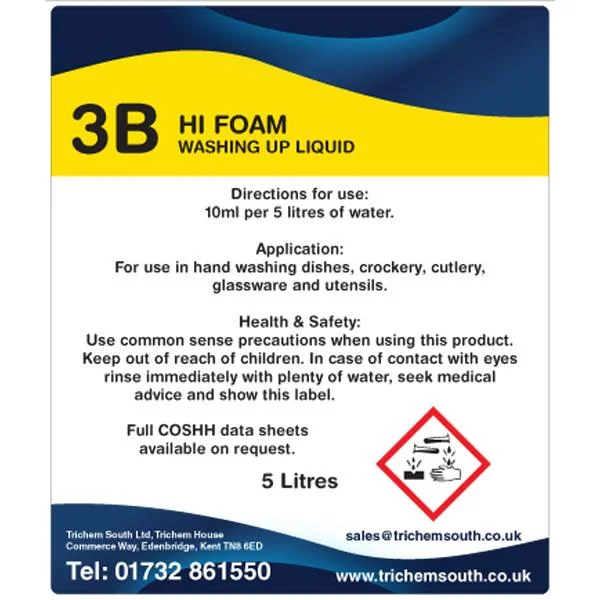
2. GHS hazard pictograms. The red-bordered diamond symbols that visually communicate the type of hazard. The specific pictograms required depend entirely on the product’s classification. We explain all nine pictograms below.
3. Signal word. Either “Danger” (for more severe hazard categories) or “Warning” (for less severe ones). Only one signal word appears on any label, corresponding to the most severe hazard present.
4. Hazard statements (H-codes). Standardised phrases that describe the nature and degree of each hazard, such as “Highly flammable liquid and vapour” (H225) or “Causes serious eye damage” (H318).
5. Precautionary statements (P-codes). Standardised phrases covering prevention, response, storage, and disposal measures. These tell users how to handle the chemical safely and what to do if something goes wrong.
6. Supplier identification. The name, address, and telephone number of the manufacturer, importer, or responsible supplier. Under GB CLP, this must be a UK-based entity for products placed on the GB market.
All six elements must be present, clearly legible, and firmly affixed to the packaging. The label must be positioned so it can be read horizontally when the container is set down in its normal position.
The Nine GHS Hazard Pictograms Explained
GHS uses nine standardised pictograms, each displayed as a black symbol on a white background within a red diamond-shaped border. These replaced the older orange-and-black CHIP symbols that were used in the UK before 2015. Each pictogram is identified by a GHS code number (GHS01 through GHS09).
Understanding which pictograms apply to your products is fundamental to compliance. The pictograms are not chosen by the label designer – they are determined by the product’s hazard classification.
GHS01 – Exploding Bomb. Covers explosives, self-reactive substances, and organic peroxides that may explode under conditions such as heat, friction, or impact. Examples include certain industrial chemicals, ammunition components, and pyrotechnic substances.
GHS02 – Flame. Covers flammable gases, liquids, solids, and aerosols, plus self-reactive substances, pyrophoric materials, self-heating substances, and those that emit flammable gases on contact with water. This is one of the most commonly seen pictograms, appearing on products from industrial solvents to aerosol sprays.
GHS03 – Flame Over Circle. Covers oxidising gases, liquids, and solids – substances that may cause or intensify fire by providing oxygen. Common in industrial settings where oxidising agents are used in manufacturing processes.
GHS04 – Gas Cylinder. Covers gases under pressure, including compressed, liquefied, refrigerated liquefied, and dissolved gases. The pictogram warns that the container may explode if heated or that the contents may cause cryogenic burns.
GHS05 – Corrosion. Covers substances that cause severe skin burns, serious eye damage, or corrosion to metals. Appears on products ranging from strong acids and alkalis to certain cleaning chemicals.
GHS06 – Skull and Crossbones. Covers acute toxicity at the most severe levels – substances that can cause death or serious harm through single or short-term exposure via oral, dermal, or inhalation routes.
GHS07 – Exclamation Mark. Covers less severe health hazards including skin and eye irritation, skin sensitisation, acute toxicity at lower severity levels, narcotic effects, and respiratory tract irritation. This is the most frequently used pictogram and appears on many household and commercial cleaning products.
GHS08 – Health Hazard. Covers serious longer-term health hazards including respiratory sensitisation, carcinogenicity, mutagenicity, reproductive toxicity, specific target organ toxicity (single or repeated exposure), and aspiration hazard. These are hazards that may not be immediately apparent but can cause serious harm over time.
GHS09 – Environment. Covers substances hazardous to the aquatic environment, both acute and chronic. The pictogram shows a dead tree and dead fish, indicating the product can harm water-based ecosystems.
Not every product will carry all nine pictograms – most carry between one and four. There are also precedence rules that determine which pictograms to display when a product has multiple hazards. For example, if the skull and crossbones (GHS06) is required, the exclamation mark (GHS07) is generally not used for the same hazard category, as the more severe pictogram takes precedence.
Signal Words: Danger vs Warning
GHS uses two signal words to indicate the relative severity of a hazard:
“Danger” is used for the more severe hazard categories. If a product is classified with a Category 1 flammable liquid or an acute toxicity Category 1, 2, or 3 substance, the label carries the signal word “Danger”.
“Warning” is used for less severe categories. A Category 4 flammable liquid or a Category 4 acute toxicity substance would carry “Warning”.
Only one signal word appears on any given label. If a product has multiple hazards with different severity levels, the label uses the signal word corresponding to the most severe hazard. You never use both “Danger” and “Warning” on the same label.
Some very low-hazard classifications do not require a signal word at all. In these cases, neither “Danger” nor “Warning” appears.
Hazard Statements and H-Codes
Hazard statements are standardised phrases that describe the nature of the hazard posed by a chemical. Each statement has a corresponding H-code for reference purposes. The codes are organised by hazard type:
H200 series covers physical hazards – explosive, flammable, oxidising, gases under pressure, and related dangers. For example, H225 means “Highly flammable liquid and vapour” and H280 means “Contains gas under pressure; may explode if heated”.
H300 series covers health hazards – toxicity, skin corrosion, eye damage, sensitisation, carcinogenicity, and similar risks. H301 means “Toxic if swallowed”, H315 means “Causes skin irritation”, and H350 means “May cause cancer”.
H400 series covers environmental hazards, primarily relating to aquatic toxicity. H400 means “Very toxic to aquatic life” and H411 means “Toxic to aquatic life with long lasting effects”.
A critical rule: the full written hazard statement must always appear on the label. You cannot substitute the H-code number alone. Writing “H225” on a label instead of “Highly flammable liquid and vapour” is non-compliant. The H-code may appear alongside the statement for reference, but it must never replace it.
A product may carry multiple hazard statements if it presents more than one hazard. All applicable statements must appear on the label.
Precautionary Statements and P-Codes
Precautionary statements tell users how to handle a chemical safely and what to do if exposure occurs. They are organised into four categories:
P100 series – General. General precautions such as “Keep out of reach of children” (P102) and “Read label before use” (P103).
P200 series – Prevention. Measures to prevent exposure or incidents, such as “Keep away from heat, hot surfaces, sparks, open flames and other ignition sources. No smoking” (P210) or “Wear protective gloves/protective clothing/eye protection/face protection” (P280).
P300 series – Response. Actions to take if exposure or an incident occurs, such as “IF SWALLOWED: Call a POISON CENTRE/doctor” (P301 + P310) or “IF ON SKIN: Wash with plenty of water” (P302 + P352).
P400 series – Storage and disposal. Measures for safe storage and disposal, such as “Store in a well-ventilated place. Keep cool” (P403 + P235) or “Dispose of contents/container in accordance with local regulations” (P501).
The GB CLP Regulation allows some discretion in selecting precautionary statements – you should include those most relevant to the specific product and its intended use. The aim is to provide genuinely useful safety guidance without overloading the label with excessive text that people will not read.
GHS Labels vs Transport Labels: Key Differences
One of the most common areas of confusion in chemical labelling is the difference between GHS workplace labels and transport labels. They serve different purposes, protect different people, and follow different rules.
GHS/CLP labels are designed for the point of use – workplaces, storage facilities, retail shelves. They communicate hazards to the person handling, using, or storing the chemical. They feature red diamond pictograms, signal words, and detailed hazard and precautionary statements.
Transport labels follow the UN Recommendations on the Transport of Dangerous Goods and are implemented in the UK through regulations such as the Carriage of Dangerous Goods and Use of Transportable Pressure Equipment Regulations (CDG) and the International Maritime Dangerous Goods Code (IMDG). These labels are designed for carriers, loaders, and emergency responders during transit. They use diamond-shaped class labels with specific colours and class numbers, UN numbers, and proper shipping names.
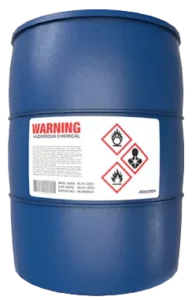
The two labelling systems are not interchangeable. A drum sitting in your warehouse needs a CLP-compliant chemical label so staff can identify the hazards and take appropriate precautions. That same drum being loaded onto a lorry for transport also needs the correct transport class labels so the driver and any emergency responders know what they are dealing with.
When chemicals are shipped in packaging that carries both types of label, there is one simplification: where the GHS pictogram relates to the same hazard as a transport class label, the GHS pictogram does not need to be duplicated on the outer packaging. However, all other GHS label elements must still be present.
GHS and Safety Data Sheets
Safety Data Sheets (SDS) are the detailed companion documents to GHS labels. While the label provides a quick visual summary of the hazards, the SDS contains comprehensive information across 16 standardised sections covering identification, hazard composition, first aid measures, firefighting, accidental release, handling and storage, exposure controls, physical properties, stability and reactivity, toxicological information, ecological information, disposal, transport, regulatory information, and more.
The information on your GHS label and your SDS must be consistent. The classification, pictograms, signal word, and H/P statements on the label must match Section 2 of the SDS exactly. Any discrepancy between label and SDS is a compliance failure that regulators will pick up on.
Under the GB CLP Regulation, SDSs must be provided to downstream users and distributors for all classified hazardous substances and mixtures. They must be in English, reference UK legislation, and include a UK-based supplier contact.
Secondary Container Labelling
GHS labelling obligations do not end with the original container. If a hazardous chemical is transferred to a secondary container – a spray bottle, a smaller storage vessel, a mixing tank – that secondary container must also carry GHS-compliant labelling.
This is a frequent compliance gap, particularly in workplaces where chemicals are decanted into smaller containers for daily use. At minimum, secondary container labels should include the product name (matching the SDS), applicable pictograms, the signal word, and relevant hazard and precautionary statements.
There is a narrow exception under COSHH for containers used immediately by the person who filled them – but even then, best practice is to label everything. Unlabelled containers are a significant safety risk and a common trigger for HSE enforcement action.
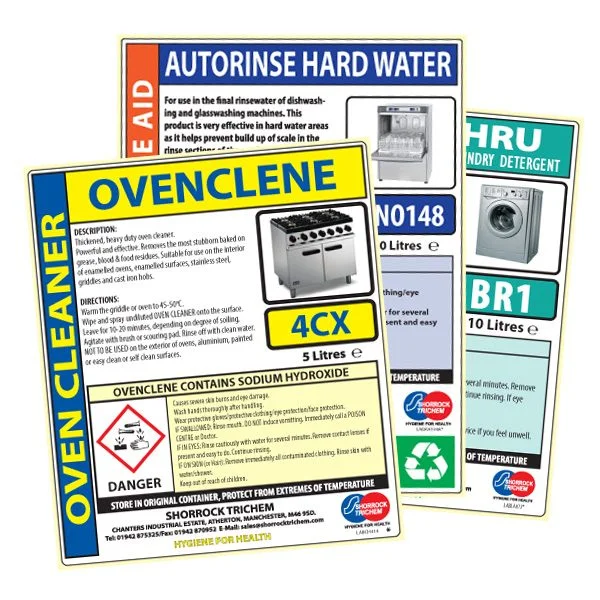
At PID Labelling, we produce durable warning labels and hazard labels suitable for secondary container applications, printed on materials that resist the chemicals they identify.
GHS and International Trade
One of the primary goals of GHS was to reduce the burden of relabelling products for different markets. In practice, the picture is more nuanced than “one label fits all” because different countries have adopted different revisions of GHS and may have country-specific additional requirements.
The core GHS pictograms, signal words, and hazard statement structures are consistent globally. However, differences arise in areas such as classification thresholds, which hazard categories a country has adopted, supplementary label information, and language requirements.
For UK chemical exporters, key considerations include ensuring labels meet the importing country’s GHS implementation, providing multilingual labels where required, and complying with any additional national requirements. For example, products destined for the EU now require a UFI code and an EU-based responsible person on the label, which GB CLP does not mandate.
Despite these differences, GHS has dramatically simplified international chemical trade. The fundamental hazard communication – pictograms, classification criteria, and SDS format – is now consistent across over 70 countries that have adopted the system.
GHS Labels for Marine Transport: BS5609
When hazardous chemicals are transported by sea, GHS labels face an additional challenge: they must survive the marine environment. The International Maritime Dangerous Goods (IMDG) Code requires that labels on chemical containers remain identifiable after three months of immersion in seawater.
This durability requirement is defined by British Standard 5609 (BS5609), which sets rigorous testing standards for label materials (Section 2) and printed labels (Section 3). Labels that pass BS5609 testing have been proven to withstand saltwater, UV radiation, abrasion from sand and debris, and extreme temperature cycling.
If your business exports chemicals by sea, your GHS labels must be printed on BS5609-compliant materials using certified printer and ink combinations. For comprehensive guidance on this standard, see our BS5609 marine transport labels guide.
At PID Labelling, we produce BS5609-compliant chemical labels that meet both GHS content requirements and marine durability standards, ensuring your products are compliant from warehouse to destination port.
Who Is Responsible for GHS Labelling?
Under the GB CLP Regulation, responsibility for correct GHS labelling falls on several parties in the supply chain:
Manufacturers who produce chemical substances or mixtures must classify and label them before placing them on the market. They bear primary responsibility for the accuracy of the classification.
Importers who bring chemical products into Great Britain take on the responsibility of the manufacturer for classification and labelling purposes. If you import a product from the EU or elsewhere, the foreign supplier’s classification does not automatically transfer – you must verify it against GB CLP requirements.
Downstream users who reformulate, repackage, or further process chemicals are responsible for reclassifying if necessary and ensuring correct labels are applied to their products.
Distributors must ensure that products they supply carry compliant labels, though they typically rely on upstream classification.
The HSE enforces GHS/CLP compliance in Great Britain. Non-compliance can result in enforcement notices, prosecution, fines, and in serious cases, imprisonment. The penalties reflect the seriousness of getting chemical labelling wrong – mislabelled chemicals can and do cause injuries, deaths, and environmental contamination.
Common GHS Labelling Mistakes
Having produced thousands of chemical labels over the years, we regularly see the same errors. Avoiding these will save you time, money, and potential enforcement action.
Using H-codes without full statements. The label must carry the complete written hazard statement. “H225” on its own is not compliant – it must read “Highly flammable liquid and vapour”. The code can appear alongside the statement for reference, but never instead of it.
Applying incorrect pictograms. Each pictogram must correspond to the actual classification, not to a general sense of what the product does. Verify every pictogram against the classification criteria in your SDS.
Using both “Danger” and “Warning”. Only one signal word is permitted per label. If multiple hazards are present, use the signal word corresponding to the most severe hazard.
Inconsistency between label and SDS. The classification, pictograms, signal word, and statements on your label must exactly match Section 2 of your Safety Data Sheet. Discrepancies are a red flag for regulators.
Neglecting secondary containers. Decanting chemicals into unlabelled bottles or tanks is one of the most common workplace safety violations. Every container holding a hazardous chemical needs appropriate labelling.
Illegible labels. Cramming text onto undersized labels defeats the purpose of hazard communication. If the container is too small for all required information, use fold-out labels or attach labelling to outer packaging.
Ignoring pictogram precedence rules. When a product has multiple hazards, certain pictograms take precedence over others. For example, if GHS06 (skull and crossbones) is required, GHS07 (exclamation mark) should not appear for the same route of exposure.
Using outdated CHIP symbols. The old orange-and-black hazard symbols were fully phased out in the UK by June 2017. Any products still carrying these symbols are non-compliant.
Getting Your GHS Labels Right
At PID Labelling, we have over 20 years of experience producing GHS-compliant chemical labels, hazard labels, and warning labels for businesses across the UK. We understand the regulatory requirements and the practical challenges of getting chemical labelling right.
Our labels are printed on durable materials designed to withstand the environments your products encounter – whether that is chemical exposure in a factory, outdoor storage, or marine transport requiring BS5609 compliance. We offer both pre-printed labels for standard products and variable data printing for products with frequently changing formulations.
Whether you need labels for pesticides and fertilisers, cleaning products, industrial solvents, or any other chemical product, we can help you produce labels that meet every GHS requirement while maintaining a professional appearance that reflects your brand.
Need GHS-compliant chemical labels? Call us on 01332 864895 to discuss your requirements, or fill in our contact form for a quote.
Disclaimer: This guide is provided for general information purposes only and does not constitute legal advice. For definitive guidance on GHS classification and labelling requirements for your specific products, consult the Health and Safety Executive, your trade association, or a regulatory specialist. PID Labelling accepts no legal responsibility for the accuracy of the information in this guide.
Frequently Asked Questions
What does GHS stand for and what does it do?
GHS stands for the Globally Harmonised System of Classification and Labelling of Chemicals. It is a United Nations framework that standardises hazard communication for chemicals worldwide, including standardised hazard pictograms, signal words, hazard statements, and precautionary statements. GHS is itself voluntary; individual countries adopt it through their own legislation. In Great Britain it is adopted through GB CLP, with HSE representing the UK at the UN GHS Sub-Committee.